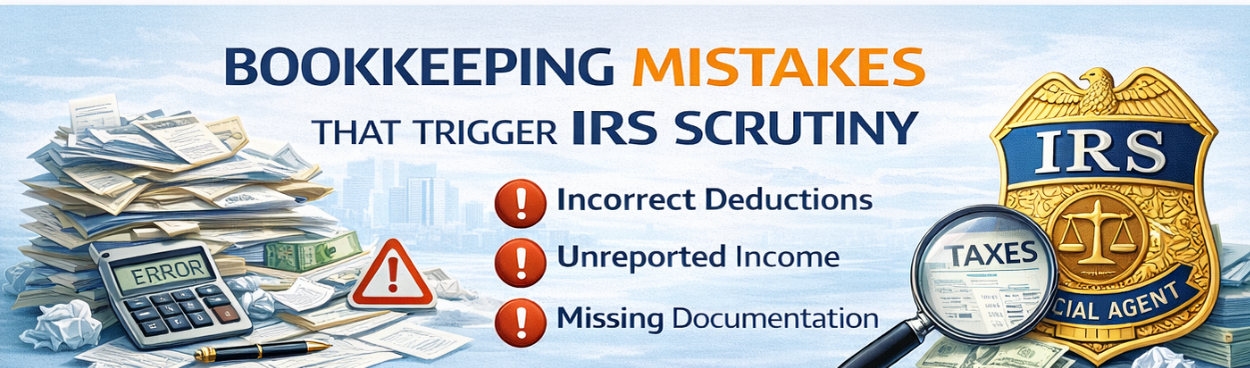
Accurate bookkeeping is the foundation of tax compliance and business success. The IRS, under Internal Revenue Code Section 6001, requires every business to keep records that clearly show income and expenses, and to retain those records for as long as they may be needed for tax administration (Source: Sec. 6001 Notice or regulations requiring records, statements, and special returns; Publication 583 (12/2024)). But what happens if your books are less than perfect? Certain bookkeeping mistakes are notorious for drawing IRS attention—and can lead to audits, penalties, or disallowed deductions. Here’s what to watch for, and how to fix common errors before they become costly problems.
1. Mixing Personal and Business Expenses
Why It Triggers Scrutiny:
Commingling personal and business funds makes it difficult to substantiate business deductions. The IRS may disallow expenses you can’t clearly prove are business-related, and commingled accounts are a red flag for auditors (Source: Publication 583 (12/2024)).
How to Fix It:
- Open a dedicated business bank account and credit card.
- Only pay business expenses from business accounts.
- Reconstruct records for any mixed transactions, and document the business purpose of each expense.
2. Incomplete or Missing Records
Why It Triggers Scrutiny:
The IRS requires you to keep supporting documents for all income, deductions, and credits claimed on your return. Missing receipts, invoices, or bank statements can result in disallowed deductions and estimated assessments (Source: Publication 583 (12/2024)).
How to Fix It:
- Gather and organize all available records.
- For missing receipts, use bank statements, credit card records, or other third-party documentation.
- If documentation is unavailable, create a contemporaneous log or written explanation for the expense.
3. Unreported Income or Deposits
Why It Triggers Scrutiny:
The IRS matches income reported on your tax return to information returns (Forms 1099, W-2, etc.) and bank deposits. Unexplained deposits or underreported income are common audit triggers (Source: Publication 583 (12/2024)).
How to Fix It:
- Regularly reconcile your books to bank statements.
- Identify and document the source of every deposit.
- Amend prior returns if you discover unreported income.
4. Overstated or Unsupported Deductions
Why It Triggers Scrutiny:
Claiming unusually high deductions relative to your income or industry norms can prompt IRS questions. Deductions must be “ordinary and necessary” and properly substantiated (Source: Sec. 162 Trade or business expenses; Publication 535 (2022)).
How to Fix It:
- Review your deductions for accuracy and documentation.
- Remove or adjust any expenses that lack clear business purpose or proof.
- Keep receipts, invoices, and logs for all deductible expenses.
5. Inconsistent or Late Recordkeeping
Why It Triggers Scrutiny:
Inconsistent, delayed, or backdated entries can result in errors, missed income, or duplicate expenses. The IRS expects records to be kept contemporaneously and to reflect actual transactions (Source: Publication 583 (12/2024)).
How to Fix It:
- Set a regular schedule for updating your books (at least monthly).
- Use accounting software to automate and timestamp entries.
- Review and reconcile accounts regularly to catch errors early.
6. Payroll and Employment Tax Errors
Why It Triggers Scrutiny:
Miscalculating payroll taxes, misclassifying workers, or failing to file employment tax returns can result in IRS penalties and audits (Source: Publication 15 (Circular E)).
How to Fix It:
- Ensure all employees and contractors are properly classified.
- File all required payroll tax returns and make timely deposits.
- Correct any errors by filing amended returns and paying any owed taxes or penalties.
7. Ignoring IRS Notices or Audit Letters
Why It Triggers Scrutiny:
Failing to respond to IRS correspondence can escalate minor issues into major problems, including enforced collections or expanded audits.
How to Fix It:
- Respond promptly to all IRS notices.
- Provide requested documentation and explanations.
- Seek professional help if you’re unsure how to respond.
Best Practices to Prevent Bookkeeping Mistakes
- Keep Business and Personal Finances Separate: Use dedicated accounts and cards.
- Maintain Organized, Contemporaneous Records: Store receipts, invoices, and logs in a secure, accessible system.
- Reconcile Regularly: Match your books to bank and credit card statements monthly.
- Use Accounting Software: Automate entries and reduce manual errors.
- Consult Your Accountant: Schedule regular reviews to catch and correct issues early.
What If You Discover a Mistake?
If you find an error after filing your tax return, the IRS encourages you to file an amended return to correct it. Timely self-correction can reduce penalties and demonstrate good faith (Source: Publication 583 (12/2024); see also IRS guidance on amended returns and reasonable cause for penalty abatement).
Conclusion
Bookkeeping mistakes can happen to any business, but ignoring them can trigger IRS scrutiny, audits, and costly penalties. By understanding the most common red flags and taking proactive steps to fix errors, you’ll protect your business, maximize your deductions, and stay compliant with IRS rules.
This post is for informational purposes only and does not constitute tax or legal advice. Please consult a qualified tax professional for advice specific to your business.
References: