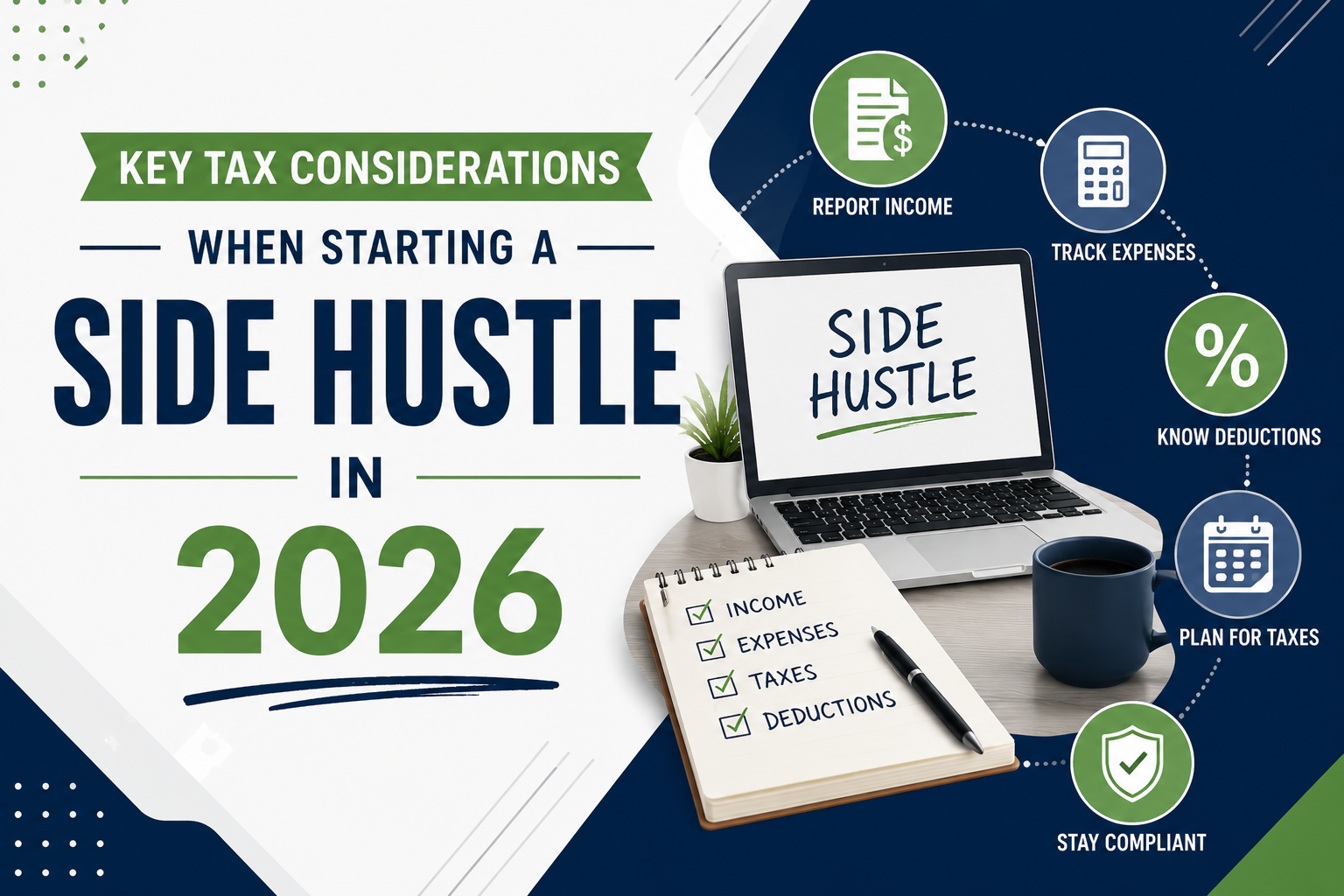
Starting a side hustle can be a smart way to earn extra income, test a business idea, or build toward full-time self-employment. It also creates tax obligations that many first-time business owners do not expect. In general, if you operate your own business or have other self-employment income, such as from babysitting or selling crafts, that income is taxable and may trigger filing, reporting, and self-employment tax obligations.
This post explains the main federal tax issues to think about when launching a side hustle in 2026.
1. A side hustle is usually a business for tax purposes
The IRS treats you as self-employed if you carry on a trade or business as a sole proprietor, are an independent contractor, are a member of a partnership, or are otherwise in business for yourself. Publication 583 similarly explains that a sole proprietorship is an unincorporated business owned by one individual, and that the business has no existence apart from the owner.
For most side hustlers, that means:
- You report the income on your individual return.
- You may need Schedule C to report profit or loss from the activity.
- You may owe self-employment tax in addition to income tax.
2. You may have to file even if the side hustle is small
A common misconception is that a small side hustle does not need to be reported unless you receive a tax form. That is incorrect.
Publication 17 states that self-employed persons must file Form 1040 or 1040-SR and Schedule SE if net earnings from self-employment, excluding church employee income, were $400 or more. Also provides that self-employment income does not include net earnings from self-employment if those net earnings are less than $400.
So there are two separate thresholds to keep in mind:
- Income tax filing thresholds based on filing status, age, and gross income.
- Self-employment tax threshold of $400 of net earnings.
Even if you do not receive a Form 1099, you still must report all taxable side-hustle income.
3. Side hustle income is generally subject to self-employment tax
- 12.4% old-age, survivors, and disability insurance tax on self-employment income.
- 2.9% hospital insurance tax on self-employment income.
That means the basic self-employment tax rate is 15.3%, subject to the Social Security wage base limit for the 12.4% portion and no wage base limit for the 2.9% Medicare portion.
There is also an additional 0.9% Medicare tax on self-employment income above certain thresholds:
- $250,000 for joint returns,
- $125,000 for married filing separately,
- $200,000 for other taxpayers.
4. “Net earnings from self-employment” is not the same as gross receipts
Your self-employment tax is based on net earnings, not gross revenue.
That means if your side hustle earns $10,000 but you have $3,000 of deductible business expenses, your self-employment tax base is generally based on the net amount, subject to the detailed Schedule SE computation rules.
5. Not all income is self-employment income
Some amounts are excluded from self-employment income even if they are taxable for income tax purposes.
- rentals from real estate, unless received as a real estate dealer.
- dividends and most interest, unless received in a dealer business.
- most capital gains and losses.
- certain limited partner distributive shares.
This matters because many side hustles involve mixed income streams. For example, if someone has a consulting side hustle and also earns investment income, only the consulting income is generally relevant for self-employment tax.
6. You may need to make estimated tax payments
Because side hustle income usually is not subject to withholding, many taxpayers need to pay estimated tax during the year.
Publication 17 explains that estimated tax is used to pay income tax, self-employment tax, and certain other taxes when withholding is not enough. In most cases, you must pay estimated tax for 2026 if:
- you expect to owe at least $1,000 after withholding and refundable credits, and
- your withholding plus refundable credits will be less than the smaller of 90% of your 2026 tax or 100% of your 2026 tax, subject to special rules for higher-income taxpayers.
For higher-income taxpayers, the safe harbor can increase to 110% of prior-year tax.
If your side hustle starts midyear, the annualized income installment method may help avoid underpayment penalties by matching payments more closely to when income is actually earned.
7. Good records are essential from day one
Publication 583 emphasizes that everyone in business must keep records, and that good records help monitor the business, prepare financial statements, identify sources of receipts, track deductible expenses, prepare returns, and support items reported on returns.
At minimum, side hustlers should keep records of:
- gross receipts,
- invoices,
- bank deposits,
- business expenses,
- mileage and vehicle use,
- asset purchases,
- payroll if they hire help.
The IRS does not require a specific recordkeeping format, but your system must clearly show income and expenses.
8. Separate business and personal finances if possible
Publication 583 recommends opening a business checking account and keeping business and personal accounts separate.That is not a statutory requirement for every sole proprietor, but it is one of the easiest ways to improve recordkeeping and reduce errors.
Using a separate account helps:
- identify business receipts,
- track deductible expenses,
- support tax return positions,
- reduce the chance of missing income or overstating deductions.
9. You can deduct ordinary and necessary business expenses
Publication 583 explains that deductible business expenses must be both ordinary and necessary. Ordinary means common and accepted in your field; necessary means helpful and appropriate.
Depending on the side hustle, deductible expenses may include:
- advertising,
- software,
- supplies,
- professional fees,
- business mileage,
- home office expenses if the requirements are met,
- depreciation on equipment.
But personal expenses are not deductible merely because they are convenient for the business.
10. Home office deductions are available, but only if the rules are met
If you use part of your home for your side hustle, you may be able to deduct expenses related to business use of the home.
Publication 583 states that to qualify, you generally must use part of the home:
- exclusively and regularly for business, and
- as your principal place of business, a place to meet clients, or a separate structure used in the business.
There is also a simplified method under which the deduction is generally figured by multiplying $5 by the square footage used for the qualified business use, up to 300 square feet.
11. Vehicle deductions require care
If you use your car for your side hustle, you may generally deduct either:
- actual expenses, or
- the standard mileage rate.
For 2026, Publication 17 states the business standard mileage rate is 70 cents per mile. Publication 225 confirms the same rate for 2026.
If you use the vehicle for both business and personal purposes, you must allocate expenses between the two uses.
12. If you hire workers, payroll tax rules may apply
A side hustle can grow quickly. If you hire employees, you may need an EIN and may become responsible for employment taxes.
Publication 583 explains that employers may need to handle:
- federal income tax withholding,
- Social Security and Medicare taxes,
- federal unemployment tax,
- information returns such as Forms W-2 and 1099.
Misclassifying workers as independent contractors can create liability for employment taxes and penalties.
13. Information returns matter, but they do not control taxability
Side hustlers often receive Forms 1099-NEC, 1099-K, or 1099-MISC. These forms are important, but your reporting obligation does not depend on whether you receive one.
Publication 17 states that if you received certain types of income, you may receive a Form 1099, but you still must report taxable income even if the form is missing. Publication 583 similarly notes that information returns are used by the IRS to compare reported payments with tax returns.
So if your side hustle earns income through apps, direct payments, or cash, all taxable income still must be reported.
14. Gig and sharing economy income is taxable
Publication 17 specifically notes that if you operate your own business or have self-employment income such as babysitting or selling crafts, you should consult small business guidance. Publication 17 also discusses brokers and payment reporting generally, while Publication 583 explains that if you make reportable payments to nonemployees, you may need to issue Forms 1099.
For gig workers, the practical point is simple: app-based income, freelance income, and side-hustle receipts are generally taxable and often self-employment income.
15. A side hustle can affect credits and deductions on your personal return
Because side hustle income changes AGI, taxable income, and self-employment tax, it can affect many other items on your return.
For example:
- it may increase or reduce eligibility for the earned income credit depending on total earned income;
- it may affect IRA deduction phaseouts and Roth IRA contribution eligibility;
- it may affect estimated tax obligations.
Publication 596 notes that earned income for EIC purposes includes net earnings from self-employment.
16. Some activities may be hobbies rather than businesses
Not every money-making activity is treated as a for-profit business. The sources here do not provide a full hobby-loss analysis for side hustles, but Publication 583 emphasizes that deductible business expenses are tied to carrying on a business, and Publication 17 directs self-employed individuals to business-specific guidance.
If an activity is not engaged in for profit, expense deductions may be limited or unavailable. That issue often requires a facts-and-circumstances analysis.
17. Farmers and agricultural side hustles have special rules
If the side hustle is farming or agricultural, special rules may apply.
Publication 225 explains that farming includes cultivating, operating, or managing a farm for profit, including livestock, dairy, poultry, fish, fruit, truck farms, ranches, orchards, and similar operation. It also notes that farmers may have special estimated tax rules and special self-employment tax considerations.
18. Basic tax forms a side hustler may encounter
Depending on the facts, a side hustler may need some combination of:
- Form 1040 or 1040-SR;
- Schedule C for business profit or loss;
- Schedule SE for self-employment tax;
- Form 1040-ES for estimated tax;
- Form 8829 for business use of home in some cases;
- Form SS-4 if an EIN is needed.
19. The biggest practical mistakes to avoid
Based on the sources, the most common side-hustle tax mistakes are likely to include:
- not reporting income because no Form 1099 was received;
- failing to make estimated tax payments;
- poor recordkeeping;
- mixing personal and business expenses;
- overlooking self-employment tax.
20. Bottom line
A side hustle in 2026 is not just extra income. It can create a separate layer of federal tax compliance involving income reporting, self-employment tax, estimated tax, deductions, and recordkeeping.