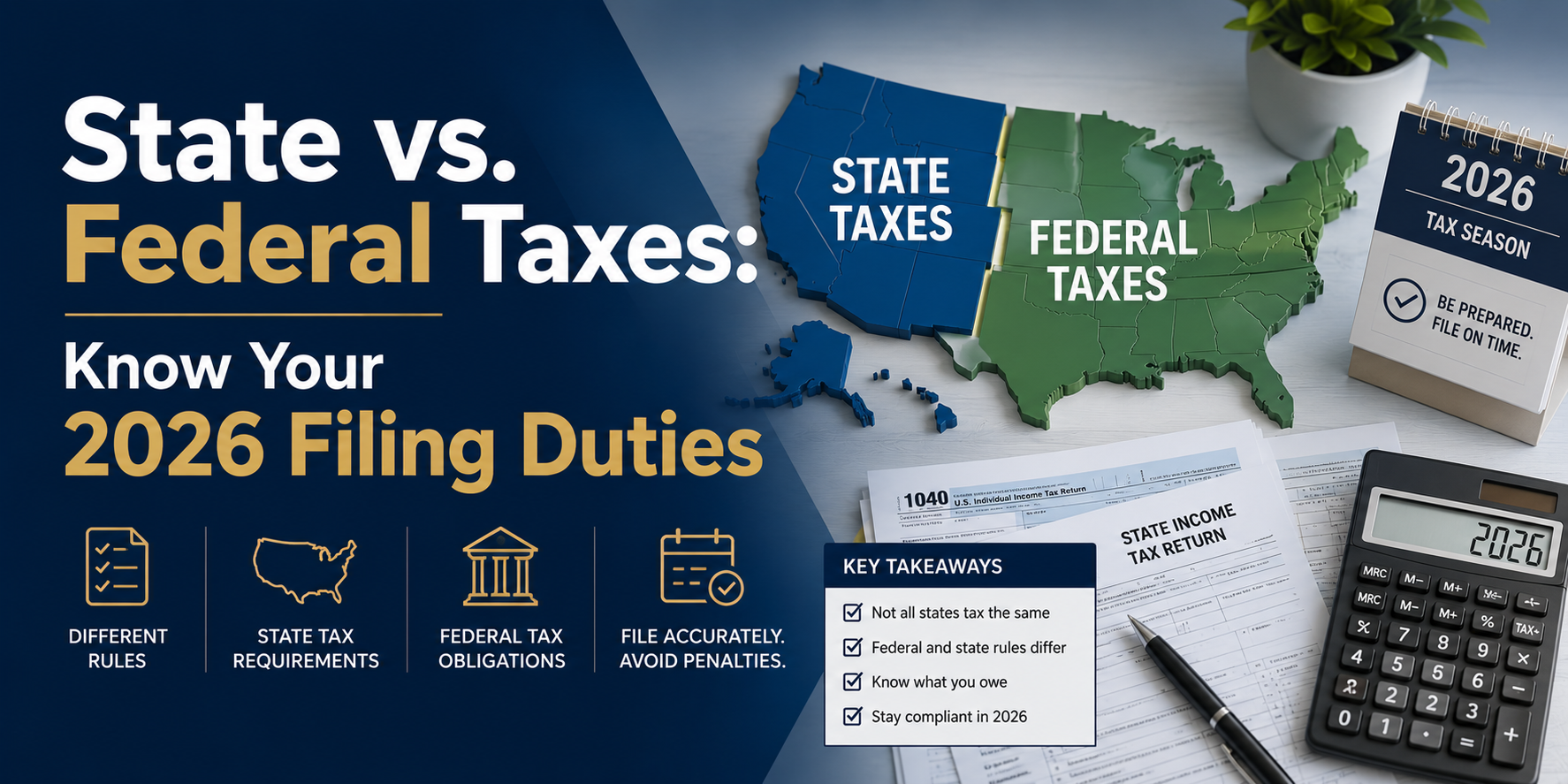
For 2026, federal and state tax filing duties are related but not identical. A taxpayer may have to file a federal return, a state return, both, or in some cases neither, depending on filing status, gross income, age, residency, source of income, and whether special filing triggers apply. Federal filing duties are governed primarily by the Internal Revenue Code and IRS filing thresholds, while state filing duties depend on each state’s own tax law. For federal purposes, most individual returns for calendar-year taxpayers are due April 15, 2026, unless extended. State due dates often track the federal deadline, but not always.
Federal filing duties for 2026
The federal starting point is whether the taxpayer meets the IRS filing thresholds. IRS Publication 17 states that filing requirements generally depend on three factors: gross income, filing status, and age. For 2026, the basic federal filing thresholds are as follows: single under age 65, $15,750; single age 65 or older, $17,750; married filing jointly with both spouses under 65, $31,500; married filing jointly with one spouse age 65 or older, $33,100; married filing jointly with both spouses age 65 or older, $34,700; married filing separately, $5; head of household under age 65, $23,625; head of household age 65 or older, $25,625; qualifying surviving spouse under age 65, $31,500; and qualifying surviving spouse age 65 or older, $33,100.
Those thresholds reflect the increased standard deduction for 2026. Publication 17 states that the 2026 standard deduction is $15,750 for single and married filing separately, $31,500 for married filing jointly and qualifying surviving spouse, and $23,625 for head of household. Because the filing thresholds for many taxpayers effectively track the standard deduction, the increased deduction also increased the amount of income many taxpayers can receive before a federal filing obligation arises.
Federal filing duties are not determined solely by those threshold tables. Publication 17 also lists separate filing triggers that require a return even when gross income is below the general threshold. These include, among others, owing alternative minimum tax, additional tax on retirement accounts or other tax-favored accounts, household employment taxes, uncollected Social Security and Medicare tax on tips or wages, recapture taxes, receiving HSA or Archer MSA distributions, having net earnings from self-employment of at least $400, having church employee income of $108.28 or more, receiving advance premium tax credit payments, having section 965 inclusions or installment obligations, or transferring a clean vehicle credit to a dealer.
Federal filing may also be advisable even when not required. Publication 17 notes that taxpayers should file if they want to claim a refund of withholding or estimated tax payments, or refundable credits such as the additional child tax credit, premium tax credit, American opportunity credit, or refundable adoption credit.
Special federal rules that often affect filing duties
Several federal rules create filing obligations or alter the filing threshold analysis.
First, married filing separately is unusually strict. For 2026, the gross income filing threshold is generally $5 regardless of age. That means many married taxpayers who file separately will have a federal filing duty even with minimal income.
Second, dependents have separate filing rules. Publication 17 explains that a dependent may have to file based on earned income, unearned income, or gross income tests. For example, a single dependent under age 65 generally must file if unearned income exceeds $1,350, earned income exceeds $15,750, or gross income exceeds the greater of $1,350 or earned income plus $450, subject to the annual cap.
Third, self-employed taxpayers often must file even when their net income is modest. Publication 17 states that a taxpayer with net earnings from self-employment of $400 or more must file Form 1040 and Schedule SE.
Fourth, residents of Puerto Rico and taxpayers with territorial income face special federal rules. Publication 17 states that a bona fide resident of Puerto Rico generally excludes Puerto Rico-source income from U.S. gross income, but may still have to file a U.S. return if they have U.S.-source income or U.S. government wages. Publication 1321 further explains that because excluded Puerto Rico income requires allocation of the standard deduction or itemized deductions, the filing threshold for a bona fide Puerto Rico resident can be lower than the standard federal threshold tables suggest. It also states that married filing separately Puerto Rico filers generally must file if gross income subject to U.S. tax is $5 or more.
Federal due dates and extensions
For 2026 calendar-year individual returns, the federal due date is April 15, 2026. Taxpayers can request an automatic six-month extension by filing Form 4868 by the due date, extending the filing deadline to October 15, 2026. But the extension is only for filing, not for paying tax. Publication 17 states that interest, and potentially penalties, apply if tax due is not paid by the original due date.
Taxpayers outside the United States may receive an automatic two-month extension to file and pay, generally to June 15, 2026, if they meet the statutory conditions, although interest still runs from the regular due date on unpaid tax. Combat zone rules can extend deadlines further.
State filing duties are separate and vary by state
Unlike federal filing duties, state filing duties are not governed by a single national rule. States have their own tax agencies, tax bases, filing thresholds, residency rules, and due dates. Some states impose an individual income tax; others do not. Some states conform closely to federal adjusted gross income or taxable income; others decouple from federal rules in important ways.
That means a taxpayer’s federal filing duty does not automatically determine the taxpayer’s state filing duty. A taxpayer may not need to file federally but may still need to file in a state, especially if the state has a lower filing threshold, taxes a broader base, or requires a return to claim a refund of withholding. Conversely, a taxpayer may have a federal filing duty but no state filing duty if the taxpayer lives in a state with no individual income tax or has no state-source income in a taxing state.
State filing duties also become more complicated when a taxpayer has multistate connections. Residency, part-year residency, nonresident source income, and local taxes can all matter. The Accounting Insights articles note that some states impose no individual income tax, while others have progressive or flat-rate systems, and some local jurisdictions impose additional income taxes.
Federal and state taxable income often differ
Even when a state starts with federal adjusted gross income, state taxable income can differ materially from federal taxable income.
For example, federal law allows a standard deduction of $15,750 for single filers and $31,500 for married filing jointly in 2026, but states may use different standard deductions, different itemized deduction rules, or no standard deduction at all.
Federal law also limits the deduction for state and local taxes. Publication 17 notes that for 2026 the overall SALT deduction limit increased to $40,000, reduced for higher modified AGI but not below $10,000, with a $20,000 cap for married filing separately. That federal deduction rule affects federal taxable income, but it does not determine whether a state taxes the same income or allows the same deductions.
The Accounting Insights articles also note that states may require additions or subtractions from federal AGI, such as exempting U.S. Treasury interest or taxing out-of-state municipal bond interest.
Filing deadlines may align, but do not assume they do
Federal returns for calendar-year individuals are due April 15, 2026. Many states align their due dates with the federal deadline, but not all do. The Accounting Insights articles note that some states follow the federal date while others use different dates.
A federal extension also does not automatically guarantee a state extension in every jurisdiction. Taxpayers need to confirm whether the state honors the federal extension automatically, requires a separate extension filing, or requires payment by the original due date to avoid penalties and interest.
Practical examples
Here are a few common 2026 scenarios:
- A single taxpayer under age 65 with $14,000 of wage income and no special filing triggers may not have a federal filing duty because the amount is below the $15,750 threshold. But the taxpayer could still need to file a state return depending on the state’s threshold or to claim a refund of state withholding.duty because the threshold is $5.
- A gig worker with $600 of net self-employment income may have a federal filing duty because net earnings from self-employment of $400 or more trigger filing.
- A bona fide Puerto Rico resident with excluded Puerto Rico-source income and some U.S.-source interest may still need to file a U.S. return after allocating the standard deduction under section 933 rules.
- A taxpayer living in a no-income-tax state may have no state income tax filing duty, but still must file federally if federal thresholds or special triggers are met.