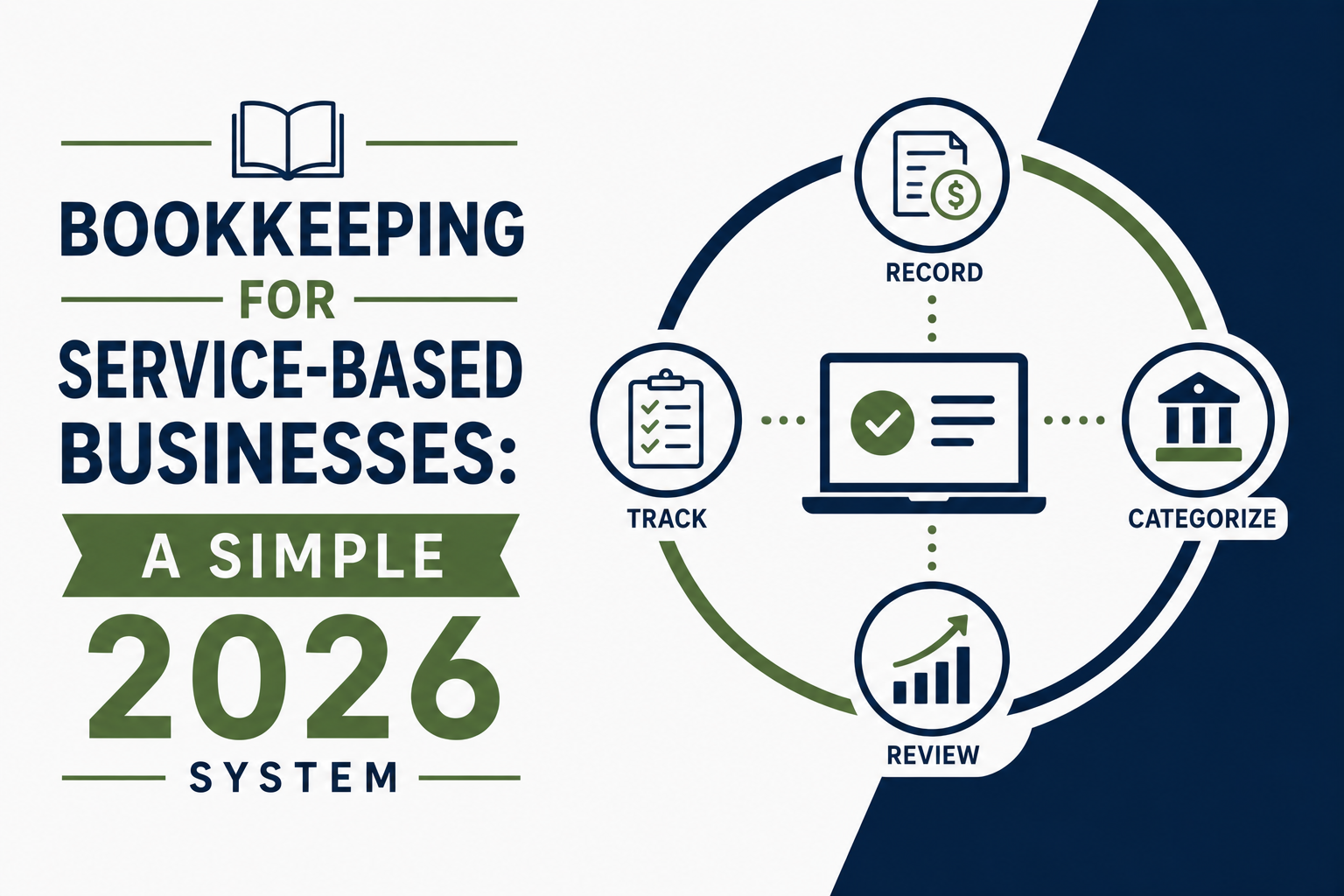
Bookkeeping for Service-Based Businesses: A Simple 2026 System
For many service-based business owners, bookkeeping often becomes a year-end scramble rather than an ongoing process. Whether you operate a consulting firm, marketing agency, healthcare practice, coaching business, law office, accounting firm, or freelance operation, maintaining accurate financial records throughout the year is one of the most effective ways to improve profitability, simplify tax compliance, and reduce stress.
In 2026, bookkeeping is more important than ever. The IRS continues expanding information matching programs, while recent tax law changes under the One Big Beautiful Bill Act (OBBBA) have updated reporting thresholds, depreciation opportunities, and deduction rules that directly affect service businesses.
Fortunately, a simple and consistent bookkeeping system can help keep your business organized and tax-ready all year long.
Why Bookkeeping Matters
Accurate bookkeeping helps business owners:
- Monitor profitability
- Track cash flow
- Identify tax deductions
- Prepare accurate tax returns
- Support financing applications
- Reduce audit risk
- Make informed business decisions
Without reliable records, it becomes difficult to determine whether a business is actually generating profit.
Step 1: Separate Business and Personal Finances
Every service business should maintain separate financial accounts.
At minimum, this includes:
- A business checking account
- A business savings account
- A business credit card
- Dedicated payment processing accounts
Avoid paying personal expenses from business accounts whenever possible.
Why It Matters
Separating finances creates cleaner records and stronger support for business deductions.
Step 2: Choose the Right Accounting Method
Most service businesses use one of two accounting methods.
Cash Method
Income is recognized when received.
Expenses are recognized when paid.
This method is commonly used by:
- Consultants
- Freelancers
- Contractors
- Small professional practices
Accrual Method
Income is recognized when earned.
Expenses are recognized when incurred.
This method often provides a more complete picture of financial performance.
Why It Matters
Consistency in accounting methods improves reporting accuracy and compliance.
Step 3: Create a Simple Chart of Accounts
A chart of accounts organizes transactions into meaningful categories.
Common income categories include:
- Service revenue
- Consulting income
- Retainer fees
- Project income
Common expense categories include:
- Advertising and marketing
- Software subscriptions
- Professional fees
- Office expenses
- Insurance
- Travel
- Continuing education
- Contract labor
- Payroll
Why It Matters
Proper categorization simplifies financial reporting and tax preparation.
Step 4: Track Revenue Weekly
Do not wait until year-end to review income.
Each week:
- Review invoices issued
- Match deposits to invoices
- Verify payment processor activity
- Follow up on unpaid balances
Why It Matters
Regular monitoring helps identify errors and collection issues before they become major problems.
Step 5: Capture Every Business Expense
Many service businesses lose valuable deductions because receipts are misplaced or transactions are never recorded.
Common deductible expenses include:
- Software subscriptions
- Internet service
- Professional memberships
- Licensing fees
- Business insurance
- Marketing expenses
- Office supplies
- Continuing education
Documentation Matters
Maintain:
- Receipts
- Vendor invoices
- Bank statements
- Credit card statements
Strong documentation helps support deductions if the IRS requests verification.
Step 6: Understand Reporting Thresholds and Contractor Payments
Many service businesses regularly pay independent contractors and receive payments through third-party payment platforms.
Contractor Reporting Rules
For payments made after December 31, 2025, the general information-reporting threshold under Section 6041 increased from $600 to $2,000.
This threshold applies to many payments reported on information returns such as Forms 1099-MISC and 1099-NEC.
Form 1099-K Changes
The OBBBA restored the historical reporting threshold for third-party settlement organizations.
For 2026, Form 1099-K reporting generally applies only when:
- Gross payments exceed $20,000, and
- The number of transactions exceeds 200
This replaces the previously proposed lower reporting thresholds.
Why It Matters
Business owners should continue maintaining complete records regardless of whether an information return is issued.
Step 7: Monitor Equipment and Asset Purchases Carefully
Many service businesses purchase:
- Computers
- Office equipment
- Furniture
- Cameras
- Specialized tools
- Technology systems
Proper bookkeeping ensures these purchases receive the correct tax treatment.
Section 179 Expensing
For tax years beginning in 2026:
- Maximum Section 179 deduction: $2,560,000
- Phaseout threshold: $4,090,000
The deduction begins to phase out dollar-for-dollar once qualifying purchases exceed the phaseout threshold.
Qualifying Property
Section 179 generally applies to:
- Tangible personal property
- Computers
- Office equipment
- Furniture
- Certain qualified improvement property
- Certain nonresidential real property improvements such as roofs and HVAC systems
Important Limitation
Unlike bonus depreciation, Section 179 deductions generally cannot exceed business taxable income.
Any excess deduction is generally carried forward to future years.
SUV Limitation
For qualifying SUVs with a gross vehicle weight rating exceeding 6,000 pounds but not exceeding 14,000 pounds:
- The 2026 Section 179 limit is generally $32,000.
Why It Matters
Tracking purchases properly can significantly increase available deductions.
Step 8: Understand Bonus Depreciation Rules
The OBBBA permanently restored 100% bonus depreciation for qualified property acquired after January 19, 2025.
Qualified Property Requirements
Generally, property must have a MACRS recovery period of 20 years or less.
Examples include:
- Computers
- Equipment
- Office furniture
- Certain vehicles
Order of Application
Businesses generally must:
- Apply Section 179 first.
- Apply bonus depreciation to any remaining basis.
- Apply regular MACRS depreciation to any remaining amount.
Passenger Automobile Limits
For passenger automobiles placed in service during 2026 and eligible for bonus depreciation:
- First-year depreciation limit generally equals $20,300.
If bonus depreciation is not used:
- First-year limit generally drops to $12,300.
Why It Matters
Understanding the interaction between Section 179, bonus depreciation, and MACRS helps maximize deductions.
Step 9: Set Aside Money for Taxes
One of the most common bookkeeping mistakes is failing to reserve cash for taxes.
Consider moving a portion of profits into a separate tax savings account throughout the year.
Potential obligations may include:
- Federal income tax
- State income tax
- Self-employment tax
- Payroll taxes
Estimated Tax Safe Harbors
Generally, taxpayers avoid underpayment penalties by paying the lesser of:
- 90% of current-year tax liability, or
- 100% of prior-year tax liability
For taxpayers whose 2025 adjusted gross income exceeded:
- $150,000 ($75,000 if married filing separately)
the prior-year safe harbor generally increases to:
- 110% of prior-year tax liability
Why It Matters
Regular tax planning helps avoid year-end surprises and penalties.
Step 10: Reconcile Accounts Monthly
Every month:
- Reconcile bank accounts
- Reconcile credit cards
- Review accounts receivable
- Review accounts payable
- Review uncategorized transactions
Why It Matters
Monthly reconciliations help identify errors before they become larger problems.
Step 11: Review Financial Reports Every Month
Business owners should review three core reports regularly.
Profit and Loss Statement
Shows:
- Revenue
- Expenses
- Net income
Balance Sheet
Shows:
- Assets
- Liabilities
- Owner’s equity
Cash Flow Statement
Shows:
- Cash received
- Cash spent
- Available cash reserves
Why It Matters
These reports provide a more accurate picture of business performance than simply checking bank balances.
Special Consideration for Qualified Production Property
Most service businesses will not qualify, but businesses engaged in qualifying production activities should be aware of a new provision under Section 168(n).
Certain nonresidential real property used in qualified production activities may qualify for:
- 100% special depreciation allowances
This generally applies to qualifying manufacturing, production, or refining activities where substantial transformation of tangible personal property occurs.
Why It Matters
Certain healthcare production facilities, laboratories, or specialized production operations may qualify for enhanced deductions.
Common Bookkeeping Mistakes to Avoid
Many service businesses encounter preventable bookkeeping issues.
Common mistakes include:
- Mixing personal and business expenses
- Failing to reconcile accounts
- Losing receipts
- Ignoring fixed asset records
- Misclassifying contractors and employees
- Falling behind on bookkeeping
- Waiting until tax season to organize records
A Simple Monthly Bookkeeping Checklist
Every month:
✓ Download bank statements
✓ Reconcile bank accounts
✓ Reconcile credit cards
✓ Categorize transactions
✓ Review income deposits
✓ Review contractor payments
✓ Update fixed asset schedules
✓ Review financial statements
✓ Set aside tax reserves
✓ Back up accounting records
Completing this checklist regularly typically requires far less effort than reconstructing records at year-end.
Final Thoughts
The best bookkeeping system is not necessarily the most sophisticated—it is the one that is followed consistently. For service-based businesses, a simple process built around weekly reviews, monthly reconciliations, organized documentation, and regular financial reporting can dramatically improve financial visibility and reduce tax-time stress.
With updated information-reporting thresholds, permanent 100% bonus depreciation, expanded Section 179 opportunities, and ongoing IRS compliance initiatives, maintaining accurate books throughout 2026 is one of the smartest investments a business owner can make. Strong bookkeeping not only supports tax compliance but also provides the financial information necessary to build a profitable and sustainable business.