
Standard Deduction vs. Tax Brackets in 2026: How They Work Together
Many taxpayers mistakenly believe their federal tax bracket is based on their gross income. In reality, your tax bracket is determined by your taxable income, which is calculated after subtracting deductions.
Understanding the relationship between the standard deduction and tax brackets is one of the most important concepts in tax planning. The standard deduction reduces the amount of income subject to tax, while the tax brackets determine the rates applied to your remaining taxable income.
Here’s how the two work together in 2026.
How Taxable Income Is Calculated
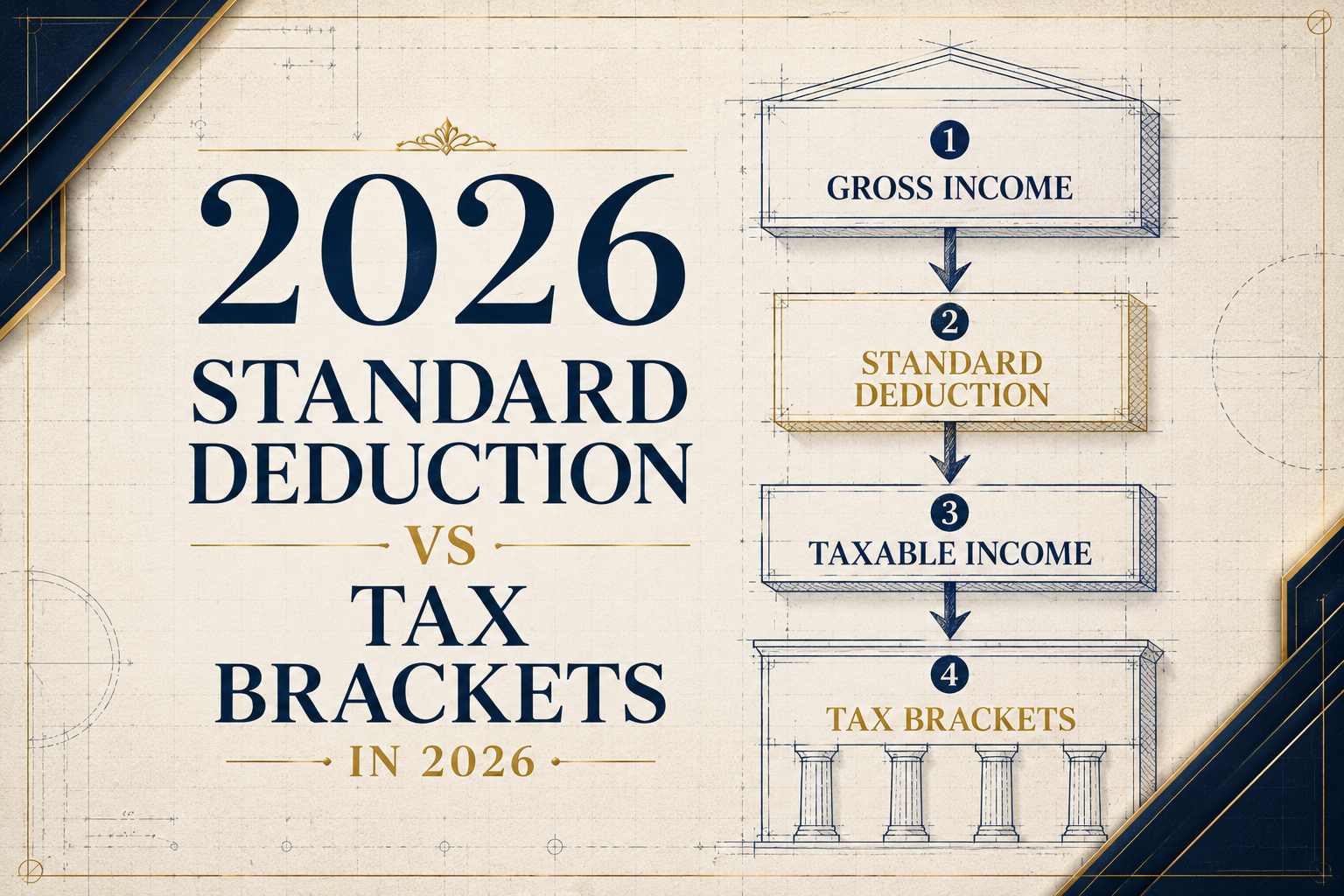
Before applying any tax rates, you must first determine your taxable income.
For most taxpayers, the process follows these steps:
- Determine your filing status.
- Calculate your adjusted gross income (AGI).
- Subtract either:
- The standard deduction, or
- Your itemized deductions if they are larger.
- Apply the federal tax brackets to the remaining taxable income.
The tax brackets never apply directly to your gross income.
2026 Standard Deduction Amounts
For the 2026 tax year, the standard deduction amounts are:
- Single: $16,100
- Married Filing Separately: $16,100
- Head of Household: $24,150
- Married Filing Jointly: $32,200
- Qualifying Surviving Spouse: $32,200
Taxpayers who are age 65 or older or legally blind may qualify for an additional standard deduction.
- $1,650 generally
- $2,050 if unmarried and not a surviving spouse
2026 Federal Tax Brackets for Single Filers
- 10%: Up to $12,400
- 12%: $12,401 to $50,400
- 22%: $50,401 to $105,700
- 24%: $105,701 to $201,775
- 32%: $201,776 to $256,225
- 35%: $256,226 to $640,600
- 37%: Over $640,600
2026 Federal Tax Brackets for Married Filing Jointly
- 10%: Up to $24,800
- 12%: $24,801 to $100,800
- 22%: $100,801 to $211,400
- 24%: $211,401 to $403,550
- 32%: $403,551 to $512,450
- 35%: $512,451 to $768,700
- 37%: Over $768,700
2026 Federal Tax Brackets for Head of Household
- 10%: Up to $17,700
- 12%: $17,701 to $67,450
- 22%: $67,451 to $105,700
- 24%: $105,701 to $201,775
- 32%: $201,776 to $256,200
- 35%: $256,201 to $640,600
- 37%: Over $640,600
2026 Federal Tax Brackets for Married Filing Separately
- 10%: Up to $12,400
- 12%: $12,401 to $50,400
- 22%: $50,401 to $105,700
- 24%: $105,701 to $201,775
- 32%: $201,776 to $256,225
- 35%: $256,226 to $384,350
- 37%: Over $384,350
Example: How the Standard Deduction Lowers Your Taxable Income
Suppose a single taxpayer earns $90,000 in gross income during 2026 and claims the standard deduction.
Calculation:
- Gross Income: $90,000
- Standard Deduction: ($16,100)
- Taxable Income: $73,900
In this example, the federal tax brackets apply to $73,900, not the full $90,000.
This reduction can significantly lower the amount of tax owed.
Understanding Marginal Tax Rates
Your tax bracket generally refers to your highest marginal tax rate.
However, that does not mean all of your taxable income is taxed at that rate.
The federal tax system is progressive, meaning income is taxed in layers. Lower portions of income are taxed at lower rates first, and only the income that falls within a higher bracket is taxed at the higher rate.
For example, a single taxpayer with $120,000 of taxable income in 2026 will have portions of income taxed at:
- 10%
- 12%
- 22%
- 24%
Only the amount above $105,700 reaches the 24% bracket.
Important Exceptions and Planning Considerations
Several special rules may affect your deduction and tax bracket calculations:
- If a married taxpayer files separately and the other spouse itemizes deductions, the standard deduction may not be available.
- Estates and trusts generally do not qualify for the standard deduction.
- Personal exemptions remain suspended at $0 for 2026.
- High-income taxpayers may face limitations that affect the value of itemized deductions.
- Additional deductions such as IRA contributions, HSA contributions, and certain business deductions may further reduce taxable income.
Because of these factors, two taxpayers with identical gross income may end up in different tax situations.
Why Understanding This Matters
Knowing how the standard deduction and tax brackets interact can help you:
- Estimate your tax liability more accurately
- Make smarter retirement contribution decisions
- Evaluate Roth conversion opportunities
- Plan charitable contributions
- Adjust withholding and estimated tax payments
- Reduce taxable income through strategic planning
The key question isn’t, “What tax bracket is my income in?” The real question is, “What is my taxable income after deductions?”
Final Thoughts
For 2026, the standard deduction remains one of the most valuable tax benefits available to individual taxpayers. By reducing taxable income before the tax brackets are applied, it lowers the amount of income exposed to federal tax rates.
Understanding the difference between gross income, taxable income, deductions, and tax brackets can help you make better financial decisions and avoid costly misconceptions.
Need Help With Tax Planning in 2026?
As a CPA firm, we help individuals, families, retirees, self-employed professionals, and business owners navigate changing tax laws, maximize deductions, and develop proactive tax strategies.
Whether you’re evaluating the standard deduction, considering itemizing, planning retirement contributions, or looking for ways to reduce your taxable income, our team can help you create a personalized tax plan.
Contact our CPA team today to schedule a consultation and discover tax-saving opportunities tailored to your unique financial situation.
Smart tax planning starts long before tax season—and the right strategy can make a significant difference in your bottom line.