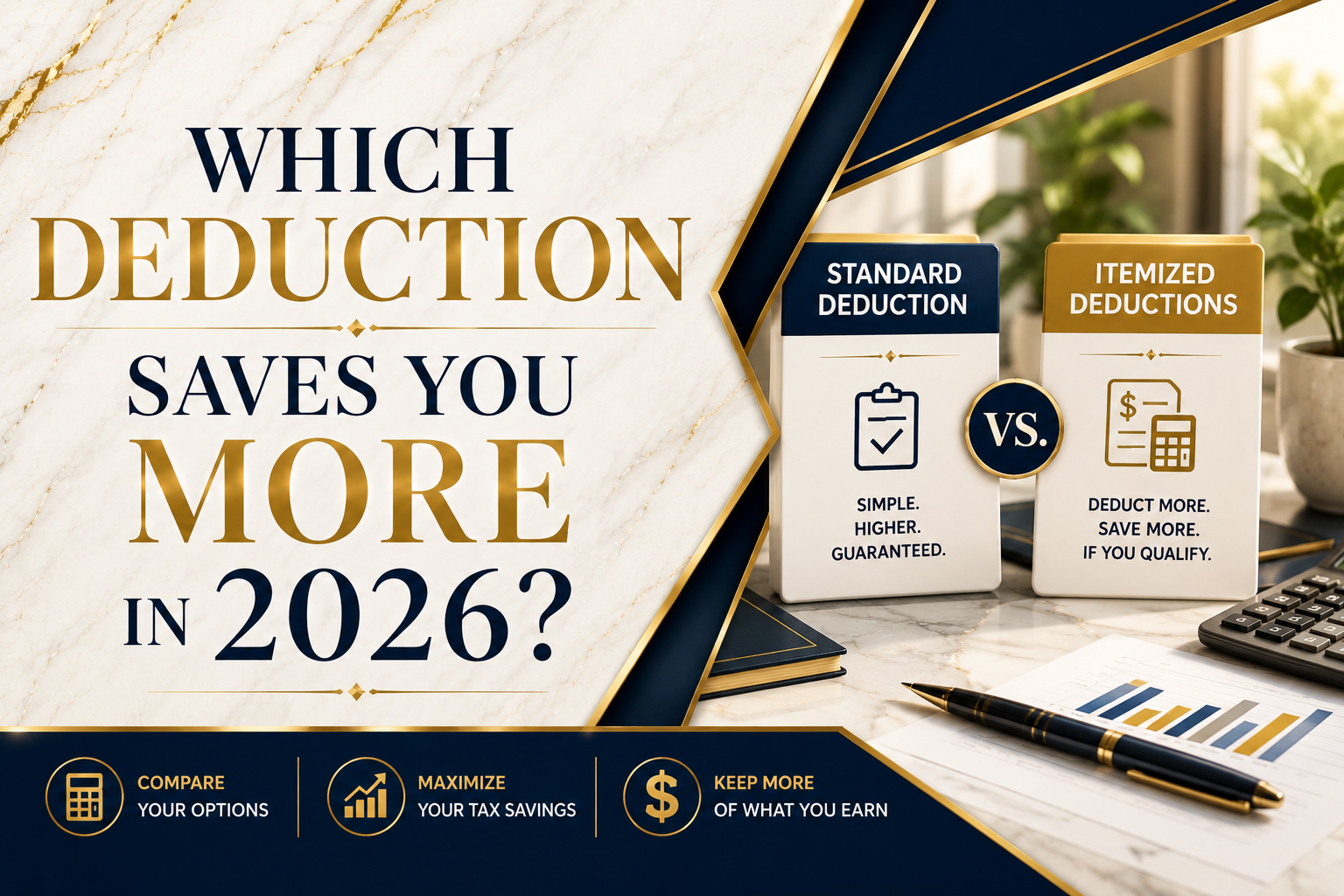
Which Deduction Saves You More in 2026?
One of the biggest questions taxpayers face each year is whether to claim the standard deduction or itemize deductions.
For the 2026 tax year, the answer is simple: the deduction that saves you more is the one that produces the larger reduction in your taxable income.
In many cases, the increased standard deduction will provide the greatest tax benefit. However, taxpayers with significant mortgage interest, charitable contributions, medical expenses, or state and local taxes may benefit more from itemizing.
Here’s how to determine which option is best for you.
How the Rules Work
Federal tax law allows most taxpayers to reduce taxable income by choosing one of two options:
- Claim the standard deduction.
- Elect to itemize deductions on your federal income tax return.
You generally cannot claim both. The goal is to choose the deduction that provides the greatest tax savings.
2026 Standard Deduction Amounts
For the 2026 tax year, the standard deduction amounts are:
- Single: $16,100
- Married Filing Separately: $16,100
- Head of Household: $24,150
- Married Filing Jointly: $32,200
- Qualifying Surviving Spouse: $32,200
Additional Standard Deduction
- $2,050 for unmarried taxpayers who are age 65 or older or blind.
- $1,650 for each qualifying married taxpayer or qualifying surviving spouse who is age 65 or older or blind.
For dependents, the standard deduction is generally limited to the greater of $1,350 or earned income plus $450, up to the regular standard deduction for the applicable filing status.
Important 2026 Itemized Deduction Limits
Even if your deductible expenses appear high, several IRS limitations may reduce the amount you can actually claim.
State and Local Taxes (SALT)
- Maximum deduction: $40,400
- $20,200 if Married Filing Separately
The deduction begins to phase down for higher-income taxpayers but generally cannot be reduced below the statutory minimum.
Medical Expenses
Only unreimbursed medical expenses that exceed 7.5% of your adjusted gross income (AGI) are generally deductible.
Charitable Contributions
Beginning in 2026, taxpayers who itemize generally may deduct charitable contributions only to the extent they exceed 0.5% of AGI, subject to other applicable IRS limitations.
Overall Itemized Deduction Limitation
High-income taxpayers may also see their itemized deductions reduced if taxable income exceeds:
- $768,700 – Married Filing Jointly or Qualifying Surviving Spouse
- $640,600 – Single or Head of Household
- $384,350 – Married Filing Separately
When the Standard Deduction Usually Saves More
The standard deduction is often the better choice if you:
- Rent your home instead of owning.
- Have little or no mortgage interest.
- Pay relatively low state and local taxes.
- Make modest charitable donations.
- Do not have significant medical expenses exceeding the IRS threshold.
For many taxpayers, the larger standard deduction introduced under current tax law makes itemizing unnecessary.
When Itemizing Usually Saves More
Itemizing may reduce your tax bill if you have substantial deductible expenses such as:
- Mortgage interest.
- State and local taxes up to the SALT limit.
- Large charitable contributions.
- Medical expenses above the 7.5% AGI threshold.
- Qualified disaster losses.
If your total allowable itemized deductions exceed your standard deduction, itemizing will generally result in lower taxable income.
Important Exceptions
Some taxpayers cannot claim the standard deduction.
For example:
- If you are Married Filing Separately and your spouse itemizes deductions, you generally cannot claim the standard deduction.
- Certain nonresident aliens also generally are not eligible for the standard deduction.
These situations require careful tax planning to determine the most beneficial filing strategy.
You May Still Qualify for Other Deductions
Choosing the standard deduction does not prevent you from claiming certain other deductions allowed outside of itemized deductions.
Depending on your circumstances, you may also qualify for:
- Qualified Business Income (QBI) Deduction.
- Qualified Tips Deduction.
- Qualified Overtime Deduction.
- Charitable deduction available to non-itemizers (subject to annual limits).
These deductions can further reduce your taxable income even if you do not itemize.
Final Thoughts
There is no one-size-fits-all answer when deciding between the standard deduction and itemizing. The best choice depends on your filing status, income, deductible expenses, and eligibility for various tax provisions.
For many taxpayers, claiming the standard deduction will produce the largest tax savings. However, if your mortgage interest, charitable contributions, medical expenses, and other eligible deductions exceed the standard deduction after applying IRS limits, itemizing may significantly reduce your tax bill.
Reviewing your deductions every year is one of the simplest ways to avoid paying more tax than necessary.
Need Help Choosing the Best Deduction?
Our CPA team helps individuals, families, retirees, and business owners evaluate whether claiming the standard deduction or itemizing will produce the greatest tax savings.
We stay up to date with the latest IRS rules and develop personalized tax strategies designed to legally minimize your tax liability while ensuring full compliance.
Contact our CPA team today to schedule a consultation and make sure you’re taking advantage of every deduction available for the 2026 tax year.
Professional tax planning today can help you keep more of what you earn tomorrow.