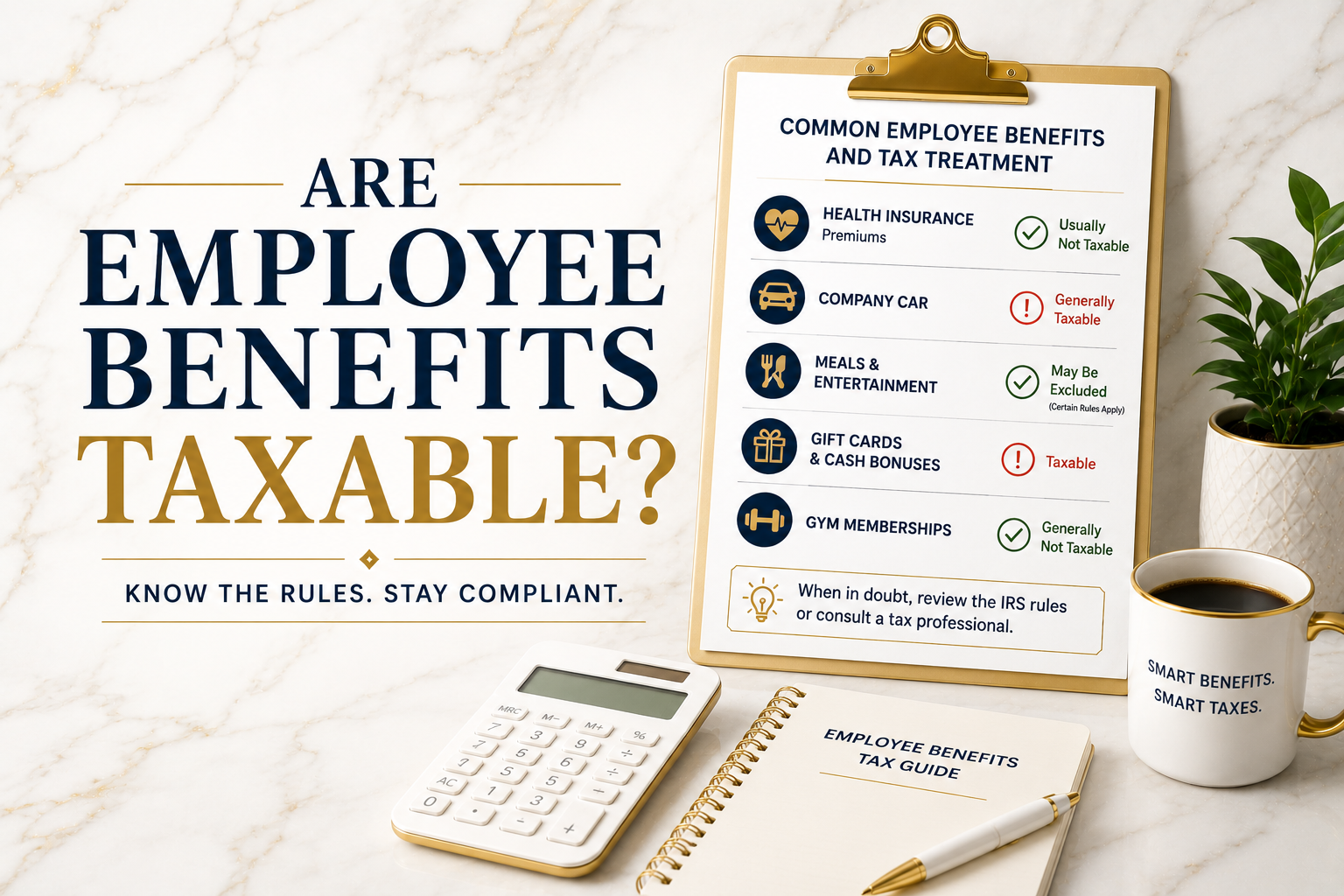
Are Employee Benefits Taxable? Here’s What Employers Need to Know
Many employers offer valuable perks to attract and retain employees—but not every benefit is tax-free.
As a general rule, employee benefits are considered taxable compensation unless a specific IRS provision excludes them from income.
The General Rule
Most fringe benefits must be included in an employee’s taxable wages unless they qualify for a specific tax exclusion.
If no exclusion applies, employers generally must:
- Include the benefit in employee wages
- Withhold applicable payroll taxes
- Report the value on Form W-2
Common Tax-Free Employee Benefits
Several employee benefits may qualify for tax-free treatment when IRS requirements are met, including:
- Qualified employee discounts
- Working condition benefits
- De minimis (small, infrequent) benefits
- Qualified transportation benefits
- Employer-paid health insurance
- Educational assistance programs
- Dependent care assistance
- Qualified retirement planning services
Important 2026 Tax-Free Limits
- Qualified parking: Up to $340 per month
- Transit and commuter benefits: Up to $340 per month
- Health FSA salary reduction limit: $3,400
- Dependent care assistance: Up to $7,500
- Educational assistance: Up to $5,250
- Adoption assistance: Up to $17,670 (subject to income phaseouts)
Not Every Tax Exclusion Applies the Same Way
Some benefits may be exempt from federal income tax but still be subject to Social Security, Medicare, or FUTA taxes.
Certain exclusions may also be limited for:
- Highly compensated employees
- 2% S corporation shareholders
- Key employees under specific benefit plans
Moving Expense Reimbursements
For most employees, employer-paid moving expenses remain taxable.
Tax-free treatment generally applies only to:
- Active-duty military members moving under qualifying orders
- Certain qualifying intelligence community employees
Key Takeaways
- ✔ Employee benefits are generally taxable unless a specific IRS exclusion applies.
- ✔ Several common benefits remain tax-free when eligibility requirements are met.
- ✔ Annual IRS dollar limits apply to many fringe benefit programs.
- ✔ Some benefits are exempt from income tax but still subject to payroll taxes.
- ✔ Proper payroll reporting helps avoid IRS penalties and compliance issues.
Need Help Managing Employee Benefits?
Our CPA team can help you determine which employee benefits are taxable, maximize available exclusions, and ensure your payroll reporting complies with current IRS rules.
Contact us today for expert guidance on your 2026 employee benefit tax obligations.
Proper planning today can help your business stay compliant while maximizing the value of employee benefits.