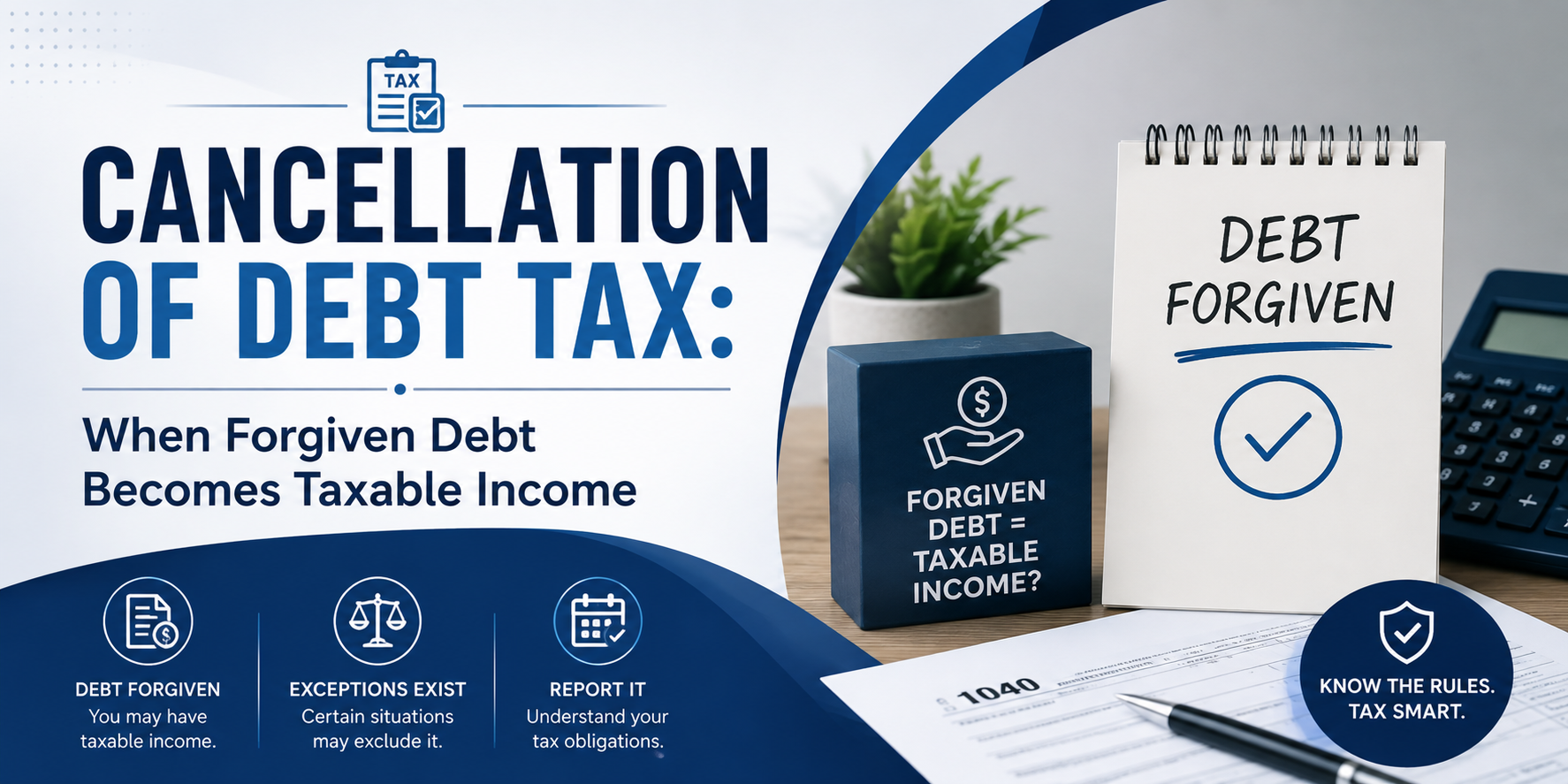
When Forgiven Debt Is Taxable
Having a debt forgiven can feel like financial relief—but it may also create a federal tax bill.
Under IRC Section 61(a)(11), canceled or forgiven debt is generally included in gross income unless a specific exception or exclusion applies. That means you can owe tax even though you never received cash.
However, not every canceled debt is taxable. Bankruptcy, insolvency, certain farm and real estate business debts, qualifying student loans, and other special situations may allow some or all of the forgiven amount to be excluded.
Here’s what taxpayers should know in 2026.
What Is Cancellation of Debt Income?
Cancellation of Debt (COD) income generally arises when a lender cancels, forgives, or discharges debt that you were legally required to repay.
Examples may include:
- Credit card debt settlements
- Personal loan forgiveness
- Business debt cancellation
- Mortgage debt forgiveness
- Debt canceled after a foreclosure or repossession
- Certain student loan discharges
Taxable cancellation-of-debt income is generally treated as ordinary income.
Does Form 1099-C Make the Debt Taxable?
No.
A lender generally files Form 1099-C, Cancellation of Debt, when it cancels at least $600 of qualifying debt.
However, Form 1099-C does not determine whether the canceled debt is taxable.
The $600 threshold applies to the lender’s information-reporting requirement—not to whether you must report the income.
You may still have taxable cancellation-of-debt income even if you never receive a Form 1099-C.
Bankruptcy Exclusion
Debt discharged in a qualifying Title 11 bankruptcy case is generally excluded from taxable income if:
- You are under the jurisdiction of the bankruptcy court, and
- The discharge is granted by the court or occurs under a court-approved plan.
The bankruptcy exclusion generally takes priority over several other COD exclusions, including insolvency and certain business-debt exclusions.
Even though the discharged debt may not be immediately taxable, other tax consequences can still arise through reductions in tax attributes.
Insolvency Exclusion
You may be able to exclude canceled debt if you were insolvent immediately before the debt was canceled.
You are generally insolvent when:
Total Liabilities > Fair Market Value of Total Assets
The exclusion is limited to the amount of your insolvency.
Example:
Suppose:
- $40,000 of debt is canceled.
- Your liabilities exceed the fair market value of your assets by $25,000 immediately before the cancellation.
You may generally exclude $25,000 under the insolvency exclusion.
The remaining $15,000 is generally taxable unless another exception or exclusion applies.
Qualified Farm Debt
Certain canceled farm debt may also qualify for exclusion.
Generally, the debt must:
- Have been incurred directly in operating a farming business.
- Meet specific gross-receipts requirements.
- Be discharged by a qualifying lender.
One important requirement generally provides that at least 50% of aggregate gross receipts for the three taxable years preceding the discharge must be attributable to farming.
This test uses gross receipts—not net farm income.
Qualified Real Property Business Debt
Certain taxpayers other than C corporations may elect to exclude canceled qualified real property business indebtedness.
Generally, the debt must:
- Be incurred or assumed in connection with real property used in a trade or business.
- Generally be secured by that real property.
- Meet the applicable statutory requirements.
The exclusion is subject to limitations based on factors such as:
- The amount by which the debt exceeds the property’s fair market value.
- The taxpayer’s adjusted basis in depreciable real property.
This exclusion can be valuable for qualifying real estate businesses, but it requires careful calculation.
Principal Residence Debt Rules for 2026
The principal residence debt exclusion is significantly more limited for 2026.
Under current law, the exclusion generally applies only if:
- The debt was discharged before January 1, 2026, or
- The discharge is made under an arrangement entered into and evidenced in writing before January 1, 2026.
For a discharge occurring in 2026, that generally means a written arrangement must have been in place before January 1, 2026.
The maximum qualified principal residence indebtedness generally is:
- $750,000, or
- $375,000 for Married Filing Separately.
Taxpayers should not assume that mortgage debt forgiven during 2026 automatically qualifies for this exclusion.
Student Loan Forgiveness
Student loan cancellation has special rules.
Certain discharges may continue to qualify for tax-free treatment, including qualifying:
- Public-service or work-related loan forgiveness programs
- Discharges due to death
- Discharges due to total and permanent disability
- Other specifically authorized programs
However, the broader temporary federal exclusion for certain student loan discharges applied only through December 31, 2025.
A student loan canceled in 2026 should therefore be reviewed under the specific rules that apply to the discharge rather than automatically treated as tax-free.
Other Situations That May Not Create COD Income
Some canceled debts are treated under separate rules rather than as taxable cancellation-of-debt income.
Examples may include:
- Debt canceled as a gift or inheritance
- Certain debts that would have produced a deductible expense for a cash-method taxpayer
- Certain seller-financed purchase-price reductions
For example, if a seller reduces purchase-money debt owed by a solvent buyer, the reduction may be treated as a purchase-price adjustment that reduces the buyer’s basis in the property rather than creating immediate taxable income.
Foreclosure and Repossession Rules
Foreclosures and repossessions can create two separate tax issues:
- Cancellation-of-debt income, and
- Gain or loss from the disposition of the property.
The result depends heavily on whether the debt is recourse or nonrecourse.
Recourse Debt
With recourse debt, the borrower is personally liable for repayment.
A foreclosure may generally produce:
- Gain or loss on the deemed sale of the property, and
- Separate cancellation-of-debt income if the canceled debt exceeds the property’s fair market value.
The fair market value of the property is generally used to determine the amount realized on the disposition.
Nonrecourse Debt
With nonrecourse debt, the borrower generally is not personally liable beyond the collateral.
In this situation, the borrower generally does not recognize separate cancellation-of-debt income.
Instead, the entire outstanding debt is generally treated as the amount realized on the disposition—even if the debt exceeds the property’s fair market value.
Form 982 and Tax Attribute Reductions
If you exclude canceled debt under IRC Section 108, you will generally need to file Form 982, Reduction of Tax Attributes Due to Discharge of Indebtedness.
Excluded debt may reduce certain tax attributes, including:
- Net operating losses
- Tax credit carryovers
- Capital loss carryovers
- Property basis
- Other specified tax attributes
These reductions generally occur after determining tax for the year of discharge.
As a result, excluding canceled debt now can reduce tax benefits available in future years.
Key Takeaways
✔ Canceled debt is generally taxable as ordinary income unless an exception or exclusion applies.
✔ Form 1099-C does not determine whether debt forgiveness is taxable.
✔ Bankruptcy and insolvency can exclude some or all canceled debt from income.
✔ Special exclusions may apply to qualified farm debt and qualified real property business debt.
✔ Principal residence debt relief is much more limited for 2026 discharges.
✔ Certain student loan forgiveness programs may remain tax-free, but the broad temporary exclusion ended after 2025.
✔ Foreclosures involving recourse and nonrecourse debt can produce very different tax results.
✔ Taxpayers claiming a Section 108 exclusion generally need to file Form 982.
✔ Excluding COD income may reduce valuable tax attributes in future years.
Final Thoughts
Debt forgiveness does not automatically mean you owe federal income tax, but it should never be ignored.
The tax treatment depends on the type of debt, your financial condition immediately before the cancellation, whether the debt was connected to a business or property, and whether a specific statutory exception or exclusion applies.
Receiving Form 1099-C is only the beginning of the analysis. Before reporting the entire canceled balance as taxable income—or excluding it entirely—review the applicable bankruptcy, insolvency, business-debt, mortgage, student-loan, and foreclosure rules.
Need Help With Canceled Debt or Form 1099-C?
Our CPA team helps individuals and business owners analyze cancellation-of-debt income, determine whether bankruptcy or insolvency exclusions apply, prepare Form 982, and accurately report Forms 1099-C and foreclosure transactions.
Contact our CPA team to schedule a consultation and review how your forgiven debt may be treated for federal tax purposes.
Sources
- 26 U.S.C. § 61, Gross income defined
- 26 U.S.C. § 108, Income from discharge of indebtedness
- IRS Publication 4681, Canceled Debts, Foreclosures, Repossessions, and Abandonments
- IRS Topic No. 431, Canceled Debt – Is It Taxable or Not?
About this article: This article was generated with the help of artificial intelligence using Ask Blue J, an AI tax research tool, and reviewed by Accu-Tax before publishing. It is general information as of September 24, 2026, not tax, legal or accounting advice for your situation. Tax rules change often. Please contact a tax professional for personalized advice before acting on anything here.