How Immediate Expensing Works in 2026
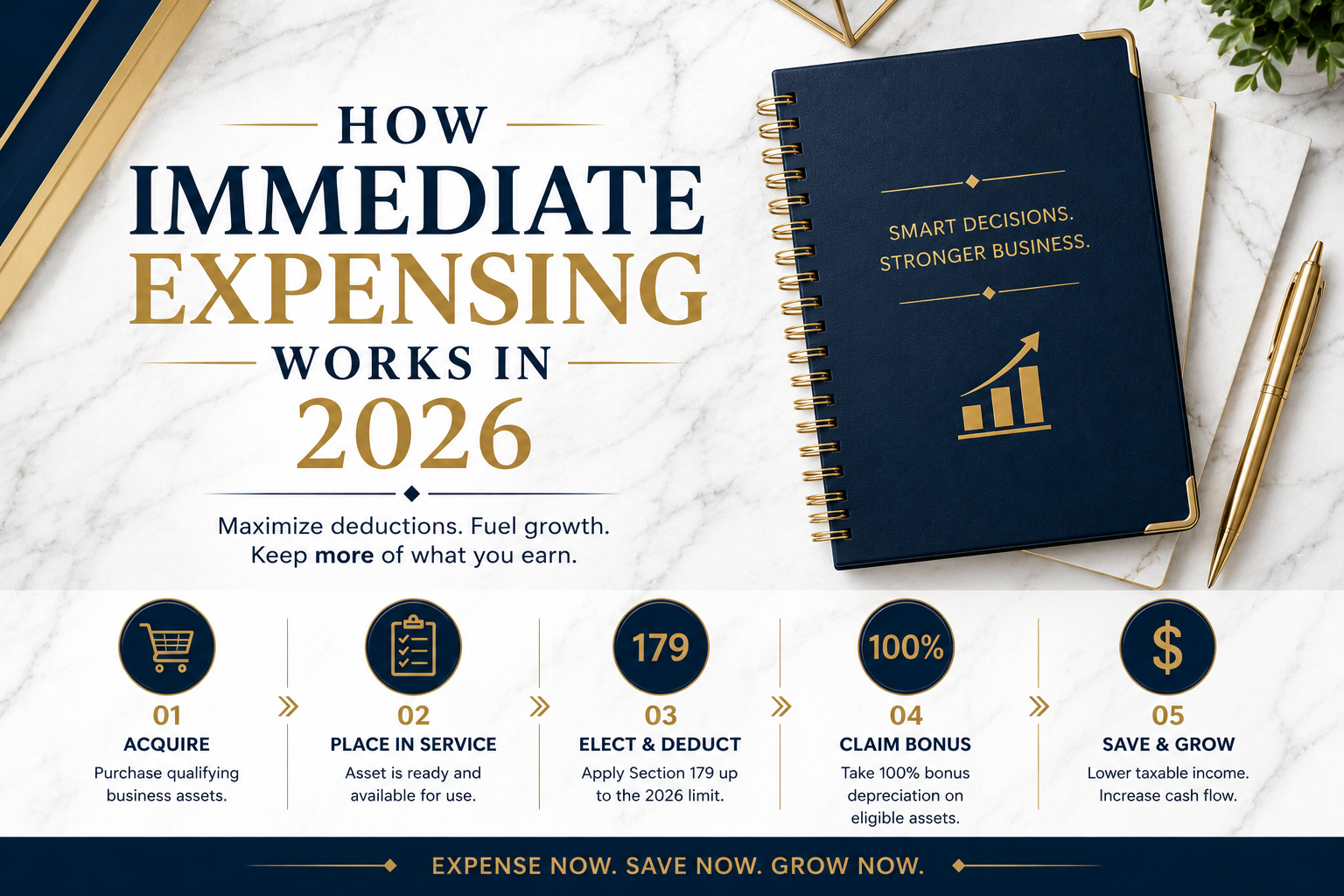
Immediate expensing allows businesses to recover the cost of qualifying assets much faster than traditional depreciation. Instead of spreading deductions over several years, eligible businesses may deduct part—or even all—of an asset’s cost in the year it is placed in service.
For 2026, immediate expensing generally follows a three-step process:
- Apply any Section 179 deduction.
- Apply bonus depreciation.
- Depreciate any remaining basis using MACRS.
Understanding how these rules work together can help businesses maximize deductions and improve cash flow.
Step 1: Section 179 Expensing
Section 179 allows businesses to elect to immediately deduct the cost of qualifying business property placed in service during the tax year.
2026 Section 179 Limits
- Maximum deduction: $2,560,000.
- Phase-out begins when qualifying property placed in service exceeds $4,090,000.
Once total qualifying purchases exceed the phase-out threshold, the available deduction is reduced dollar-for-dollar.
Taxable Income Limitation
The Section 179 deduction generally cannot exceed taxable income from the active conduct of a trade or business. Any unused deduction may generally be carried forward to future tax years.
Qualifying Property
- Business equipment and machinery.
- Certain computer software.
- Qualified improvement property.
- Roofs.
- HVAC systems.
- Fire protection and alarm systems.
- Security systems installed in existing nonresidential buildings.
Common Exclusions
Section 179 generally does not apply to:
- Estates and trusts.
- Property acquired by gift or inheritance.
- Certain related-party acquisitions.
Step 2: Bonus Depreciation
After applying any Section 179 deduction, businesses may qualify for bonus depreciation on the remaining basis of eligible property.
Bonus Depreciation Rates for 2026
- 100% for qualified property acquired after January 19, 2025 and placed in service during 2026.
- 20% for qualified property acquired before January 20, 2025 and placed in service during 2026.
Eligible Property
- MACRS property with a recovery period of 20 years or less.
- Certain computer software.
- Water utility property.
- Certain film, television, theatrical, and sound recording productions.
When Bonus Depreciation Does Not Apply
- Property required to use the Alternative Depreciation System (ADS).
- Property placed in service and disposed of during the same tax year.
- Certain other property excluded under IRS rules.
Businesses may also elect out of bonus depreciation for an entire class of property if doing so better aligns with their overall tax strategy.
Step 3: MACRS Depreciation
After Section 179 and bonus depreciation are applied, any remaining asset basis is depreciated under the Modified Accelerated Cost Recovery System (MACRS).
Depending on the asset type, MACRS generally uses:
- 200% declining balance for most 3-, 5-, 7-, and 10-year property.
- 150% declining balance for most 15- and 20-year property.
- Straight-line depreciation for nonresidential real property, residential rental property, qualified improvement property, and certain other assets.
Special Rule for Qualified Production Property
Separate from standard bonus depreciation, certain qualified production property may be eligible for a 100% special depreciation allowance under IRC Section 168(n), provided all statutory construction, acquisition, election, and placed-in-service requirements are satisfied.
This provision may benefit businesses making significant investments in manufacturing and production facilities.
How Immediate Expensing Works in Practice
For most businesses, the process looks like this:
- Elect Section 179 for qualifying assets, subject to the annual limits.
- Apply bonus depreciation to the remaining basis.
- Depreciate any remaining amount using MACRS over the asset’s recovery period.
Using these provisions together can significantly accelerate tax deductions and improve after-tax cash flow.
Final Thoughts
Immediate expensing in 2026 is not a single tax rule—it is the combined application of Section 179, bonus depreciation, and MACRS depreciation.
By understanding the order of these deductions and the eligibility requirements for each, businesses can make more informed purchasing decisions and maximize available tax benefits.
Proper planning before acquiring equipment, software, vehicles, or building improvements can result in substantial tax savings.
Need Help Maximizing Your Business Tax Deductions?
As a CPA firm, we help business owners develop tax strategies that maximize Section 179 deductions, bonus depreciation, and other valuable tax incentives while staying fully compliant with IRS rules.
Whether you’re investing in equipment, expanding your operations, or planning major capital purchases, our experienced CPA team can help you identify the most tax-efficient approach for your business.
Contact our CPA team today to schedule a consultation and discover how proactive tax planning can help your business maximize deductions in 2026 and beyond.
Strategic tax planning today can create meaningful savings for your business tomorrow.