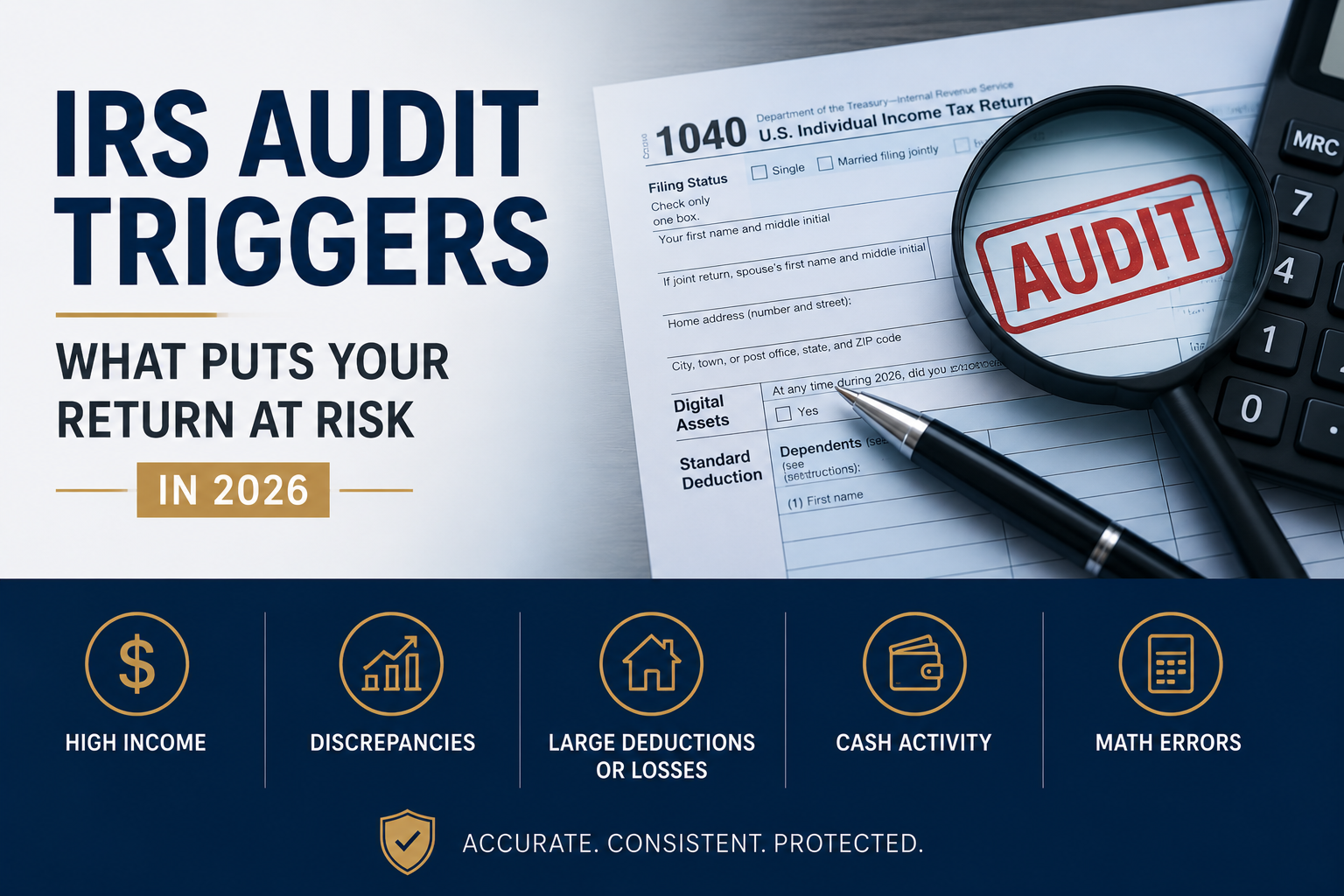
Most tax returns are accepted as filed. But some returns are selected for examination based on mismatches, risk scoring, related-party issues, or specific compliance priorities.
If you want to reduce audit risk, the key is not guessing at “secret red flags.” It is understanding the IRS’s legal authority, how returns are selected, and which reporting patterns tend to draw scrutiny. Under, the IRS may examine books, records, and other data relevant or material to determining the correctness of a return or tax liability. And under, the IRS generally has 3 years after a return is filed to assess tax, with longer periods in some cases.
This post explains common audit triggers in 2026 and why they matter.
1. Information return mismatches
One of the clearest audit or notice triggers is a mismatch between what you report and what third parties report to the IRS. The IRS may select returns based on third-party documentation that does not match the return.
Common examples include mismatches involving:
- Forms W-2
- Forms 1099
- brokerage reporting
- bank-reported interest or dividends
- payment platform reporting
The IRS’s examination publication specifically says returns may be selected when third-party information does not match the return. The audit article also notes that correspondence audits often begin after discrepancies are identified in matching return data against third-party information.
2. High DIF or UIDIF scores
The IRS uses computer-assisted selection methods. The audit article describes the Discriminant Function System (DIF) as a scoring method intended to identify returns with a high potential for inaccuracies or mismatches, and the Unreported Income DIF (UIDIF) as estimating the potential yield from unreported income.
That means a return can be selected even without a specific third-party mismatch if its overall pattern differs enough from comparable returns. The IRS examination publication likewise says some returns are selected through random selection and computer screening based on statistical formulas and norms for similar returns.
3. High income and complex returns
High-income taxpayers remain a major enforcement focus. The audit article states that audits increasingly focus on very high incomes because of the complexity of those returns and the greater potential for irregularities.
The IRS research bulletin on indirect deterrence also notes that enforcement resources have increasingly been discussed in relation to high-dollar noncompliance and complex taxpayers. High income alone is not wrongdoing, but it often correlates with:
- more entities
- more pass-through income
- more foreign reporting
- more deductions and elections
- more valuation and basis issues
Those features make the return more likely to be selected for review.
4. Rounded numbers and estimated figures
The audit article identifies returns with rounded or estimated figures as a focus area .That does not mean every rounded number is a problem, but a return full of round-dollar deductions can suggest approximation rather than contemporaneous records.
This is especially risky where the item should ordinarily be supported by invoices, receipts, logs, or statements.
5. Large business expenses or unusual deductions
The audit article specifically mentions rental income and very high business expenses as audit-prone areas. More generally, deductions that appear disproportionate to income or to the nature of the business can increase risk.
Examples often include:
- unusually high Schedule C expenses
- large charitable deductions
- large casualty or valuation-based deductions
- deductions inconsistent with industry norms
The IRS can examine books and records relevant to those items under and may summon testimony or records under and (3).
6. Self-employment income and cash-intensive activity
Correspondence audits commonly involve business expenses and self-employment income. Returns with sole proprietorship income often present higher audit risk because they may involve:
- limited withholding
- fewer third-party controls
- more opportunity for omitted receipts
- more subjective expense allocations
The IRS research bulletin on compliance burden also notes that self-employed taxpayers face materially higher compliance burdens than wage earners, reflecting the complexity of reporting and substantiating business income and expenses.
7. Earned Income Tax Credit claims
The audit article notes that EITC recipients are audited more frequently. The IRS research conference materials also discuss audit disparities and the IRS’s efforts to refine EITC audit selection.
This does not mean claiming the EITC is improper. It means the IRS historically devotes substantial compliance attention to refundable credits, especially where eligibility depends on facts like:
- earned income
- qualifying children
- residency
- filing status
8. Related-party or network examinations
The IRS examination publication states that returns may be selected because they involve issues or transactions with other taxpayers, such as business partners or investors, whose returns were selected.
So even if your own return does not stand out independently, you may be examined because of:
- partnership-level issues
- investor/promoter relationships
- related entities
- counterparties already under review
9. Cryptocurrency and digital asset transactions
The audit article says the IRS has intensified monitoring of cryptocurrency transactions and expects taxpayers to fully document gains and losses and report them properly. It also notes that exchanges and platforms may issue Forms 1099-K and 1099-B, though those forms may not capture every aspect of digital asset activity.
The IRS Advisory Council materials also show the IRS’s continuing work on Form 1099-DA and digital asset reporting systems. In practice, digital asset audit risk often increases where there is:
- incomplete basis tracking
- wallet-to-wallet transfers without documentation
- inconsistent reporting across exchanges
- omission of taxable dispositions
10. Foreign accounts and international reporting failures
The Code extends the assessment period where certain foreign information reporting is missing. provides that where information required under sections including 6038, 6038A, 6038B, 6038D, 6046, 6046A, or 6048 is not furnished, the time for assessment does not expire before 3 years after the required information is furnished.
That makes international reporting failures especially significant. The IRSAC materials also emphasize the complexity and penalty exposure associated with foreign information returns and offshore compliance.
Common triggers include:
- unfiled Forms 5471, 5472, 8938, or similar forms
- foreign account reporting inconsistencies
- foreign-source income omitted from the return
- cross-border structures with incomplete disclosures
11. Listed transactions and disclosure failures
Provides a special rule for listed transactions. If a taxpayer fails to include required information about a listed transaction, the time for assessment with respect to that transaction does not expire before 1 year after the earlier of the date the information is furnished or the date a material advisor satisfies requirements in response to an IRS request.
That rule reflects the IRS’s strong focus on disclosure compliance in potentially abusive transactions. Failure to disclose can itself become a major audit issue, separate from the substantive tax treatment.
12. Large partnerships and campaign-driven enforcement
The audit article notes that the IRS may launch targeted compliance campaigns under, 7801, and 7803, and specifically mentions large partnerships among the campaign areas.
The IRS Strategic Operating Plan materials also emphasize expanded enforcement on complex taxpayers and high-dollar noncompliance. If your return touches an area under active campaign scrutiny, audit risk can rise even if the issue is not unique to you.
13. S corporation officer compensation issues
One longstanding trigger in the S corporation area is low or zero officer compensation where shareholder-employees are actively working in the business. The Journal of Accountancy article explains that the IRS closely reviews Forms 1120-S for insufficient compensation paid to shareholder-officers because wages are subject to employment taxes while distributions are not.
The article identifies several practical red flags, including:
- officer compensation reported too low relative to business activity
- inconsistent business activity codes
- inconsistent reporting of officer time devoted to the business
- positions on shareholder returns inconsistent with the corporation’s reporting
14. Cost segregation and depreciation positions
The IRS cost segregation guidance shows how closely the IRS may review depreciation classifications, project costs, indirect costs, and basis allocations. Returns involving aggressive cost segregation positions may attract scrutiny where there are questions about:
- unsupported basis
- improper allocation between and property
- use of estimates instead of actual records
- improper treatment of land preparation or indirect costs
- accounting method change issues
15. Failure to file or fraudulent returns
The normal 3-year assessment period does not apply in all cases. provides that in the case of a false or fraudulent return with intent to evade tax, tax may be assessed at any time. Likewise provides that in the case of failure to file a return, tax may be assessed at any time.
So the most serious “audit trigger” is not really a trigger at all, but conduct that removes the normal statute protection.
16. Substantial omission of gross income
Extends the assessment period to 6 years if the taxpayer omits from gross income an amount properly includible that exceeds 25% of the gross income stated on the return, or if certain foreign asset-related omissions exceed $5,000.
That does not itself create an audit, but it increases exposure by giving the IRS more time to examine the return.
17. Why audit type matters
Not every audit is the same. The IRS examination publication explains that examinations may be conducted by mail or in person. The audit article says correspondence audits are more common and less extensive, while field audits are more thorough and involve direct review of records and interviews.
Broadly:
- correspondence audits often focus on discrete issues like credits, expenses, or mismatches
- field audits tend to involve more complex returns and broader factual development
18. The IRS can expand the scope once an exam begins
If a return is selected, the IRS may expand the examination. The audit article notes that the responsible revenue agent may extend the examination to additional forms and years.The IRS examination publication similarly explains that the IRS may ask for additional information about items on the return and continue developing issues during the exam.
That means a narrow trigger can become a broader review if the IRS finds additional concerns.
19. What the IRS can ask for
Gives the IRS broad authority to:
- examine books, papers, records, or other data relevant or material to the inquiry
- summon the taxpayer or other persons
- take testimony under oath.
The IRS examination publication also explains that if an examination is conducted in person, the taxpayer may act personally or through an authorized representative, and the IRS may request records supporting the return.
20. Practical ways to reduce audit risk
The sources do not support a claim that any one tactic guarantees audit avoidance. But they do point to practical risk reducers:
- report all income shown on third-party forms
- maintain records that support deductions, basis, and credits
- avoid estimates where exact records should exist
- ensure consistency across related returns and entities
- complete required foreign and transaction disclosures on time
- use accurate business activity coding and compensation reporting where applicable
Final takeaway
In 2026, the biggest audit risks are still the familiar ones: mismatched reporting, omitted income, unusually large deductions, complex international issues, digital asset reporting problems, and returns that score high under IRS selection systems
The legal framework matters too. The IRS generally has 3 years to assess tax under, but that period can extend to 6 years for substantial omissions and indefinitely for fraud, failure to file, and certain missing foreign information returns .And once a return is under examination, gives the IRS broad authority to request records and testimony relevant to the inquiry.