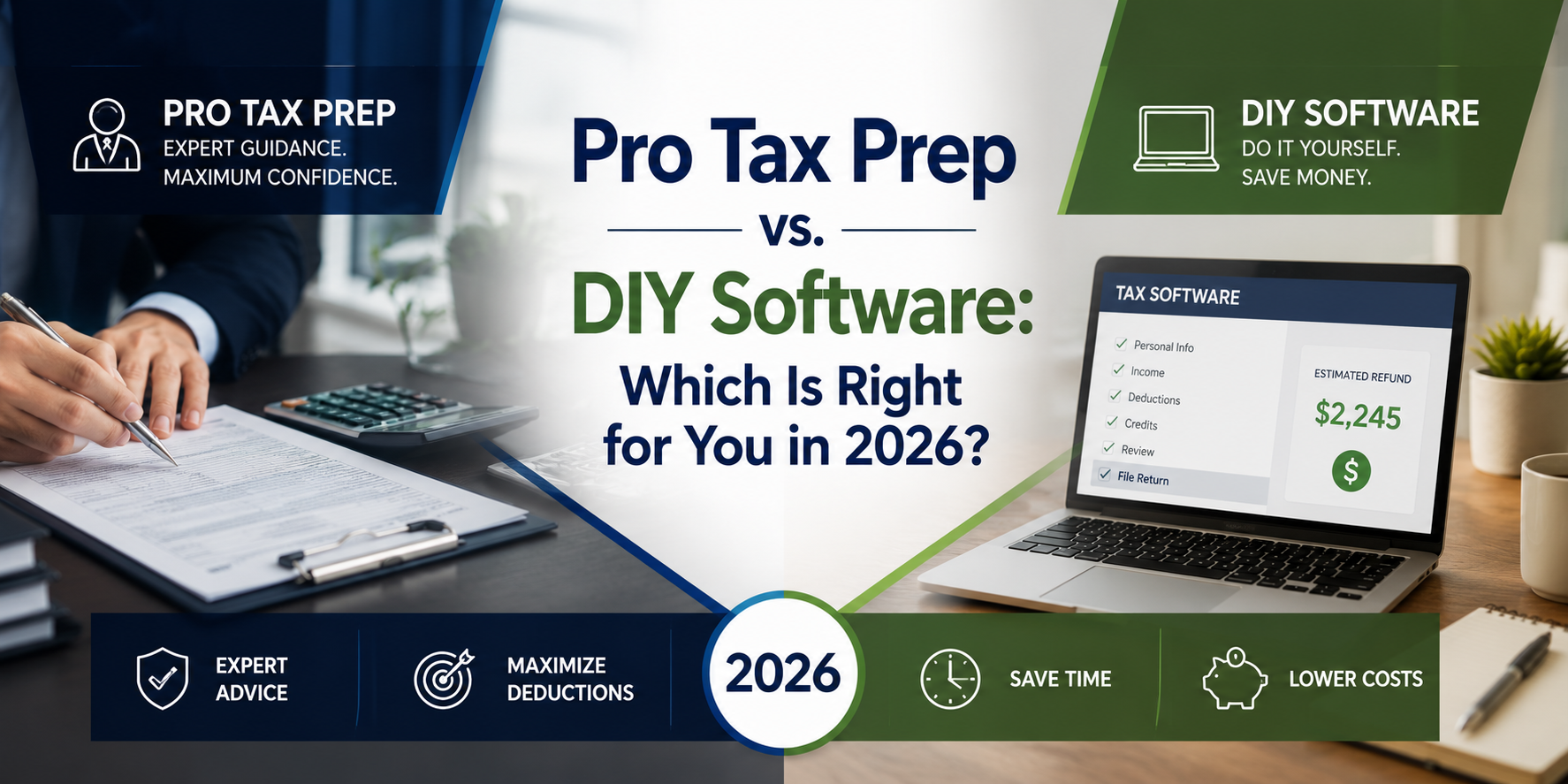
For 2026, the choice between hiring a tax professional and using do-it-yourself software depends less on preference alone and more on the complexity of your return, the kinds of income and deductions involved, and your tolerance for compliance risk. IRS sources make clear that taxpayers remain responsible for the accuracy of the return either way, but they also recognize multiple filing channels: self-preparation, software-based e-filing, IRS Free File and related free options, and paid preparers.
In general, DIY software is often a good fit for taxpayers with straightforward wage, interest, and basic credit situations. Professional preparation is often more appropriate where the return involves self-employment, rental activity, multistate issues, divorce-related tax consequences, canceled debt, property basis questions, or other areas where legal characterization matters as much as data entry.
Short answer
If your 2026 return is simple, DIY software is usually the more efficient option. If your return includes judgment-heavy issues, a paid preparer is usually the safer option. The IRS notes that many taxpayers can prepare and e-file returns themselves, including through free options, but also states that paid preparers who prepare returns for compensation generally must sign the return and include their PTIN. Even when a preparer is used, the taxpayer remains ultimately responsible for the information reported.
What the IRS recognizes as your filing options in 2026
IRS Publication 17 describes several ways to prepare and file a return:
- prepare the return yourself,
- use IRS Free File if eligible,
- use Free File Fillable Forms,
- get help through VITA or TCE if eligible,
- use a tax professional,
- e-file using software.
The IRS also emphasizes that e-filing is generally faster and more accurate than paper filing, and that many paid preparers are required to e-file returns they prepare.
That means the real comparison is not “electronic versus manual.” In 2026, both DIY and professional prep usually end in e-filing. The real difference is who is making the tax judgments.
When DIY software is usually the right fit
DIY software is often well-suited where the return is primarily mechanical rather than interpretive. Typical examples include:
- Form W-2 wage income,
- modest bank interest,
- standard deduction,
- basic child-related credits,
- no business or rental schedules,
- no major life-event tax complications,
- no prior-year carryovers or basis tracking issues.
Publication 17 is structured around the ordinary Form 1040 filing process and reflects that many taxpayers can complete returns using standard information documents like Forms W-2 and 1099.
DIY software may be especially attractive if:
- you are comfortable reviewing interview questions carefully,
- you have complete records,
- you want lower out-of-pocket cost,
- your return does not require nuanced legal analysis.
For some taxpayers, free filing options may make DIY especially compelling. Publication 17 notes that taxpayers may qualify for Free File software or use Free File Fillable Forms, and VITA/TCE programs may also be available depending on income, age, disability, or language needs.
When a professional is usually the better choice
A paid preparer is often the better choice when the return involves issues where the main challenge is not entering numbers but determining the correct tax treatment.
Common examples from the cited IRS materials include:
- self-employment income and Schedule C issues,
- rental income and expenses,
- basis calculations for property,
- sale of property,
- canceled debt,
- divorce or separation issues,
- IRA transfers incident to divorce,
- casualty or abandonment issues,
- multiform reporting with special schedules,
- amended returns involving legal corrections.
1. Self-employment and side-gig income
Publication 17 states that self-employed persons generally must file if net earnings from self-employment are $400 or more, and Schedule SE may be required. It also notes that business income and expenses may require Schedule C.
This is often where DIY software becomes less reliable in practice—not because the software cannot compute the tax, but because the taxpayer may misclassify expenses, omit income, or misunderstand filing obligations.
2. Divorce and separation
Publication 504 shows how complicated filing status, dependency claims, alimony treatment, joint liability relief, and property transfers can become after divorce or separation.
Examples include:
- whether you qualify as head of household,
- whether a child is the qualifying child of more than one person,
- whether a payment is alimony or child support,
- whether a transfer incident to divorce is taxable,
- how to divide estimated tax payments or deductions.
These are classic “professional prep” issues because the answer depends on facts and legal rules, not just arithmetic.
3. Canceled debt, foreclosure, repossession, or abandonment
Publication 4681 explains that canceled debt is generally income unless an exception or exclusion applies, such as bankruptcy, insolvency, qualified farm debt, qualified real property business debt, or qualified principal residence indebtedness.
It also explains that foreclosure, repossession, and abandonment can involve both disposition gain/loss and cancellation-of-debt income.
DIY software can handle Form 982 mechanically, but it cannot independently verify whether the taxpayer has correctly determined insolvency, basis, or the character of the debt without accurate user input and legal understanding.
4. Basis-sensitive transactions
Publication 551 shows that basis issues can arise in many contexts:
- inherited property,
- gifted property,
- property transferred incident to divorce,
- casualty adjustments,
- depreciation adjustments,
- bargain purchases,
- business-use conversions,
- multiple-asset acquisitions,
- like-kind exchanges and partial dispositions.
Basis errors often do not show up as obvious software errors. They simply produce the wrong tax result. That makes basis-heavy returns especially appropriate for professional review or preparation.
What a paid preparer does—and does not do
Publication 17 states that anyone paid to prepare, assist in preparing, or review a return generally must sign it and include their PTIN.
But the same source also makes clear that:
- you are still responsible for the accuracy of the return,
- you must provide complete and accurate information,
- using e-file does not affect audit selection,
- if another person prepares your return without charging you, that person generally should not sign as paid preparer.
So professional prep reduces risk, but it does not transfer all responsibility away from the taxpayer.
Cost is not just the prep fee
DIY software usually appears cheaper because the direct fee is lower. But the real comparison should include compliance cost and error risk.
IRS materials repeatedly emphasize recordkeeping, correct reporting, and the consequences of mistakes. Publication 17 notes that errors can delay refunds or generate notices, and amended returns may be needed if income, deductions, credits, or filing status were reported incorrectly.
That means the true cost of DIY can include:
- time spent gathering and entering data,
- time spent learning unfamiliar rules,
- risk of omitted forms or elections,
- risk of notices, penalties, or amended returns,
- missed deductions or credits.
By contrast, the true cost of professional prep includes:
- preparer fees,
- time spent organizing records,
- possible overreliance on the preparer if you do not review the return carefully.
Free help may be the middle ground
For many taxpayers, the real choice is not only “paid preparer versus software.” IRS sources identify free assistance programs that can bridge the gap.
Publication 17 states:
- VITA generally serves low-to-moderate income taxpayers, persons with disabilities, and limited-English-speaking taxpayers,
- TCE serves all taxpayers but especially those age 60 or older,
- some sites also offer do-it-yourself software support.
That means if your return is not fully simple but you do not want to hire a preparer, free assisted filing may be the best fit.
Questions to ask before choosing DIY or pro prep
A practical 2026 decision framework is:
DIY software may be right if you can answer “yes” to most of these:
- Is your income mostly from Forms W-2 and standard 1099s?
- Are you taking the standard deduction?
- Do you have no Schedule C, E, F, or complex basis issues?
- Do you understand the tax treatment of every major item on your return?
- Do you have complete records and prior-year information?
Professional prep may be right if you answer “yes” to any of these:
- Did you have self-employment, rental, or farm activity?
- Did you sell property or need basis calculations?
- Did you have divorce, custody, or alimony issues?
- Did you receive a Form 1099-C or deal with foreclosure or repossession?
- Do you need to amend a prior return?
- Are you unsure how to classify income, deductions, or credits?
2026-specific practical point: filing method and deadlines still matter
Publication 17 states that 2026 individual returns are generally due April 15, 2026, and that taxpayers can request an automatic six-month extension to file, though not to pay.
Whether you use software or a preparer, the same timing rules apply. If your return is complex, waiting too long can effectively force a rushed DIY filing or a late scramble for professional help.