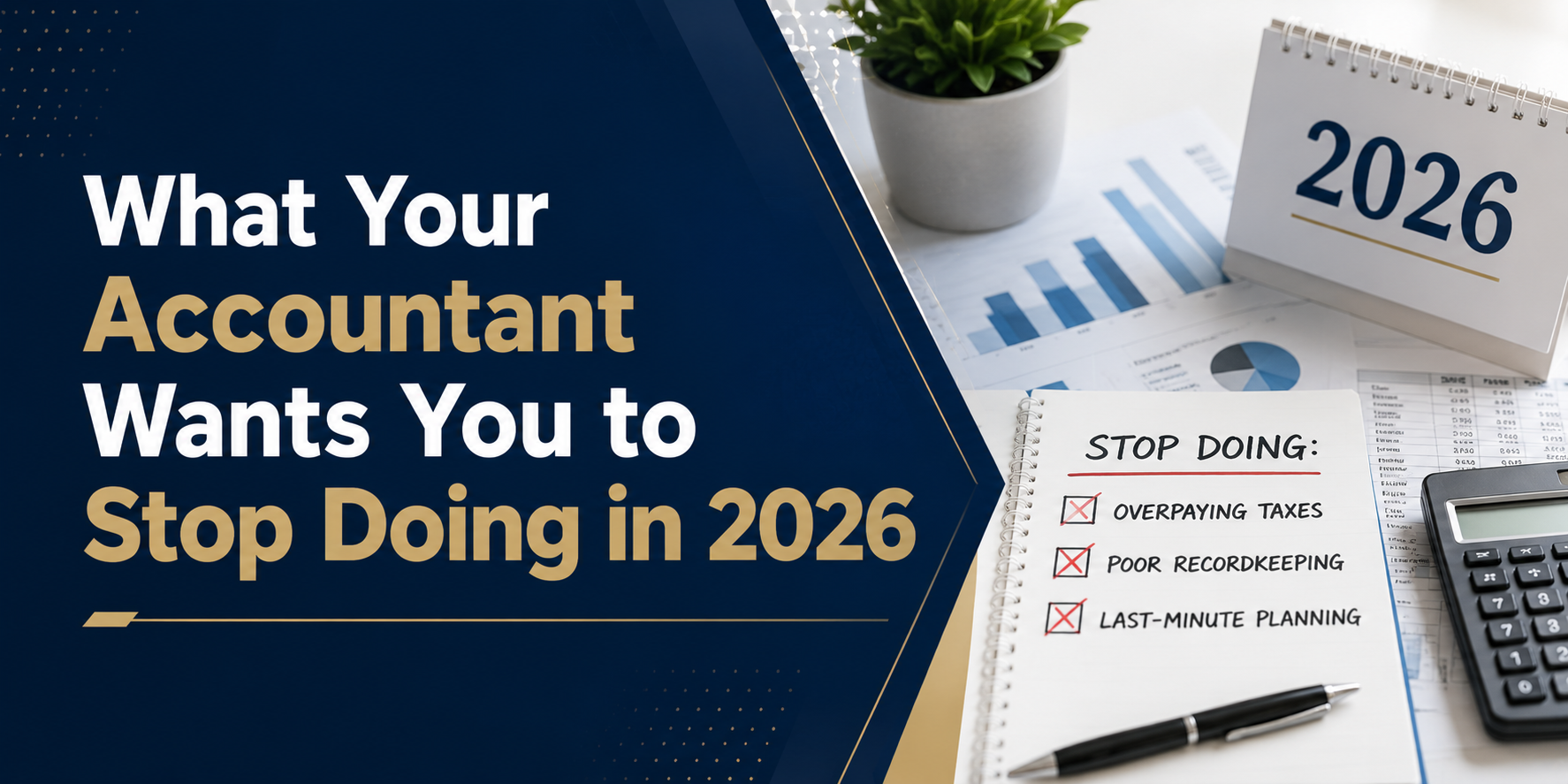
If your accountant could make a 2026 wish list, it would probably be simple: stop creating avoidable tax problems. Most year-end tax stress is not caused by obscure Internal Revenue Code issues. It is caused by poor records, mixed-use spending, late documents, missing basis information, payroll mistakes, and preventable reporting errors.
IRS guidance consistently emphasizes that taxpayers and businesses need records that clearly reflect income and expenses, support items reported on returns, and track assets and payments over time. When those basics break down, tax prep gets slower, more expensive, and riskier.
1. Stop mixing personal and business spending
This is probably the number one frustration.
If you run a business, your accountant wants business activity in business accounts and personal activity in personal accounts. IRS recordkeeping guidance stresses that records must clearly show income and expenses and identify business transactions accurately.
When you run groceries, vacations, streaming subscriptions, and actual business expenses through the same account or card, someone has to untangle it later. That someone is usually your accountant, and you are usually paying for the untangling.
Why this matters:
- it slows bookkeeping,
- increases prep fees,
- raises the chance of missed deductions,
- makes an IRS inquiry harder to answer.
2. Stop waiting until tax time to organize your books
Your accountant does not want to reconstruct 12 months of activity from bank statements, screenshots, and memory.
Publication 17 explains that taxpayers should keep receipts, canceled checks, and other proof to support deductions and credits, and Publication 946 similarly emphasizes basis and asset records.
If you hand over a “shoebox” in March or April, you are not just giving your accountant data. You are giving them a cleanup project.
What your accountant wants instead:
- monthly reconciliations,
- categorized expenses,
- current bookkeeping,
- year-end reports that already tie out.
3. Stop calling everything a write-off
Not every payment is deductible just because it was useful, convenient, or somehow related to work.
allows deductions for ordinary and necessary business expenses paid or incurred in carrying on a trade or business.
That standard is broader than many people think in some areas, and narrower than many people think in others.
Your accountant wants you to stop assuming these are automatically deductible:
- commuting costs,
- personal meals,
- club dues,
- personal legal fees,
- personal clothing,
- home expenses with no business-use support.
The issue is not just whether an expense feels business-related. It is whether it is deductible under the Code and whether you can substantiate it.
4. Stop ignoring substantiation rules
Some deductions live or die on documentation.
requires substantiation for:
- travel,
- meals and lodging while away from home,
- gifts,
- listed property.
That means your accountant wants you to stop saying:
- “I know I spent about…”
- “I don’t have the receipt, but trust me”
- “It was definitely business-related”
For these categories, estimates are often not enough. Your accountant wants:
- amount,
- date,
- place,
- business purpose,
- business relationship where relevant.
5. Stop treating meals like they are 100% deductible
They usually are not.
generally limits the deduction for food or beverages to 50% of the otherwise allowable amount.
The temporary 100% deduction for restaurant meals expired after 2022.
Also, requires that:
- the expense not be lavish or extravagant, and
- the taxpayer or an employee be present.
So in 2026, your accountant wants you to stop coding every restaurant charge as fully deductible “meals.”
6. Stop deducting entertainment like it is still allowed
It generally is not.
Disallows deductions for entertainment, amusement, or recreation expenses and facilities used in connection with those activities.
That means your accountant wants you to stop trying to deduct:
- sporting event tickets,
- concert tickets,
- golf outings,
- club memberships,
- entertainment packages dressed up as “marketing.”
Meals may still be partly deductible if separately stated and otherwise qualify, but entertainment itself is generally disallowed.
7. Stop forgetting that gifts have a hard limit
Business gifts are not fully deductible just because they are thoughtful.
Limits the deduction for gifts to any individual to $25 per year, subject to narrow exceptions for certain low-cost promotional items and display materials.
Your accountant wants you to stop assuming a $200 holiday basket is fully deductible as a business gift.
8. Stop buying equipment without saving the invoice and service date
If you buy equipment, furniture, computers, vehicles, or improvements, your accountant needs more than the amount paid.
Bonus depreciation, and MACRS depreciation all depend on details such as:
- cost,
- date acquired,
- date placed in service,
- business-use percentage,
- asset type.
Publication 946 makes clear that depreciation begins when property is placed in service, not merely purchased.
Your accountant wants you to stop sending a credit card statement line that says “Dell – $4,800” and expecting that to be enough.
9. Stop confusing repairs with improvements
This one causes constant problems.
A current expense under is different from a capital expenditure that must be recovered through depreciation.
Publication 946 explains that improvements are generally additions, restorations, or adaptations to a new or different use, and those are treated as separate depreciable property.
Your accountant wants you to stop calling every large building expenditure a “repair.”
10. Stop using your car for business without a mileage log
Vehicle deductions are a classic audit issue.
If you use a vehicle for both business and personal purposes, only the business portion is deductible. substantiation rules apply, and Publication 17 and Publication 946 both reinforce the need for records.
Your accountant wants you to stop saying:
- “I used it mostly for work”
- “I can estimate the miles”
- “I’ll recreate the log later”
Also, commuting is generally nondeductible.
11. Stop paying workers without thinking about classification
Worker classification mistakes create payroll tax, information reporting, and penalty exposure.
Publication 17 distinguishes employees from self-employed persons and notes separate filing and tax obligations.
Your accountant wants you to stop assuming everyone is a contractor because:
- they asked to be paid that way,
- it is easier,
- “everyone in the industry does it.”
Misclassification can affect withholding, employment taxes, Forms W-2 or 1099, and related penalties.
12. Stop ignoring payroll tax deposits and filings
If you have employees, payroll compliance is not optional and not something to “catch up on later.”
Publication 17 explains that certain taxpayers must file because they owe special taxes, including household employment taxes and uncollected Social Security and Medicare taxes.
Your accountant wants you to stop:
- missing payroll deposits,
- filing payroll forms late,
- assuming payroll software fixed everything automatically,
- waiting for an IRS notice before checking payroll compliance.
13. Stop assuming extensions extend time to pay
This is a yearly problem.
Publication 17 is explicit: an extension generally gives more time to file, not more time to pay. Interest still runs from the regular due date, and penalties may apply.
Your accountant wants you to stop saying, “I filed an extension, so I’m fine until October.”
You may be fine on filing. You may not be fine on payment.
14. Stop losing track of basis
Basis is one of the most common hidden tax problems.
Publication 17 repeatedly points taxpayers to basis rules for property, and Publication 946 explains that depreciation,, casualty losses, and other adjustments affect basis over time.
Your accountant wants you to stop selling:
- stock,
- crypto,
- rental property,
- business assets,
- inherited or gifted property
without knowing basis.
If basis is missing, gain may be overstated, understated, or impossible to support.
15. Stop assuming every 1099 is automatically correct
Information returns are important, but they are not infallible.
Publication 17 explains that if you receive a form with incorrect information, you should ask the payer for a corrected form. If you receive a form after filing, you may need to amend.
Your accountant wants you to stop:
- blindly entering every 1099 without review,
- ignoring duplicate reporting,
- assuming a mismatch means your books are wrong.
The right answer is to reconcile the form to your records.
16. Stop waiting to mention major life events
Your accountant wants to know early if you had:
- a divorce,
- a death in the family,
- a home sale,
- debt cancellation,
- foreign accounts,
- a new business,
- a new rental,
- stock compensation,
- an S corporation election issue,
- health insurance changes,
- digital asset transactions.
These are not “small details.” They often change filing status, reporting forms, deductions, credits, or timing.
17. Stop assuming software or payroll platforms replace judgment
Software is useful. It is not a substitute for facts, records, or legal analysis.
Publication 17 makes clear that taxpayers remain responsible for the accuracy of the return, even when using software or a paid preparer.
Your accountant wants you to stop assuming:
- “the software would have caught it,”
- “the payroll company handles all tax issues,”
- “if it imported, it must be right.”
18. Stop filing late because you are overwhelmed
Late filing and late payment create avoidable penalties and interest.
Publication 17 explains the failure-to-file and failure-to-pay penalties, including the general 5% per month failure-to-file penalty and 0.5% per month failure-to-pay penalty, subject to limits and exceptions.
Your accountant would much rather help you file an extension, estimate payment, or prioritize missing items than clean up a late-filed return with penalties attached.
19. Stop ignoring IRS notices
IRS notices do not improve with age.
Publication 17 explains that if you discover an error, you may need to file Form 1040-X, and that notices may explain refund differences, offsets, or other issues.
Your accountant wants you to stop:
- setting notices aside,
- assuming they are wrong without review,
- waiting until the deadline has passed.
20. Stop making your accountant guess
This may be the biggest one.
Your accountant wants facts, not assumptions. They want:
- complete records,
- timely answers,
- explanations of unusual transactions,
- copies of notices,
- prior-year returns,
- entity documents,
- payroll reports,
- loan statements,
- asset invoices,
- year-end books.