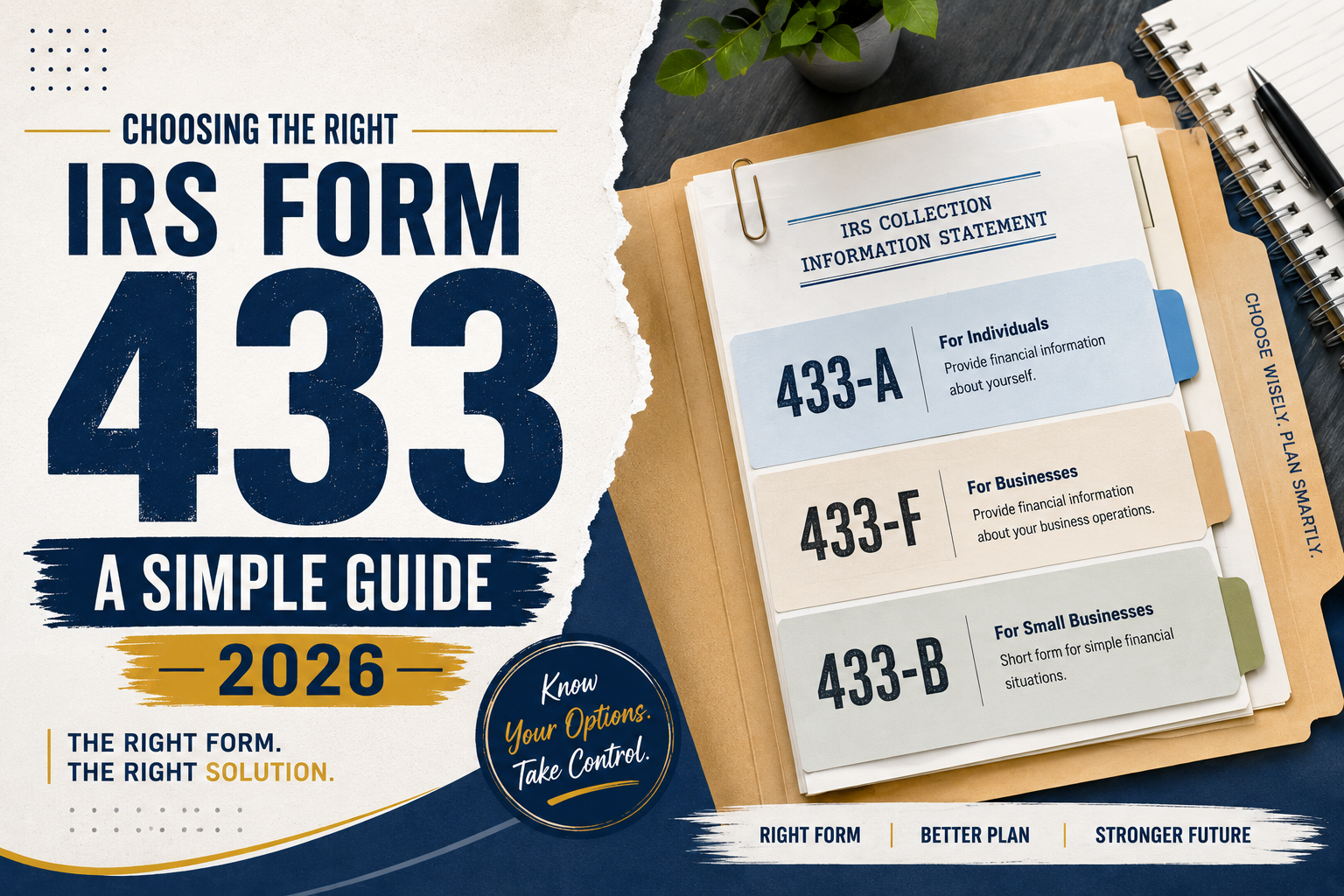
Choosing the Right IRS Form 433: A Simple 2026 Guide
If you’re trying to resolve IRS tax debt, chances are you’ve been asked to complete a Form 433. For many taxpayers, this is where confusion begins.
The IRS uses several versions of Form 433 to evaluate your financial situation, determine your ability to pay, and decide whether you qualify for payment plans, hardship relief, or an Offer in Compromise.
Choosing the wrong form can delay your case and slow down the resolution process.
Here’s a simple guide to understanding which Form 433 you may need in 2026.
What Is IRS Form 433?
Form 433 is a Collection Information Statement used by the IRS to gather detailed financial information.
The form helps the IRS evaluate:
- Your income
- Your expenses
- Your assets
- Your liabilities
- Your ability to pay outstanding tax debt
The specific version of Form 433 depends on two key factors:
- Whether the tax debt belongs to an individual or a business entity
- Whether you are applying for an Offer in Compromise (OIC)
Form 433-A: For Individuals and Sole Proprietors
Form 433-A is generally used when the IRS needs financial information from an individual taxpayer.
This form is commonly used by:
- Individual taxpayers
- Wage earners
- Self-employed individuals
- Sole proprietors
If you operate your business as a sole proprietorship, the IRS generally treats your business finances as part of your personal financial situation.
Because of this, sole proprietors typically use Form 433-A rather than Form 433-B.
Form 433-B: For Business Entities
Form 433-B is designed for separate business entities.
This form is generally used by:
- Corporations
- Partnerships
- LLCs taxed as corporations
- Certain other LLC structures
Because these businesses are separate legal and tax entities, the IRS evaluates the business’s finances independently from the owner’s personal finances.
If your tax debt belongs to the business itself, Form 433-B is often the appropriate form.
Form 433-A (OIC): For Personal Offers in Compromise
If you are applying for an Offer in Compromise to settle personal tax debt, you will generally use Form 433-A (OIC).
This form is commonly used by:
- Individuals
- Wage earners
- Self-employed taxpayers
- Sole proprietors
The IRS uses this version to calculate your reasonable collection potential and determine whether your offer amount is acceptable.
Form 433-B (OIC): For Business Offers in Compromise
Businesses seeking an Offer in Compromise generally use Form 433-B (OIC).
This form is specifically designed for:
- Corporations
- Partnerships
- LLCs classified as corporations
- Other qualifying business entities
Form 433-B (OIC) gathers detailed information about:
- Business assets
- Business income
- Business expenses
- Ownership structure
- Accounts receivable
- Available equity
It is used alongside Form 656 when a business is attempting to settle tax debt for less than the full amount owed.
One Important Rule for Sole Proprietors
This is one of the most common mistakes taxpayers make.
If your business is a sole proprietorship, you generally should not use Form 433-B (OIC).
Instead, the IRS instructs sole proprietors to use Form 433-A (OIC).
Because a sole proprietorship is not a separate tax entity from its owner, the IRS evaluates the business and personal finances together.
A Simple Decision Tree
If the tax debt belongs to you personally:
- Use Form 433-A
If you are submitting an Offer in Compromise for personal tax debt:
- Use Form 433-A (OIC)
If the tax debt belongs to a separate business entity:
- Use Form 433-B
If the business is submitting an Offer in Compromise:
- Use Form 433-B (OIC)
If the business is a sole proprietorship:
- Use Form 433-A or Form 433-A (OIC), not Form 433-B
Why Entity Classification Matters
The IRS evaluates collection alternatives differently depending on the taxpayer’s legal structure.
A sole proprietorship is generally treated as an extension of the owner.
Corporations and partnerships, however, are treated as separate entities for collection purposes.
Using the correct form helps ensure the IRS receives the financial information required to properly evaluate your case.
Common IRS Resolution Programs That Require Form 433
Form 433 is frequently required when requesting:
- Installment Agreements
- Partial Payment Installment Agreements
- Currently Not Collectible Status
- Offer in Compromise Programs
- Hardship Relief Requests
- Collection Appeals
Providing complete and accurate financial information is critical because the IRS uses these forms to determine your eligibility for relief.
Final Thoughts
Choosing the correct Form 433 is one of the first and most important steps when resolving IRS tax debt.
For most taxpayers, the decision comes down to two simple questions:
- Are you an individual or a separate business entity?
- Are you applying for an Offer in Compromise?
Individuals and sole proprietors generally use Form 433-A or Form 433-A (OIC), while corporations, partnerships, and certain LLCs generally use Form 433-B or Form 433-B (OIC).
Using the right form from the beginning can help avoid delays and improve the chances of a successful resolution.
Need Help Resolving IRS Tax Debt?
As a CPA firm, we help taxpayers navigate IRS collections, prepare Forms 433, negotiate installment agreements, evaluate Offer in Compromise eligibility, and develop strategies to resolve tax debt efficiently.
Whether you’re an individual taxpayer, self-employed professional, sole proprietor, or business owner, our team can help determine the best IRS resolution option for your situation.
Contact our CPA team today to schedule a consultation and get professional guidance on your IRS tax debt resolution strategy.
The right paperwork and strategy can make a significant difference when dealing with the IRS.