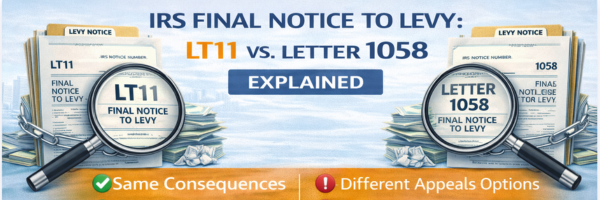
If you’ve received an LT11 or Letter 1058 from the IRS, you’re facing a critical stage in the tax collection process. Both notices serve as a “Final Notice of Intent to Levy and Notice of Your Right to a Hearing,” but taxpayers often wonder: what’s the difference between LT11 and Letter 1058, and what should you do if you receive one? Here’s what you need to know for 2025.
What Are LT11 and Letter 1058?
Both the LT11 and Letter 1058 are official IRS notices informing you that the IRS intends to levy (seize) your property or rights to property due to unpaid taxes. These notices are required by law under Internal Revenue Code (IRC) Section 6331(d) and Section 6330, which mandate that the IRS must provide written notice at least 30 days before taking levy action.
Key Points:
- Both notices serve as the IRS’s “Final Notice of Intent to Levy.”
- Both inform you of your right to request a Collection Due Process (CDP) hearing before the IRS can proceed with a levy.
- The IRS cannot seize your property until 30 days after issuing this notice and giving you the opportunity to appeal.
LT11 vs. Letter 1058: What’s the Difference?
LT11 and Letter 1058 are functionally equivalent. The main difference is administrative:
- LT11 is typically generated and sent by the IRS’s Automated Collection System (ACS).
- Letter 1058 is usually sent by a local IRS revenue officer or field office.
Both notices:
- Contain the same legal warnings and rights.
- Trigger the same 30-day period before the IRS can levy your assets.
- Provide instructions for paying your balance, requesting an installment agreement, or appealing the proposed levy.
Why two forms?
The IRS uses different systems to manage collections. ACS handles most routine cases and issues the LT11, while more complex or high-dollar cases handled by field offices use Letter 1058. Regardless of which you receive, your rights and the IRS’s authority are the same.
What Happens After You Receive an LT11 or Letter 1058?
You have 30 days from the date of the notice to take action before the IRS can levy your property. During this time, you can:
- Pay your balance in full to stop the levy process.
- Request an installment agreement if you can’t pay in full.
- Request a Collection Due Process (CDP) hearing by submitting Form 12153. This is your opportunity to dispute the tax or propose alternatives to levy, such as an offer in compromise or payment plan.
- Provide documentation if you believe you do not owe the tax or have already paid.
If you do not respond within 30 days, the IRS may proceed to levy your wages, bank accounts, Social Security benefits, or other property.
What Property Can the IRS Levy?
The IRS can levy a wide range of assets, including:
- Wages and other income
- Bank accounts
- Business and personal assets (including vehicles and real estate)
- State tax refunds
- Social Security benefits (with some limitations)
Some property is exempt from levy under IRC Section 6334, such as certain public assistance payments and a portion of wages.
Your Rights and Next Steps
Appeal Rights:
You have the right to a Collection Due Process (CDP) hearing. This is a formal process where you can challenge the levy, propose alternatives, or raise defenses such as financial hardship. To request a hearing, submit Form 12153 within 30 days of the notice date.
Installment Agreements:
If you owe less than $50,000, you may qualify for an online payment agreement. Setting up a payment plan can stop levy action.
Hardship Relief:
If a levy would cause significant financial hardship, you can request a release or modification of the levy by contacting the IRS or the Taxpayer Advocate Service.
What If You Ignore the Notice?
If you do not respond to the LT11 or Letter 1058, the IRS can proceed with levy action. This may include garnishing your wages, freezing your bank accounts, or seizing other property. The IRS may also file a Notice of Federal Tax Lien, which can affect your credit and ability to obtain loans.
Bottom Line
LT11 and Letter 1058 are both final warnings from the IRS before levy action.
- The difference is mainly administrative; your rights and obligations are the same.
- Act quickly—within 30 days—to resolve the debt, set up a payment plan, or request a hearing.
- If you need help, consult a tax professional or contact the IRS or Taxpayer Advocate Service.
Don’t ignore these notices—timely action can protect your assets and give you options to resolve your tax debt.