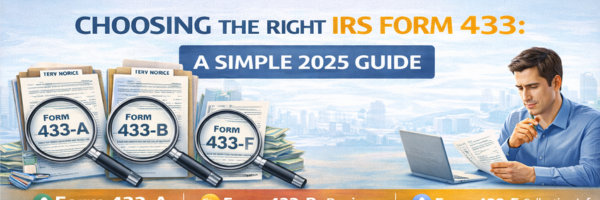
If you’re struggling to pay your tax debt or need to work out a payment arrangement with the IRS in 2025, you’ll likely encounter IRS Form 433. But with several versions—Form 433-A, 433-B, 433-F, and 433-A (OIC)—how do you know which one to use? This guide breaks down the differences and helps you choose the right form for your situation.
What Are IRS Form 433 Series Used For?
The IRS uses the Form 433 series to collect detailed financial information from taxpayers who:
- Want to set up a payment plan (installment agreement)
- Are requesting an Offer in Compromise (OIC) to settle for less than the full amount owed
- Need to demonstrate financial hardship (such as requesting “currently not collectible” status)
- Are facing enforced collection actions (like a levy or garnishment)
The information you provide helps the IRS determine your ability to pay and what type of relief or arrangement you may qualify for.
Which IRS Form 433 Do You Need?
1. Form 433-F: Collection Information Statement
Best for:
- Most individuals requesting a streamlined installment agreement (payment plan)
- Taxpayers seeking “currently not collectible” status
Features:
- Shortest and simplest of the 433 forms
- Requests basic information about your income, expenses, assets, and debts
When to use:
- If you owe less than $50,000 and are applying for a payment plan online or by phone
- If the IRS specifically requests it during a collection process
2. Form 433-A: Collection Information Statement for Wage Earners and Self-Employed Individuals
Best for:
- Individuals with more complex financial situations
- Self-employed individuals (sole proprietors)
- Those seeking a non-streamlined installment agreement or hardship relief
Features:
- More detailed than 433-F
- Requires information about personal assets, income, expenses, and (if self-employed) business details
When to use:
- If you owe more than $50,000
- If you’re self-employed or have significant assets
- If the IRS requests a full financial disclosure
3. Form 433-B: Collection Information Statement for Businesses
Best for:
- Corporations, partnerships, LLCs, and other business entities (not sole proprietors)
Features:
- Collects information about business assets, income, expenses, and liabilities
When to use:
- If your business owes taxes and you’re seeking a payment arrangement or hardship relief
4. Form 433-A (OIC) and 433-B (OIC): Offer in Compromise Applications
Best for:
- Individuals (433-A (OIC)) or businesses (433-B (OIC)) applying for an Offer in Compromise
Features:
- Similar to Forms 433-A and 433-B, but tailored for OIC requests
- Requires detailed documentation of assets, income, expenses, and liabilities
When to use:
- Only when submitting Form 656, Offer in Compromise, to settle your tax debt for less than the full amount.
How to Choose the Right Form: Quick Reference
| Your Situation | Use This Form |
|---|---|
| Individual, simple finances, payment plan | 433-F |
| Individual, complex finances/self-employed | 433-A |
| Business entity (not sole proprietor) | 433-B |
| Applying for Offer in Compromise (individual) | 433-A (OIC) |
| Applying for Offer in Compromise (business) | 433-B (OIC) |
Tips for Completing IRS Form 433
- Be thorough and accurate: The IRS will verify your information. Incomplete or inaccurate forms can delay your request or result in denial.
- Gather documentation: You’ll need recent pay stubs, bank statements, proof of expenses, and asset information.
- Include all household income: Even if only one spouse owes taxes, the IRS may require information about the entire household’s finances.
- Update as needed: If your financial situation changes, you may need to submit a new or updated Form 433.
What Happens After You Submit Form 433?
The IRS will review your financial information to determine:
- If you qualify for a payment plan, Offer in Compromise, or hardship status
- What payment amount you can reasonably afford
- Whether to suspend collection actions
If you disagree with the IRS’s decision, you may have appeal rights or can request a review.
Bottom Line
Choosing the right IRS Form 433 is essential for getting the tax relief or payment arrangement you need in 2025.
- Use 433-F for simple cases and payment plans.
- Use 433-A or 433-B for more complex or business situations.
- Use the OIC versions if you’re applying to settle your debt for less.
If you’re unsure, consult a tax professional or contact the IRS for guidance. Acting quickly and providing complete information can help you resolve your tax debt and avoid enforced collection actions.