Who Qualifies for Education Tax Credits in 2026?
Federal education tax credits can help reduce the cost of college, graduate school, and career-related education. However, not everyone qualifies, and each credit has its own eligibility rules.
For the 2026 tax year, taxpayers generally may claim either the American Opportunity Tax Credit (AOTC) or the Lifetime Learning Credit (LLC), provided they meet the IRS requirements. Beginning with 2026 returns, taxpayers must also satisfy new identification requirements before either credit can be claimed.
Here’s how to determine if you qualify.
The Three Basic Requirements
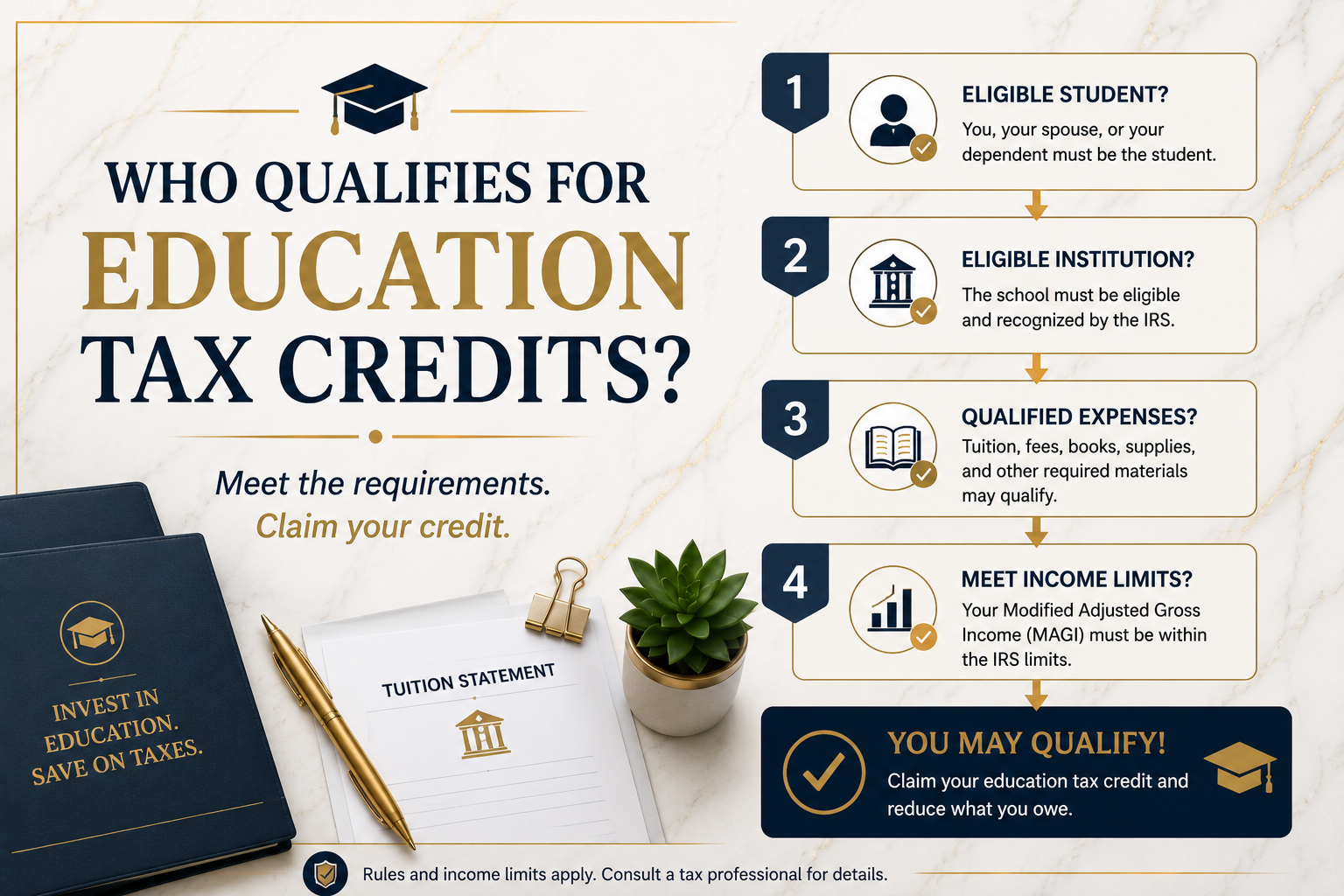
To qualify for a federal education tax credit, three general requirements must be met:
- Qualified education expenses must be paid.
- The expenses must be for an eligible student.
- The eligible student must be the taxpayer, the taxpayer’s spouse, or a dependent claimed on the taxpayer’s return.
If any one of these requirements is not satisfied, the education credit generally cannot be claimed.
Who Cannot Claim an Education Credit?
Regardless of which education credit you are considering, you generally are not eligible if:
- You file your tax return as Married Filing Separately.
- You are a nonresident alien who does not elect to be treated as a U.S. resident for tax purposes.
- Your modified adjusted gross income (MAGI) exceeds the allowable limits.
- You are claimed as a dependent on another taxpayer’s return.
Meeting these basic filing requirements is the first step toward claiming either education credit.
Income Limits for 2026
Both the American Opportunity Credit and the Lifetime Learning Credit use the same modified adjusted gross income (MAGI) phaseout ranges.
For 2026, the credits begin to phase out when MAGI exceeds:
- $80,000 for Single or Head of Household filers
- $160,000 for Married Filing Jointly
The credits are completely phased out once MAGI reaches:
- $90,000 for Single or Head of Household
- $180,000 for Married Filing Jointly
If your income exceeds these limits, you generally cannot claim either education credit.
Who Qualifies for the American Opportunity Tax Credit?
The American Opportunity Tax Credit has stricter eligibility requirements because it provides the larger tax benefit.
Generally, an eligible student must:
- Be pursuing a degree, certificate, or other recognized educational credential.
- Be enrolled at least half-time for at least one academic period during the year.
- Not have completed the first four years of postsecondary education before the tax year begins.
- Not have claimed the American Opportunity Credit for more than four prior tax years.
- Not have a federal or state felony drug conviction at the end of the tax year.
If these requirements are met, the American Opportunity Tax Credit generally provides the greatest education tax savings.
Who Qualifies for the Lifetime Learning Credit?
The Lifetime Learning Credit is available to a much broader group of students.
Unlike the American Opportunity Credit, the student:
- Does not need to pursue a degree.
- Does not need to attend school at least half-time.
- May take just one qualifying course.
- May be enrolled in graduate school.
- May take classes to improve or acquire job skills.
- Is not disqualified because of a felony drug conviction.
This flexibility makes the Lifetime Learning Credit a valuable option for working professionals and lifelong learners.
Qualified Education Expenses
Both education credits require qualified education expenses, but the rules differ slightly.
For the American Opportunity Tax Credit, qualified expenses generally include:
- Tuition
- Required enrollment fees
- Books
- Course materials
- Required supplies
Books and required course materials generally qualify even if purchased from a source other than the educational institution.
For the Lifetime Learning Credit, qualified expenses generally include:
- Tuition
- Required enrollment fees
- Books and supplies only if they must be purchased directly from the educational institution as a condition of enrollment
Education expenses paid using tax-free assistance—such as scholarships, Pell Grants, veterans’ educational assistance, or employer-provided educational assistance—generally must be excluded when calculating either credit.
Special Rules for Dependents
If the student is claimed as your dependent, only the taxpayer claiming that dependent may claim the education credit.
Even if the student personally pays some of the qualified education expenses, those payments are generally treated as having been made by the taxpayer claiming the dependent.
New Filing Requirements Beginning in 2026
Beginning with returns filed for tax years after December 31, 2025, additional identification requirements apply.
Taxpayers generally must include:
- A valid Social Security Number (SSN) for the taxpayer.
- A valid SSN for the spouse if filing jointly.
- The name and valid SSN of any qualifying student who is not the taxpayer or spouse.
- The Employer Identification Number (EIN) of the eligible educational institution.
The Social Security Number generally must be valid for work and issued before the due date of the tax return.
In most situations, taxpayers should also receive Form 1098-T from the educational institution unless a qualifying IRS exception applies.
Which Education Credit Should You Choose?
If the student qualifies for the American Opportunity Tax Credit, it will usually provide the larger tax benefit because:
- It offers up to $2,500 per eligible student.
- A portion of the credit may be refundable.
- Qualified course materials receive broader treatment.
The Lifetime Learning Credit is often the better choice when:
- The student has already used the American Opportunity Credit for four years.
- The student is attending graduate school.
- The student is enrolled less than half-time.
- The education is for continuing education or job skills training.
Final Thoughts
Qualifying for an education tax credit in 2026 requires more than simply paying tuition. Taxpayers must meet income limits, satisfy filing requirements, pay qualified education expenses, and ensure the student meets the eligibility rules for the specific credit being claimed.
The American Opportunity Tax Credit generally provides greater tax savings but has stricter eligibility requirements, while the Lifetime Learning Credit offers broader eligibility for a wider range of educational programs.
Carefully reviewing these rules before filing can help maximize your education tax benefits and reduce the risk of IRS processing delays.
Need Help Claiming Education Tax Credits?
As a CPA firm, we help students, parents, and families maximize education tax benefits while ensuring full compliance with current IRS requirements.
Whether you’re claiming the American Opportunity Tax Credit, the Lifetime Learning Credit, or planning future education expenses, our experienced CPA team can help you determine your eligibility and maximize every available tax savings opportunity.
Contact our CPA team today to schedule a consultation and make the most of your education tax benefits in 2026 and beyond.
Professional tax planning today can help make higher education more affordable tomorrow.