Home Sale Tax Exclusion in 2026: What Homeowners Need to Know
Selling your home can create a significant federal tax consequence—but many homeowners may qualify to exclude a substantial portion of the gain.
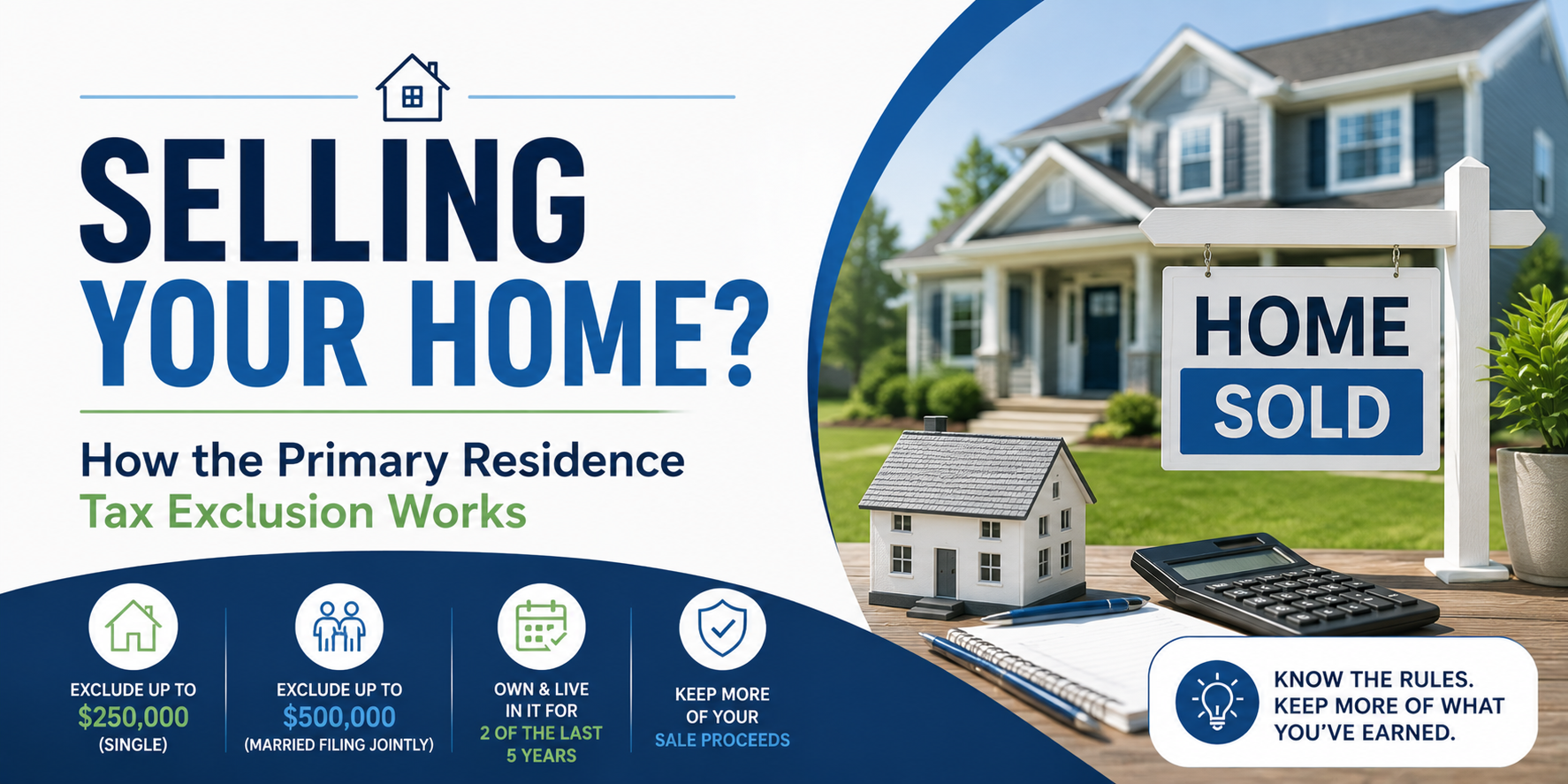
Under IRC Section 121, eligible taxpayers may exclude up to $250,000 of gain from the sale of a principal residence, or up to $500,000 for certain married couples filing jointly.
The key point is that the exclusion applies to gain, not the total sale proceeds.
Here’s what homeowners should understand about the 2026 home sale exclusion rules.
What Is the Section 121 Home Sale Exclusion?
IRC Section 121 generally allows taxpayers to exclude gain from the sale of a principal residence if they satisfy specific ownership and use requirements.
During the five-year period ending on the date of sale, you generally must have:
- Owned the home for periods totaling at least two years, and
- Used the home as your principal residence for periods totaling at least two years.
The ownership and use periods do not have to be continuous, and they do not necessarily have to occur at the same time.
How Much Gain Can You Exclude?
The maximum exclusion is generally:
- $250,000 for an eligible individual
- $500,000 for certain married couples filing jointly
To qualify for the full $500,000 exclusion on a joint return, generally:
- Either spouse must satisfy the ownership test.
- Both spouses must independently satisfy the use test.
- Neither spouse may be disqualified by the prior-sale lookback rule.
The Exclusion Applies to Gain—Not the Selling Price
One of the most common misunderstandings is assuming the exclusion applies to the amount received from the sale.
It does not.
Your gain is generally calculated as:
Amount Realized − Adjusted Basis = Gain
Your amount realized generally includes the selling price reduced by qualifying selling expenses.
Your adjusted basis generally starts with your original purchase price and may be adjusted for items such as:
- Capital improvements
- Certain acquisition costs
- Depreciation
- Casualty adjustments
- Other required basis changes
Only the qualifying gain—up to the applicable Section 121 limit—may be excluded.
What Counts as Your Principal Residence?
You generally can have only one principal residence at a time.
If you own or use multiple homes, the IRS considers the overall facts and circumstances.
Relevant factors may include:
- Where you spend most of your time
- Your employment location
- Where your family lives
- Your tax return address
- Your driver’s license and vehicle registration address
- Your mailing address
- Banking relationships
- Religious, recreational, and community affiliations
No single factor automatically determines which property is your principal residence.
The Two-Year Lookback Rule
Even if you meet the ownership and use tests, the exclusion generally is not available if you excluded gain from another principal-residence sale during the two-year period ending on the current sale date.
This prevents taxpayers from repeatedly claiming the exclusion on frequent home sales.
Can You Qualify for a Partial Exclusion?
Yes.
Even if you do not satisfy the full two-year ownership or use requirements, you may qualify for a reduced exclusion if the sale primarily resulted from certain qualifying circumstances, including:
- A change in employment location
- Health reasons
- Certain unforeseen circumstances
The reduced exclusion is generally based on the portion of the two-year period that you satisfied the applicable requirements.
For example, the calculation generally compares your qualifying ownership, residence, or post-prior-sale period with 730 days or 24 months.
Nonqualified Use Can Reduce the Exclusion
Special rules apply when a home has periods of nonqualified use after 2008.
Nonqualified use generally refers to periods when the property was not used as your principal residence.
A portion of the gain may become taxable based on the ratio of:
Nonqualified Use Period ÷ Total Ownership Period
However, several exceptions may apply, including certain:
- Rental periods after the taxpayer’s final use as a principal residence
- Periods of qualified official extended duty
- Temporary absences of up to an aggregate two years under qualifying circumstances
Depreciation Generally Cannot Be Excluded
If you claimed—or were entitled to claim—depreciation on the property for periods after May 6, 1997, the portion of gain attributable to that depreciation generally cannot be excluded under Section 121.
That gain is generally recognized and may be taxed as unrecaptured Section 1250 gain.
This commonly affects homeowners who:
- Previously rented the home
- Operated a business from part of the property
- Claimed depreciation deductions for qualifying business use
Business and Rental Use of Your Home
Using part of your property for rental or business purposes can affect the home sale exclusion.
If the business or rental portion is physically separate from your dwelling—such as:
- A detached building
- A separate apartment
- Business acreage
you may generally need to allocate:
- Sales price
- Adjusted basis
- Selling expenses
between the residential and nonresidential portions.
Gain on a separate nonresidential portion generally does not qualify for the Section 121 exclusion unless that portion independently satisfies the residential-use requirements.
What If the Business Area Is Inside the Home?
If the business or rental area is within the same dwelling unit as your principal residence, a separate gain allocation generally is not required solely because of that use.
However, any gain attributable to depreciation allowed or allowable after May 6, 1997 generally remains taxable.
Special Rules May Apply
Section 121 also contains special rules for certain situations, including:
- Surviving spouses
- Transfers between spouses or former spouses
- Divorce arrangements
- Vacant land sold in connection with the residence
- Involuntary conversions
- Certain military and government personnel
- Qualifying periods in licensed care facilities
- Sales of certain remainder interests
Because these rules can materially affect eligibility, unusual ownership or occupancy situations should be reviewed carefully before filing.
Like-Kind Exchange Restrictions
The Section 121 exclusion generally is unavailable for property acquired through a qualifying nonrecognition like-kind exchange if the property is sold during the five-year period beginning on the date of acquisition.
Special restrictions can therefore apply when residential property has previously been involved in a Section 1031 transaction.
Do You Have to Report the Sale?
You generally do not need to report the sale of your principal residence if:
- Your entire gain qualifies for exclusion, and
- You did not receive Form 1099-S.
Reporting is generally required if:
- You have taxable gain.
- You received Form 1099-S.
- You choose to report otherwise excludable gain.
Taxable home sale gain is generally reported using:
- Form 8949
- Schedule D
A separate rental or business portion may also require Form 4797.
Records You Should Keep
To support your gain calculation and Section 121 exclusion, keep records such as:
- Original purchase documents
- Closing statements
- Capital improvement receipts
- Depreciation schedules
- Rental or business-use records
- Dates of ownership and occupancy
- Selling expenses
- Form 1099-S, if issued
Accurate basis records help you avoid overstating your taxable gain.
Key Takeaways
✔ Section 121 generally allows qualifying homeowners to exclude up to $250,000 of gain.
✔ Certain married couples filing jointly may qualify to exclude up to $500,000.
✔ You generally must satisfy the two-out-of-five-year ownership and use tests.
✔ The exclusion applies to gain, not the total selling price.
✔ A reduced exclusion may be available for certain employment, health, or unforeseen circumstances.
✔ Post-2008 nonqualified use can reduce the amount of gain eligible for exclusion.
✔ Depreciation after May 6, 1997 generally cannot be excluded.
✔ Separate business or rental portions may require allocation of basis and sale proceeds.
✔ Form 1099-S, taxable gain, or other circumstances may trigger reporting requirements.
Final Thoughts
The Section 121 home sale exclusion is a significant federal tax benefit for many homeowners, but qualifying requires more than simply selling a home you’ve lived in.
Ownership history, occupancy, previous home sales, rental or business use, depreciation, nonqualified-use periods, and the way the property was acquired can all affect how much gain is actually tax-free.
Reviewing these issues before closing a sale can help you properly calculate adjusted basis, claim the exclusion you qualify for, and reduce the risk of unexpected taxes.
Need Help With the Tax Consequences of Selling Your Home?
Our CPA team helps homeowners, real estate investors, landlords, and business owners calculate taxable gain, determine eligibility for the Section 121 exclusion, analyze rental and business-use issues, and properly report real estate transactions.
Contact our CPA team to schedule a consultation and understand the potential tax consequences before selling your property.
Sources
- 26 U.S.C. § 121, Exclusion of gain from sale of principal residence
- IRS Publication 523, Selling Your Home
- IRS Topic No. 701, Sale of Your Home
About this article: This article was generated with the help of artificial intelligence using Ask Blue J, an AI tax research tool, and reviewed by Accu-Tax before publishing. It is general information as of October 5, 2026, not tax, legal or accounting advice for your situation. Tax rules change often. Please contact a tax professional for personalized advice before acting on anything here.