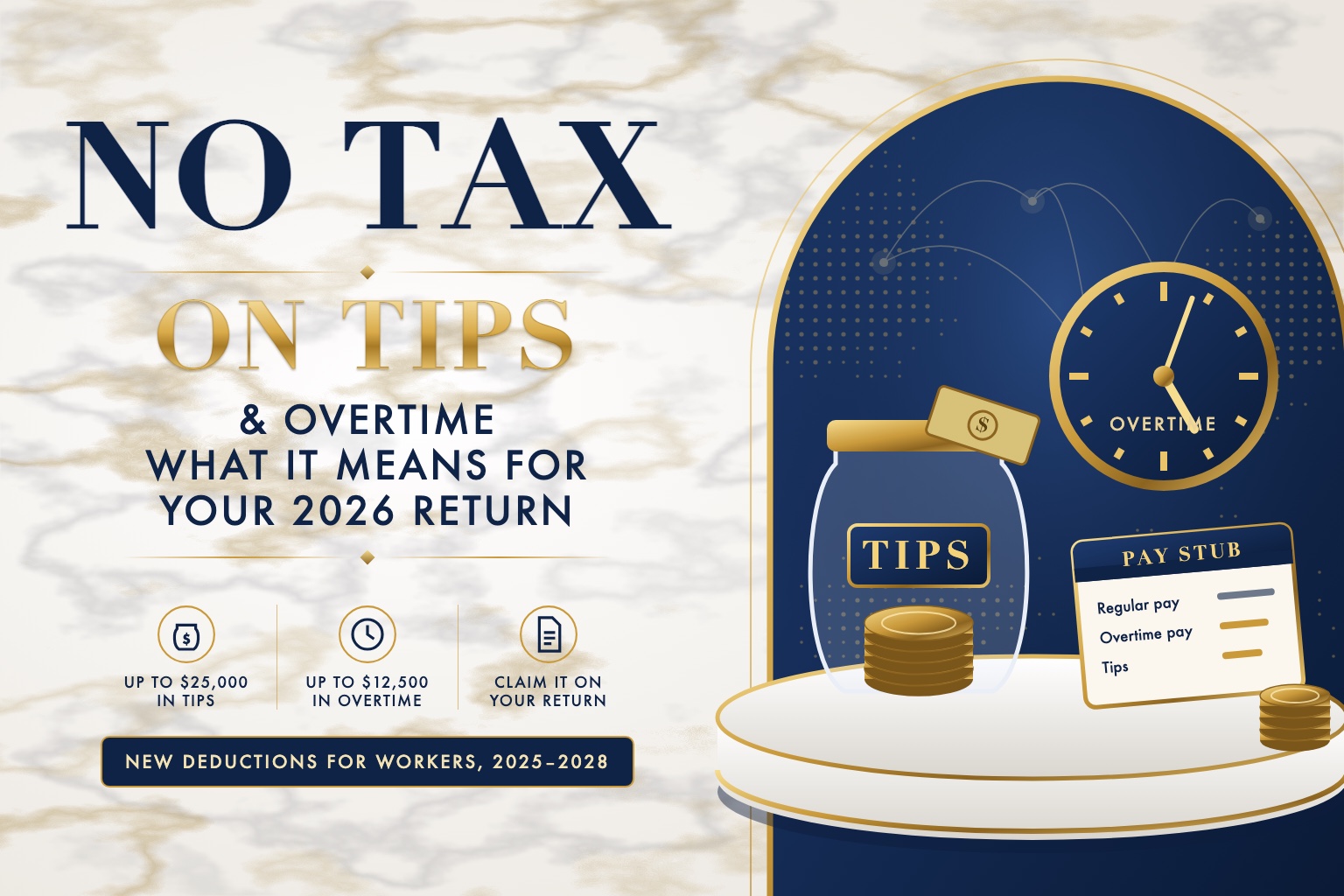
No Tax on Tips and Overtime: What It Means for Your 2026 Return
If you wait tables in St. Petersburg, tend bar in Clearwater, style hair in Largo or pick up overtime shifts at a Tampa hospital, two new federal deductions could lower your tax bill when you file your 2026 return in early 2027.
The One Big Beautiful Bill Act created a deduction for qualified tips (Internal Revenue Code Section 224) and a deduction for qualified overtime pay (Section 225). They apply for tax years 2025 through 2028.
The headlines say “no tax on tips” and “no tax on overtime,” but the actual rules are narrower. Here’s what workers should know before filing season.
The Short Version
- Tips: deduct up to $25,000 of qualified tips per return.
- Overtime: deduct up to $12,500 of qualified overtime pay, or $25,000 on a joint return.
- Income limit: both deductions shrink once modified adjusted gross income (MAGI) passes $150,000, or $300,000 for married couples filing jointly.
- No itemizing needed: you can claim them whether you take the standard deduction or itemize.
- Income tax only: tips and overtime are still subject to Social Security and Medicare taxes.
How the Tips Deduction Works
A tip generally counts as a qualified tip only if all of these are true:
- It’s a cash tip. That includes tips paid in cash or added to a card payment, and tips an employee receives through a tip-sharing or tip pool arrangement.
- It’s voluntary. The customer decides whether to tip and how much. A mandatory service charge, such as an automatic gratuity on a large party, generally doesn’t count.
- It’s earned in a tipped occupation. The job must be on the Treasury and IRS list of occupations that customarily and regularly received tips on or before December 31, 2024. Examples include servers, bartenders, hairstylists and barbers, personal trainers and certain gig and delivery workers.
Tips earned in certain professional service businesses (such as health, law, accounting, consulting and financial services) generally don’t qualify. IRS Notice 2025-69 provides transition relief for this rule while the regulations are finalized.
Self-employed and gig workers
If you earn tips as an independent contractor (for example, as a delivery driver or freelance stylist), the deduction can’t be more than the net profit from that business. In other words, the tips deduction can’t create or increase a business loss.
Example
Say a single server earns $32,000 in wages and $28,000 in qualified tips, with MAGI of $60,000. Because her income is below $150,000, she may deduct the maximum $25,000 of tips. The other $3,000 of tips stays taxable.
How the Overtime Deduction Works
This is where many workers will be surprised. The deduction does not cover your full overtime paycheck. It covers only the overtime premium required by the federal Fair Labor Standards Act (FLSA): the “half” in time-and-a-half.
Example
Say your regular rate is $20 an hour and you work 10 hours of overtime a week for 50 weeks.
- Your overtime rate is $30 an hour, so you earn $15,000 of overtime pay.
- The qualified overtime is only the $10-an-hour premium: $10 × 10 hours × 50 weeks = $5,000.
- The other $10,000 is regular straight-time pay and stays taxable.
What generally doesn’t qualify
- Overtime required only by a union contract, an employment agreement or state law, and not by the FLSA
- Weekend or holiday premium pay the FLSA doesn’t require
- The extra amount of double-time pay above what the FLSA requires
- Pay for salaried employees who are exempt from FLSA overtime rules
The Income Phase-Out
Each deduction is reduced by $100 for every $1,000 of MAGI above $150,000 ($300,000 if married filing jointly).
For example, a single filer with $180,000 of MAGI is $30,000 over the limit, so the deduction drops by $3,000. If that person had $25,000 of qualified tips, the tips deduction would be $22,000.
Who Can Claim It
- You need a valid Social Security number that’s valid for employment, and it must be on the return.
- Married couples must file jointly. Married filing separately can’t claim either deduction.
- You claim both deductions on Schedule 1-A of Form 1040, along with the other new deductions from the 2025 law.
What’s Different for 2026 Returns
For 2025, the IRS let workers use pay stubs, tip logs and their own reasonable estimates because employers’ forms hadn’t caught up yet. That relief was for 2025 only.
For 2026, your employer reports the information directly:
- Tips: your Form W-2 should show your reported cash tips and your tipped occupation. Independent contractors should see tips and occupation on their Form 1099.
- Overtime: your Form W-2 should show qualified overtime in Box 12, Code TT. Contractors who are FLSA-covered may see it on Form 1099-MISC or 1099-NEC.
Under the IRS’s current overtime guidance, you generally can’t claim more qualified overtime for 2026 than your W-2 reports, unless your employer issues a corrected W-2 (Form W-2c). If the amount looks wrong, ask your employer early in the year.
What About Florida?
Florida has no state income tax on individuals, so for most of our clients these are purely federal deductions. There’s no state return to adjust.
Steps to Take Now
- Report all of your tips to your employer each month. Tips that were never reported are hard to support.
- Keep your own tip log and pay stubs through the end of the year.
- When your 2026 W-2 arrives in January, check the tips, occupation and Box 12 Code TT amounts.
- If you’re near the income limits, plan with your tax preparer before year-end.
- Review your withholding for 2027 so you don’t overpay all year. See our withholding tips.
Key Takeaways
✔ Qualified tips: deduct up to $25,000 per return for tax years 2025–2028.
✔ Qualified overtime: deduct up to $12,500, or $25,000 on a joint return. Only the FLSA premium counts.
✔ Both phase out above $150,000 of MAGI ($300,000 joint).
✔ Available whether or not you itemize; claimed on Schedule 1-A.
✔ A valid SSN is required, and married couples must file jointly.
✔ For 2026, the amounts on your W-2 or 1099 generally control. Check them in January.
✔ Social Security and Medicare taxes still apply.
Final Thoughts
For servers, bartenders, salon workers and hourly employees who pick up extra shifts, these deductions can make a real difference. But “no tax on tips and overtime” doesn’t mean every tip or overtime dollar is tax-free. The occupation list, the FLSA premium rule, the income phase-out and the 2026 reporting rules all affect how much you can deduct.
For more on what changed this year, see 2026 Tax Changes Every Taxpayer Should Know and Should You Itemize in 2026?
Questions About Your Tips or Overtime?
Our team can review your W-2s, tip records and overtime pay, figure out which deductions you qualify for, and prepare your return. Schedule a call to get started.
Sources
- Internal Revenue Code §224 (qualified tips) and §225 (qualified overtime compensation)
- IRS Notice 2025-69
- IRS: Schedule 1-A, Additional Deductions – what to know about the new form
- IRS: What to know about the No Tax on Overtime deduction
- IRS Fact Sheet FS-2026-13: Updated Q&A on the qualified overtime deduction (August 2026)
- Treasury/IRS guidance on tips and overtime for tax year 2025