401(k) Auto-Enrollment: What the Final Rules Mean for Small Businesses
If you started a 401(k) for your business recently, or you are thinking about one, there is a rule you need to know about: most new plans must enroll employees automatically.
On November 17, 2026, the Treasury Department and the IRS issued final regulations on this SECURE 2.0 requirement (IR-2026-141). Here is what the rule requires, which businesses are exempt and when the final rules apply.
Which Plans Must Auto-Enroll
Section 414A of the Internal Revenue Code says a 401(k) or 403(b) plan established after December 29, 2022 (the day SECURE 2.0 became law) must automatically enroll eligible employees, unless an exception applies. The statute took effect for plan years beginning after December 31, 2024.
Plans adopted before December 29, 2022 are generally grandfathered. A business that joins a multiple employer plan after that date generally does not get the grandfather rule.
What Automatic Enrollment Requires
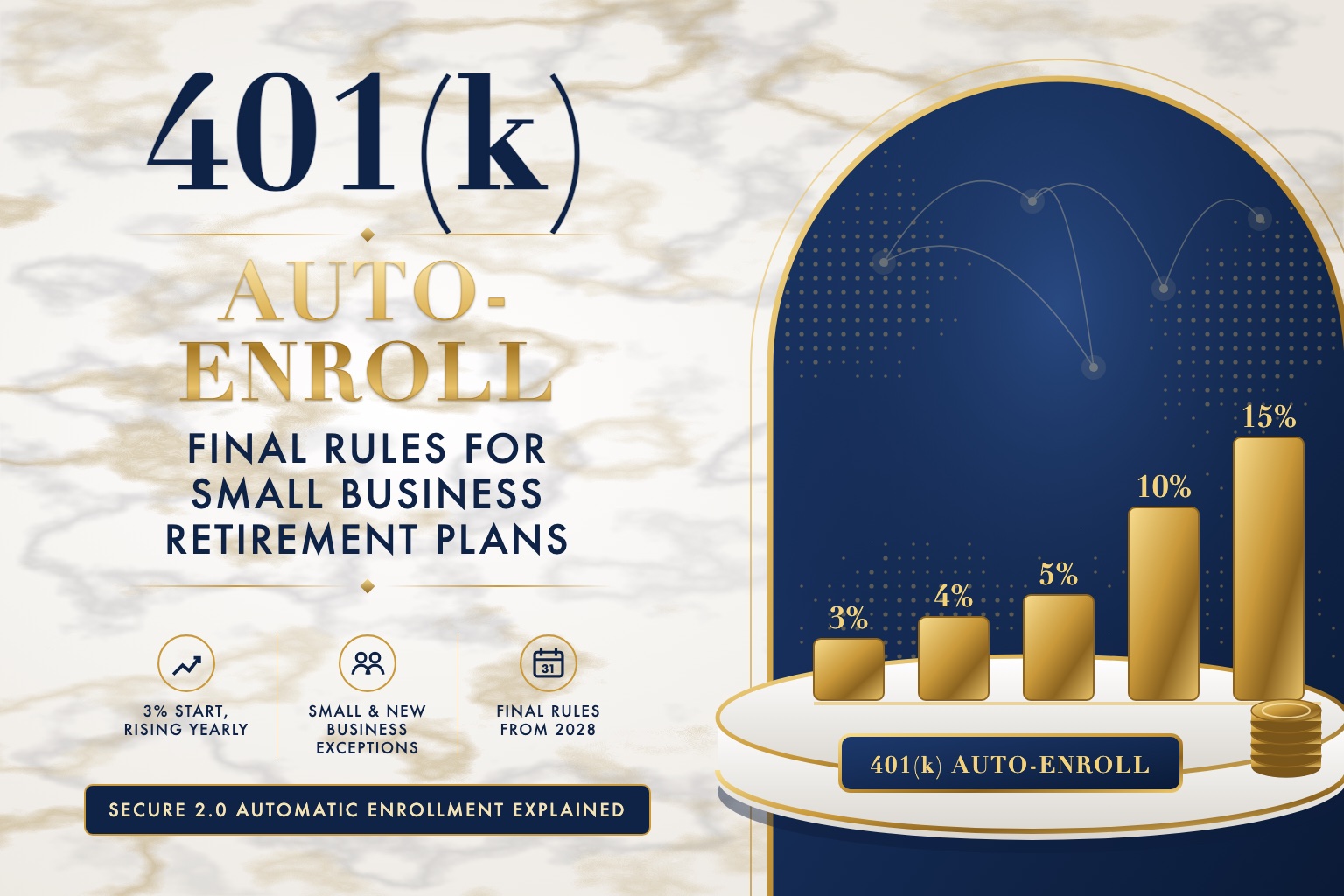
- Starting rate: employees are enrolled at a uniform rate of at least 3% and no more than 10% of pay.
- Yearly increase: after the initial period, the rate goes up by at least 1 percentage point each year until it reaches at least 10%. It can never be raised above 15%.
- Employee choice: employees can opt out or pick a different rate at any time.
- 90-day withdrawal: an employee can ask for a refund of automatic contributions within 90 days after the first one. The refund is taxable income but is not subject to the 10% early withdrawal tax.
- Default investment: money for employees who do not choose investments goes into a qualified default investment, under Department of Labor rules.
- Notice: employees get a written notice explaining the rules, generally 30 to 90 days before each plan year.
For the yearly contribution caps that still apply on top of these rules, see our post on 2026 401(k) and IRA contribution limits.
Who Is Exempt
- New businesses: while the business (and any predecessor) has existed for less than 3 years.
- Small businesses: until the first plan year that begins at least 12 months after the end of the first tax year in which the business normally employed more than 10 employees. The final rules say that once the requirement applies, it keeps applying even if headcount later drops.
- SIMPLE 401(k) plans, governmental plans and church plans.
- Plans established before December 29, 2022.
In counting employees, the final rules look at the number of employees the business normally employs, and related businesses under common control are generally counted together.
When the Final Rules Apply
The final regulations take effect January 19, 2027, and generally apply to plan years beginning after December 31, 2027. For plan years beginning after December 31, 2024 and before that date, a plan is treated as compliant if it follows a reasonable, good-faith reading of the statute (Federal Register, 91 FR 74090).
In plain terms, a covered plan should already be auto-enrolling now. The final rules give plan sponsors until the 2028 plan year (for calendar-year plans) to match every detail.
Example: Say a Tampa Bay design firm opened in 2019, started a 401(k) in 2024, and has had 14 employees for years. The plan was set up after December 29, 2022, the business is more than 3 years old, and it has more than 10 employees, so automatic enrollment generally applies. If the same firm had 8 employees, the small-business exception would generally apply until it grows past 10. (This is a hypothetical example.)
What Business Owners Should Do Now
- Find out when your 401(k) or 403(b) plan was first adopted.
- Count employees for each recent tax year, including related businesses.
- Ask your plan provider whether automatic enrollment is turned on, at what rate, and how the yearly increase is set.
- Check that payroll matches the plan: new hires should start at the default rate unless they choose otherwise.
- Budget for higher employer matching costs as more employees participate. Our post on how employee benefits are taxed covers the tax side of benefits.
Key Takeaways
✔ Most 401(k) and 403(b) plans set up after December 29, 2022 must auto-enroll employees.
✔ The default rate starts at 3% to 10% and rises at least 1 point a year to at least 10%, capped at 15%.
✔ Businesses under 3 years old, businesses with 10 or fewer employees, SIMPLE 401(k), church and governmental plans are exempt.
✔ The final rules generally apply to plan years beginning after December 31, 2027; until then, a good-faith reading of the law applies.
Final Thoughts
Automatic enrollment is mostly handled by your plan provider and payroll system, but the business owner is responsible for getting it right. The most common problems are a plan that never turned the feature on and a business that outgrew the small-business exception without anyone noticing.
If you are setting up a new plan, building automatic enrollment in from day one is usually simpler than fixing it later.
Need Help With Retirement Plan Decisions?
Accu-Tax helps small business owners compare retirement plan options and plan for the tax side of offering benefits. Schedule a call to talk through your situation.
Sources
- 26 U.S.C. § 414A, Requirements related to automatic enrollment
- Federal Register: Automatic Enrollment Requirements Under Section 414A (final regulations, Nov. 18, 2026)
- IRS News Release IR-2026-141
About this article: This article was generated with the help of artificial intelligence using Ask Blue J, an AI tax research tool, and reviewed by Accu-Tax before publishing. It is general information as of November 18, 2026, not tax, legal or accounting advice for your situation. Tax rules change often. Please contact a tax professional for personalized advice before acting on anything here.