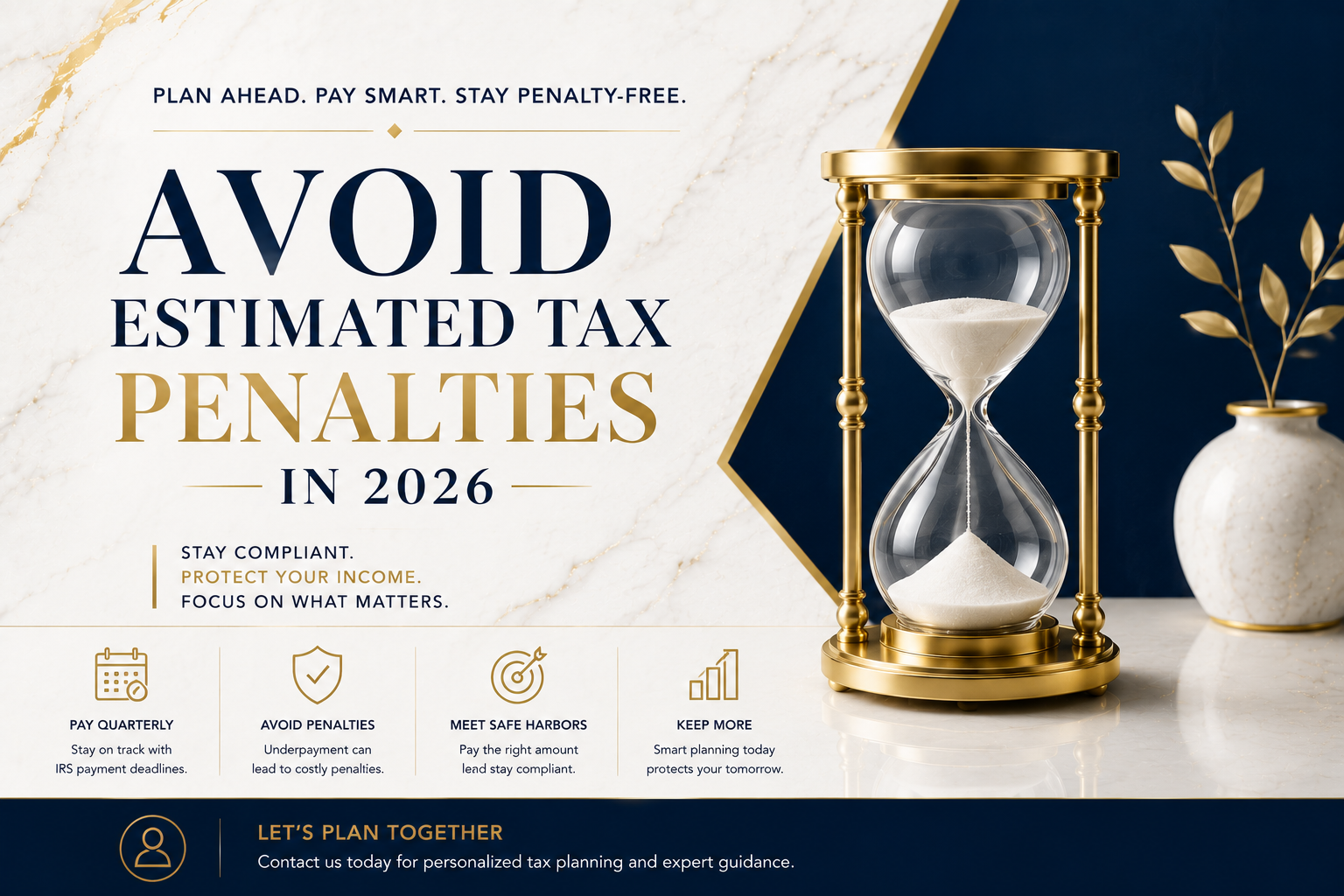
How to Avoid Estimated Tax Penalties in 2026
If you earn income that isn’t subject to tax withholding—such as self-employment income, rental income, investment income, or other non-wage earnings—you may need to make quarterly estimated tax payments. Paying too little or missing payment deadlines can result in IRS underpayment penalties.
Fortunately, the IRS provides several safe harbor rules that can help you avoid these penalties.
When Are Estimated Tax Payments Required?
Generally, you may need to make estimated tax payments if you expect to owe at least $1,000 in federal tax after subtracting withholding and refundable tax credits.
The IRS determines whether you’ve prepaid enough tax during the year by applying its estimated tax safe harbor rules.
The IRS Safe Harbor Rules
You can generally avoid an estimated tax penalty if you meet any of the following requirements:
- Your remaining tax after withholding and refundable credits is less than $1,000.
- You pay at least 90% of your total 2026 tax liability through withholding and estimated tax payments.
- You pay at least 100% of your 2025 tax liability.
- If your 2025 adjusted gross income exceeded $150,000 (or $75,000 if Married Filing Separately), you pay at least 110% of your 2025 tax liability.
- You had no federal tax liability in 2025, your return covered a full 12 months, and you were a U.S. citizen or resident for the entire year.
Meeting one of these safe harbor rules generally protects you from estimated tax underpayment penalties, even if you still owe additional tax when you file your return.
2026 Quarterly Payment Deadlines
For most calendar-year taxpayers, estimated tax payments are generally due on:
- April 15, 2026
- June 15, 2026
- September 15, 2026
- January 15, 2027
If you file your 2026 federal income tax return by January 31, 2027 and pay your balance in full, you generally do not have to make the January 15 estimated payment.
Increase Withholding Instead of Making Estimated Payments
One strategy many taxpayers overlook is increasing federal income tax withholding from wages, pensions, or certain retirement distributions.
Unlike estimated tax payments, withholding is generally treated as though it was paid evenly throughout the year—even if the withholding occurs later in the year.
For many taxpayers, adjusting withholding can be an effective way to reduce or eliminate estimated tax penalties.
What If Your Income Fluctuates?
If your income varies significantly during the year, you may benefit from using the Annualized Income Installment Method.
This method allows estimated tax payments to better reflect when income is actually earned and may reduce or eliminate penalties for:
- Seasonal businesses
- Freelancers
- Commission-based professionals
- Business owners with uneven income
When the IRS May Waive a Penalty
The IRS may waive an estimated tax penalty if the underpayment resulted from:
- A casualty or federally declared disaster.
- Other unusual circumstances where imposing the penalty would be inequitable.
- Retirement after age 62.
- A disability that contributed to the underpayment.
Taxpayers requesting a waiver generally must provide supporting documentation and an explanation of the circumstances.
Special Rules for Certain Taxpayers
Different estimated tax rules may apply to:
- Farmers and fishermen
- Estates and certain trusts
- Certain nonresident aliens
If you fall into one of these categories, your payment schedule and safe harbor calculations may differ from the standard rules.
Key Takeaways
✔ Estimated tax payments are generally required if you expect to owe at least $1,000 after withholding and credits.
✔ Meeting an IRS safe harbor rule can help you avoid underpayment penalties.
✔ Quarterly payment deadlines are April 15, June 15, September 15, 2026, and January 15, 2027.
✔ Increasing tax withholding later in the year may help reduce or eliminate estimated tax penalties.
✔ Taxpayers with seasonal or uneven income may benefit from the Annualized Income Installment Method.
✔ Certain taxpayers may qualify for penalty relief or special estimated tax rules.
Final Thoughts
The simplest way to avoid estimated tax penalties in 2026 is to satisfy one of the IRS safe harbor rules, make timely quarterly payments, or adjust your tax withholding when appropriate. Monitoring your income throughout the year allows you to make proactive adjustments and avoid unnecessary interest and penalties.
If your financial situation changes, don’t wait until tax season—review your estimated tax strategy as soon as possible.
Need Help Avoiding Estimated Tax Penalties?
Our CPA team helps self-employed professionals, investors, freelancers, landlords, and business owners calculate estimated tax payments, apply IRS safe harbor rules, and develop proactive tax strategies that minimize penalties while improving cash flow.
Contact our CPA team today to schedule a consultation and make sure you’re on track to avoid estimated tax penalties in 2026.
Proactive tax planning today can help you reduce penalties, improve cash flow, and avoid costly IRS surprises tomorrow.