LLC vs. S-Corp vs. C-Corp: Which Business Structure Is Right for You in 2026?
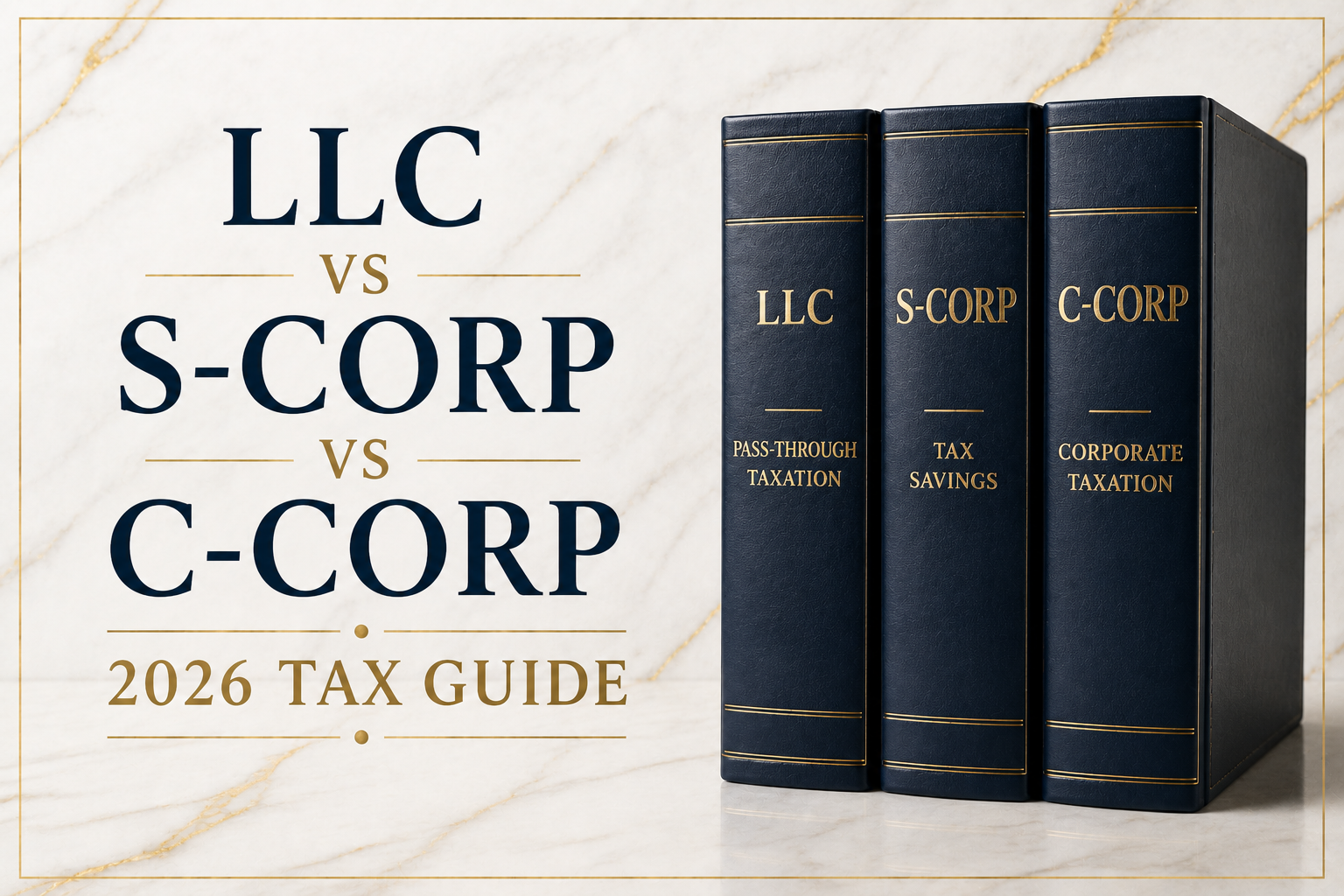
Choosing the right business structure is one of the most important tax and legal decisions you’ll make. In 2026, the choice between an LLC, an S corporation, and a C corporation can affect how your business is taxed, who can own the business, and how profits are distributed.
One common misconception is that an LLC and an S corporation are competing legal entities. In reality, an LLC is a state-law business entity, while an S corporation is a federal tax election. An LLC can even elect to be taxed as an S corporation if it qualifies.
Here’s a breakdown of how each structure works and when one may be a better fit than another.
Understanding the Difference
An LLC (Limited Liability Company) provides liability protection under state law, but its federal tax treatment depends on IRS classification rules.
By default:
- A single-member LLC is generally treated as a disregarded entity for federal tax purposes.
- A multi-member LLC is generally taxed as a partnership.
- An LLC may also elect to be taxed as either a C corporation or an S corporation.
An S corporation is a corporation—or an LLC that elects corporate taxation—that has made a valid S corporation election with the IRS.
A C corporation is the default tax classification for corporations that have not elected S corporation status.
LLC: Maximum Flexibility
Many small businesses begin as LLCs because they offer flexibility in both ownership and taxation.
Benefits of an LLC include:
- Limited liability protection for owners.
- Flexible ownership arrangements.
- Choice of federal tax classification.
- Pass-through taxation under the default rules.
- Simple administration for many small businesses.
Single-member LLCs generally report business income directly on the owner’s tax return, while multi-member LLCs typically file Form 1065 and pass income through to the members.
S Corporation: Pass-Through Taxation with Restrictions
An S corporation allows business income to pass through to shareholders without the corporation generally paying federal income tax.
However, strict eligibility rules apply.
To qualify, an S corporation generally must:
- Be a domestic corporation or eligible LLC.
- Have no more than 100 shareholders.
- Have only eligible shareholders.
- Have no nonresident alien shareholders.
- Have only one class of stock.
Because of these restrictions, S corporations are often best suited for closely held businesses with a relatively simple ownership structure.
C Corporation: Greater Ownership Flexibility
C corporations are separate taxable entities.
Unlike S corporations, C corporations generally:
- May have unlimited shareholders.
- May have foreign investors.
- May issue multiple classes of stock.
- Do not face S corporation eligibility restrictions.
The primary drawback is that C corporations are generally subject to double taxation:
- The corporation pays tax on its profits.
- Shareholders may also pay tax when profits are distributed as dividends.
Despite this, C corporations are often preferred by venture-backed startups, businesses seeking outside investors, and companies planning multiple investment rounds.
Ownership Rules Compared
LLC
- Very flexible ownership structure.
- Can have individuals, entities, and foreign owners depending on tax classification.
- May allocate profits using partnership tax rules when taxed as a partnership.
S Corporation
- Maximum of 100 shareholders.
- Limited to eligible shareholders.
- No foreign individual shareholders.
- Only one class of stock.
C Corporation
- No shareholder limits.
- Foreign ownership generally permitted.
- Multiple stock classes allowed.
- Most flexible ownership structure.
Tax Treatment Comparison
LLC (Default Taxation)
- Business income generally passes directly to the owners.
- Single-member LLCs typically report income on Schedule C.
- Multi-member LLCs generally file Form 1065.
S Corporation
- Generally no federal income tax at the corporate level.
- Income, deductions, and credits pass through to shareholders.
- Subject to eligibility restrictions.
C Corporation
- The corporation pays federal income tax.
- Shareholders may pay additional tax on dividends received.
- Offers greater flexibility for reinvesting profits and attracting investors.
Can an LLC Become an S Corporation?
Yes.
An LLC may elect to be taxed as a corporation by filing the appropriate IRS election and then elect S corporation status if it satisfies all eligibility requirements.
This allows business owners to retain the legal advantages of an LLC while receiving S corporation tax treatment.
Which Structure Is Right for Your Business?
An LLC may be a good choice if you want:
- Maximum flexibility.
- Simple administration.
- Pass-through taxation.
- Flexible ownership arrangements.
An S corporation may be appropriate if:
- You qualify under the IRS shareholder rules.
- You want pass-through taxation.
- Your ownership structure is relatively straightforward.
A C corporation may be the better option if:
- You expect outside investors.
- You plan multiple stock classes.
- You anticipate foreign ownership.
- You intend to retain earnings within the company for growth.
Final Thoughts
There is no one-size-fits-all answer when choosing between an LLC, S corporation, and C corporation. The best structure depends on your ownership goals, tax planning strategy, funding plans, and long-term business objectives.
Making the right decision at the beginning—or restructuring later when your business grows—can significantly affect taxes, compliance requirements, and future opportunities.
Need Help Choosing the Right Business Structure?
As a CPA firm, we help entrepreneurs and business owners choose the entity structure that best fits their tax strategy, growth plans, and compliance requirements.
Whether you’re forming a new business, considering an S corporation election, or evaluating whether an LLC or C corporation better fits your long-term goals, our experienced CPA team can guide you through every step.
Contact our CPA team today to schedule a consultation and build the right tax strategy for your business in 2026 and beyond.
The right business structure today can create meaningful tax savings and greater flexibility for years to come.