Understanding the Alternative Minimum Tax (AMT) in 2026
The Alternative Minimum Tax (AMT) remains one of the most misunderstood areas of the federal tax system. While legislative changes over the past decade have significantly reduced the number of taxpayers affected, AMT continues to impact certain high-income individuals, investors, executives, business owners, and taxpayers with specialized tax preference items.
In 2026, the Alternative Minimum Tax remains an important consideration for taxpayers with complex financial situations. Understanding how AMT works can help reduce surprises, improve tax planning, and prevent unexpected tax liabilities.
What Is the Alternative Minimum Tax?
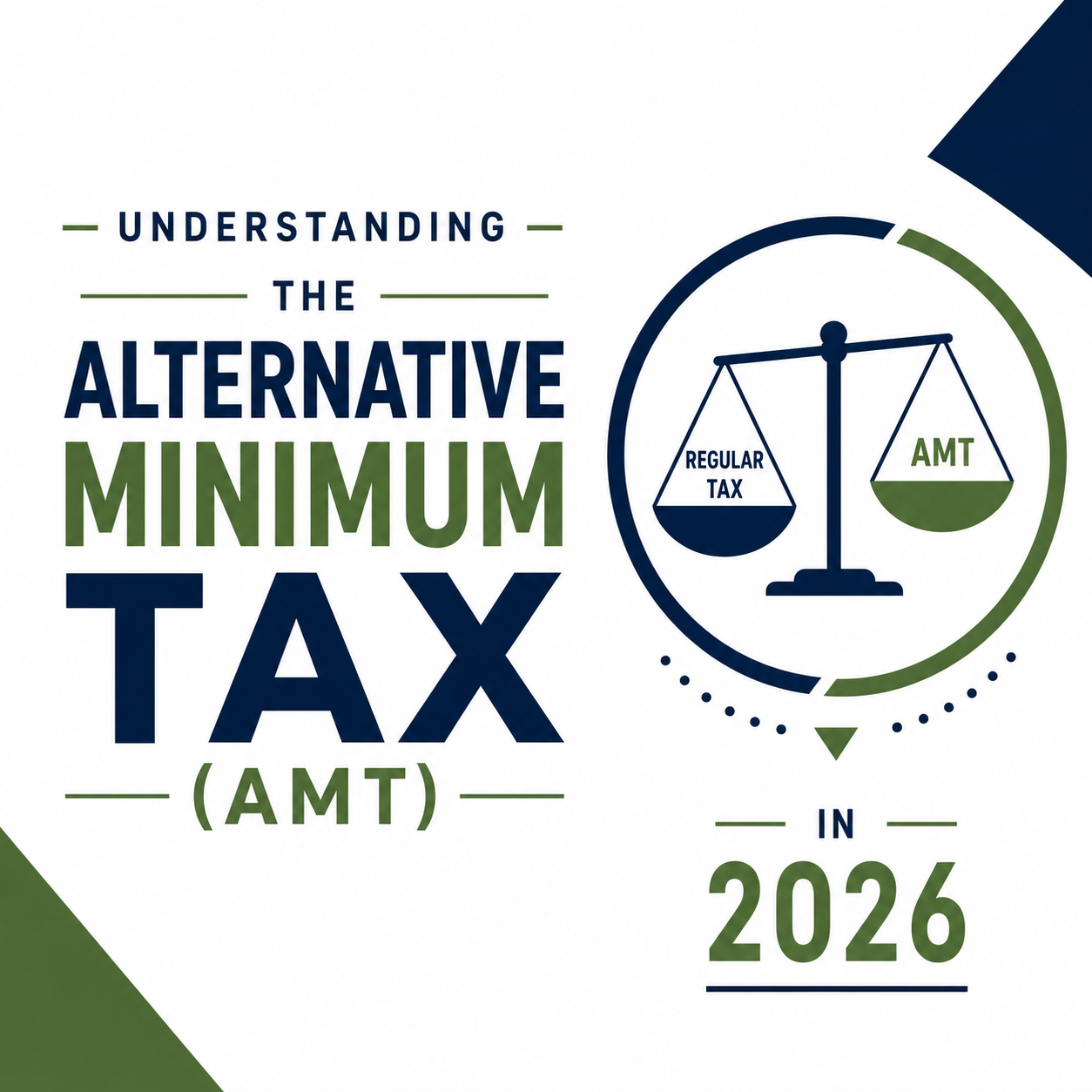
The Alternative Minimum Tax is a separate tax system that operates alongside the regular federal income tax system.
Taxpayers must generally:
- Calculate their regular federal income tax.
- Calculate their Alternative Minimum Tax.
- Compare the two calculations.
- Pay the higher amount.
The AMT uses different rules for calculating income, deductions, exemptions, and tax liability.
Why Was the AMT Created?
Congress originally created the AMT to ensure that high-income taxpayers could not eliminate federal tax liability entirely through deductions, exclusions, and tax preference items.
Although fewer taxpayers are affected today, the AMT still commonly impacts individuals with:
- High income levels
- Incentive Stock Options (ISOs)
- Significant investment activity
- Large state and local tax deductions
- Pass-through business income
- Certain depreciation adjustments
- Private activity bond interest
How the AMT Calculation Works
The AMT begins with taxable income calculated under the regular tax system.
Certain deductions and preference items are then adjusted or added back to arrive at:
Alternative Minimum Taxable Income (AMTI)
Once AMTI is determined:
- The AMT exemption is applied.
- The remaining taxable amount is subject to AMT rates.
- Tentative minimum tax is calculated.
- Tentative minimum tax is compared to regular tax liability.
If tentative minimum tax exceeds regular tax, the difference becomes additional AMT owed.
2026 AMT Exemption Amounts
The OBBBA permanently preserved the enhanced AMT exemptions originally enacted under the Tax Cuts and Jobs Act.
For 2026, the inflation-adjusted exemptions are:
- Married Filing Jointly: $140,200
- Single Filers: $90,100
- Head of Household: $90,100
- Married Filing Separately: $70,100
These larger exemption amounts continue to shield many taxpayers from AMT exposure.
How the AMT Exemption Phaseout Works
The AMT exemption is reduced once AMTI exceeds certain thresholds.
2026 Phaseout Thresholds
- Married Filing Jointly: $1,000,000
- Single Filers: $500,000
- Married Filing Separately: $500,000
Phaseout Rate
The exemption is reduced by:
- $0.50 for every $1 of AMTI exceeding the applicable threshold
This effectively creates a 50% phaseout rate.
Example
Assume a married couple filing jointly has:
- AMTI: $1,100,000
- Exemption: $140,200
Step 1:
Determine excess AMTI:
$1,100,000 − $1,000,000 = $100,000
Step 2:
Calculate phaseout reduction:
$100,000 × 50% = $50,000
Step 3:
Reduced exemption:
$140,200 − $50,000 = $90,200
Complete Phaseout
For 2026:
- The exemption is fully eliminated at approximately $1,280,400 for married filing jointly taxpayers.
- The exemption is fully eliminated at approximately $680,200 for single taxpayers.
Why It Matters
Taxpayers with income near these thresholds should perform year-end projections before recognizing major gains or exercising stock options.
AMT Tax Rates in 2026
Unlike the regular tax system, AMT uses only two tax rates.
AMT Rates
- 26%
- 28%
2026 28% Rate Threshold
The higher 28% AMT rate generally applies when AMTI exceeds:
- $244,500 for most taxpayers
- $122,250 for married filing separately taxpayers
Why It Matters
Large AMTI increases from stock options, capital gains, or business transactions may quickly move taxpayers into the 28% AMT bracket.
Common AMT Adjustments and Preference Items
Several deductions and tax benefits receive different treatment under AMT rules.
Common AMT adjustments include:
Incentive Stock Options (ISOs)
State and Local Tax Deductions
Certain Pass-Through Entity Adjustments
Private Activity Bond Interest
Depreciation Differences
Passive Activity Adjustments
The impact of these items varies depending on the taxpayer’s circumstances.
The SALT Deduction and AMT
The interaction between state and local taxes and AMT remains one of the most important planning considerations.
Regular Tax SALT Limitation
For 2026:
- $40,400 for most taxpayers
- $20,200 for married filing separately taxpayers
SALT Phase-Down Rules
The deduction begins to phase down when modified adjusted gross income exceeds:
- $505,000
- $252,500 for married filing separately taxpayers
The deduction limit is reduced by:
- 30% of excess MAGI
However, the deduction generally cannot be reduced below:
- $10,000
- $5,000 for married filing separately taxpayers
Example
A married couple with MAGI of $550,000 would calculate:
- Excess MAGI: $45,000
- Reduction: $13,500
- Available SALT deduction: $26,900
AMT Add-Back Rule
Although taxpayers may benefit from the expanded SALT deduction under the regular tax system, state and local taxes deducted for regular tax purposes are generally added back when calculating AMTI.
Why It Matters
Taxpayers claiming large SALT deductions are often more likely to trigger AMT liability.
Incentive Stock Options (ISOs): A Major AMT Trigger
One of the most common causes of AMT is exercising incentive stock options.
How It Works
When an employee exercises an ISO and continues holding the shares:
- Regular taxable income may not be recognized immediately.
- The spread between fair market value and exercise price becomes an AMT adjustment.
Example
An employee exercises options with:
- Exercise price: $50,000
- Fair market value: $250,000
The $200,000 spread may be included in AMTI despite no stock sale occurring.
Planning Opportunity
Taxpayers should model AMT consequences before exercising substantial stock options.
AMT and Business Owners
Although many historical AMT issues affecting businesses have been reduced, certain transactions still require analysis.
Section 179 Expensing
For 2026:
- Maximum deduction: $2,560,000
- Phaseout threshold: $4,090,000
Additional Limitations
Section 179 deductions:
- Cannot exceed taxable income from active trades or businesses.
- Are generally unavailable to estates and trusts.
- May be carried forward if limitations apply.
SUV Limitation
For qualifying SUVs placed in service during 2026:
- Section 179 deduction is generally limited to $32,000.
Bonus Depreciation and AMT
The OBBBA permanently restored:
- 100% bonus depreciation
for qualified property acquired and placed in service after January 19, 2025.
Qualified Property
Generally includes MACRS property with recovery periods of:
- 20 years or less
Examples include:
- Equipment
- Computers
- Furniture
- Certain vehicles
Important AMT Benefit
Current law generally eliminates one of the historic AMT depreciation adjustments because bonus depreciation is determined without regard to AMT depreciation adjustments.
Why It Matters
Many business investments that previously generated AMT differences no longer create significant AMT exposure.
AMT Credits
Taxpayers who paid AMT in prior years may qualify for a Minimum Tax Credit.
This credit may be available in future years when:
- Regular tax exceeds tentative minimum tax.
Why It Matters
Taxpayers should review prior-year returns to determine whether unused AMT credits remain available.
Estimated Tax Planning and AMT
AMT frequently creates unexpected tax liabilities if not addressed throughout the year.
General Safe Harbor
Taxpayers generally avoid underpayment penalties by paying the lesser of:
- 90% of current-year tax liability, or
- 100% of prior-year tax liability
Higher-Income Taxpayers
If 2025 adjusted gross income exceeded:
- $150,000
- $75,000 if married filing separately
the prior-year safe harbor generally increases to:
- 110% of prior-year tax liability
Why Prior-Year AGI Matters
A taxpayer expecting AMT in 2026 must review 2025 AGI carefully because crossing the threshold changes the safe-harbor requirement from 100% to 110% of prior-year tax.
Failure to account for this increase can result in underpayment penalties.
How Professional Tax Planning Can Help
AMT calculations often require specialized projections that many taxpayers do not perform during the year.
Professional advisors may help:
- Project AMT exposure
- Analyze ISO exercises
- Evaluate large capital gains
- Review SALT deduction impacts
- Coordinate depreciation elections
- Optimize estimated tax payments
Proactive planning often helps taxpayers avoid unpleasant surprises.
Final Thoughts
The Alternative Minimum Tax remains an important part of the federal tax system in 2026. While the OBBBA permanently preserved higher exemption amounts and many business-related AMT adjustments have been reduced, taxpayers with high income, significant SALT deductions, incentive stock options, investment gains, or complex business interests may still face substantial AMT exposure.
Understanding the exemption phaseout rules, AMT tax rates, SALT add-back requirements, stock option implications, and estimated tax safe harbors can help taxpayers make informed decisions and avoid unexpected liabilities. For taxpayers approaching the AMT thresholds, year-end tax modeling remains one of the most effective planning tools available.