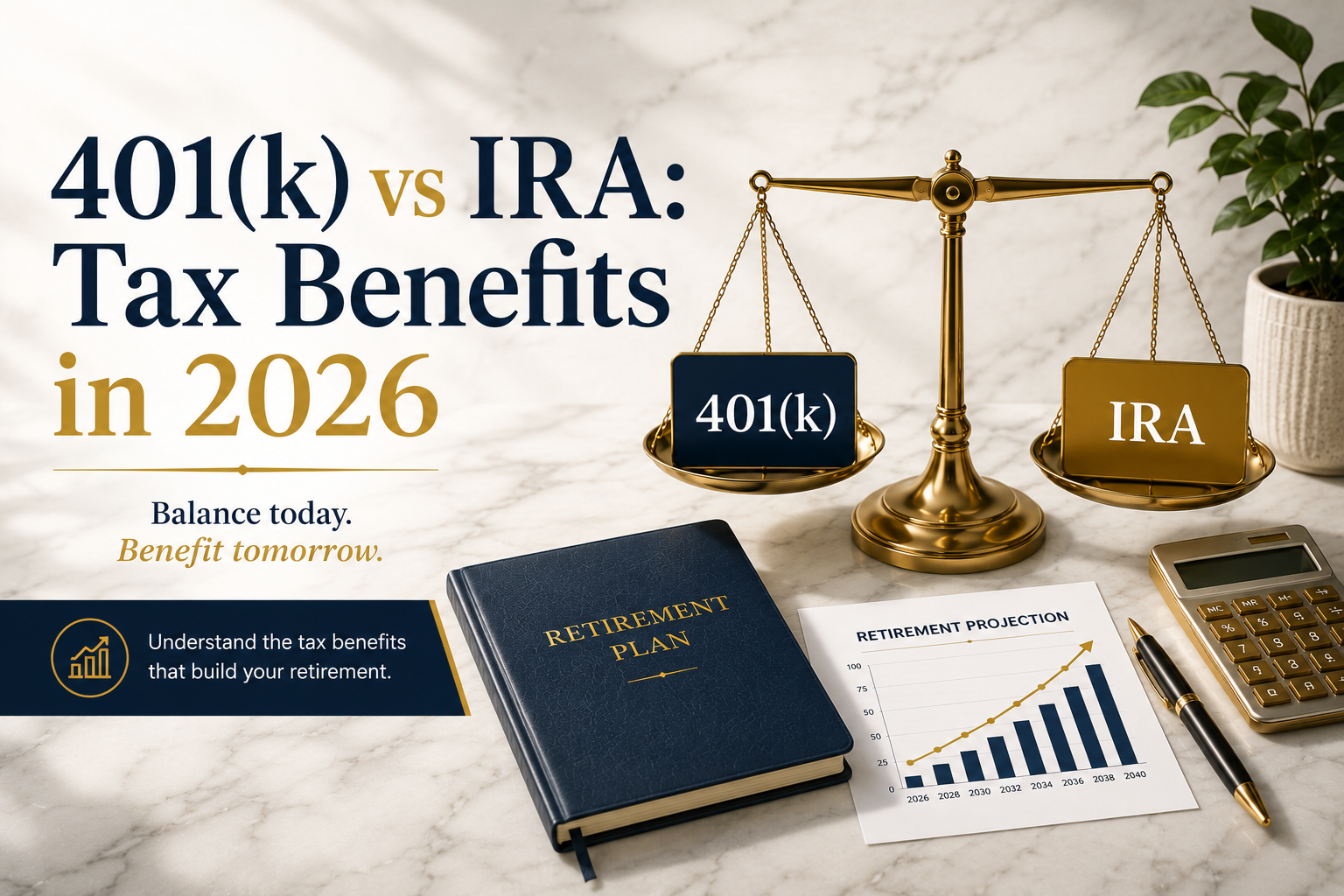
401(k) vs. IRA: Tax Benefits in 2026
Both 401(k) plans and Individual Retirement Accounts (IRAs) offer valuable tax advantages, but they serve different purposes. Choosing the right retirement account depends on your income, employer benefits, contribution goals, and long-term financial strategy.
For 2026, 401(k) plans continue to provide significantly higher contribution limits, while IRAs offer greater investment flexibility. Understanding the differences can help you maximize both your retirement savings and tax benefits.
How a 401(k) Works
A 401(k) is an employer-sponsored retirement plan that allows employees to contribute a portion of their salary toward retirement.
Traditional 401(k) contributions are generally made on a pre-tax basis, reducing your current taxable income. Taxes are deferred until funds are withdrawn during retirement.
Many employers also offer matching contributions, providing an additional retirement benefit at no extra cost to the employee.
2026 401(k) Contribution Limits
- Under age 50: $24,500
- Age 50 or older: $32,500 (includes an $8,000 catch-up contribution)
- Ages 60–63: $35,750 (includes an enhanced $11,250 catch-up contribution)
The overall annual additions limit—including employee and employer contributions—is $72,000, excluding eligible catch-up contributions.
How an IRA Works
An Individual Retirement Account (IRA) is opened and managed by the individual rather than through an employer.
You generally have two primary options:
- Traditional IRA – Contributions may be tax deductible if IRS income requirements are met.
- Roth IRA – Contributions are made with after-tax dollars, but qualified withdrawals are generally tax free.
Unlike most employer retirement plans, IRAs typically provide greater flexibility when selecting investments.
2026 IRA Contribution Limits
- Under age 50: $7,500
- Age 50 or older: $8,600 (includes the $1,100 catch-up contribution)
Your combined contributions to all Traditional and Roth IRAs cannot exceed these annual limits or your taxable compensation for the year, whichever is less.
Traditional IRA Deduction Phase-Outs
If you or your spouse participate in a workplace retirement plan, your ability to deduct Traditional IRA contributions may be limited.
- Single or Head of Household: $81,000–$91,000
- Married Filing Jointly (covered spouse): $129,000–$149,000
- Married Filing Jointly (spouse not covered): $242,000–$252,000
- Married Filing Separately: $0–$10,000
Roth IRA Income Limits
Eligibility to contribute directly to a Roth IRA also depends on your modified adjusted gross income (MAGI).
- Single or Head of Household: $153,000–$168,000
- Married Filing Jointly: $242,000–$252,000
- Married Filing Separately (living with spouse): $0–$10,000
Unlike IRAs, employee contributions to a 401(k) generally are not subject to these income phase-out rules.
Comparing the Tax Benefits
Traditional 401(k)
- Reduces current taxable income
- Higher annual contribution limits
- May include valuable employer matching contributions
- Taxes are deferred until retirement withdrawals
Traditional IRA
- May provide a current tax deduction if income limits allow
- Offers tax-deferred investment growth
- Provides greater investment flexibility
Roth 401(k)
- No immediate tax deduction
- Qualified retirement withdrawals are generally tax free
- Higher contribution limits than a Roth IRA
Roth IRA
- No upfront tax deduction
- Qualified withdrawals are generally tax free
- Subject to IRS income eligibility limits
Which Option Usually Saves More in Taxes?
If your primary goal is to reduce your current year’s taxable income, a Traditional 401(k) often provides the greatest immediate tax benefit because of its substantially higher contribution limits.
If you’re focused on generating tax-free retirement income, both the Roth 401(k) and Roth IRA can provide significant long-term advantages when eligibility requirements are met.
Many taxpayers benefit from contributing to both a 401(k) and an IRA to diversify both their retirement savings and future tax treatment.
Final Thoughts
Both 401(k) plans and IRAs are powerful retirement savings tools, but they offer different advantages. A 401(k) generally provides higher contribution limits and potential employer matching, while an IRA offers greater investment flexibility and additional retirement planning opportunities.
The right strategy depends on your income, tax bracket, employer benefits, and long-term retirement goals.
Need Help Choosing the Right Retirement Strategy?
As a CPA firm, we help individuals, families, and business owners build tax-efficient retirement plans that maximize deductions, minimize taxes, and support long-term financial success.
Whether you’re deciding between a Traditional or Roth account, evaluating employer retirement plans, or planning your annual retirement contributions, our experienced CPA team can help you make informed financial decisions.
Contact our CPA team today to schedule a consultation and develop a retirement strategy that maximizes your tax savings in 2026 and beyond.
Thoughtful retirement planning today can create lasting tax savings and greater financial confidence for the future.