The IRS is legally required to charge interest on any unpaid tax from the original due date until the balance is paid in full. In addition, late payment penalties (typically 0.5% per month, up to 25% of the unpaid tax) will accrue. If you don’t file your return on time, the late filing penalty is even steeper—usually 5% per month. The bottom line: the sooner you file and pay what you can, the less you’ll owe in the end.
Step 1: File On Time and Pay What You Can
Even if you can’t pay your full tax bill, always file your return (or request an extension) by the deadline. Pay as much as you can with your return. This reduces the balance subject to penalties and interest.
Remember: An extension to file is NOT an extension to pay. You must pay your tax by the original due date to avoid penalties and interest.
Step 2: Explore IRS Payment Options
1. Short-Term Payment Plan (Up to 180 Days)
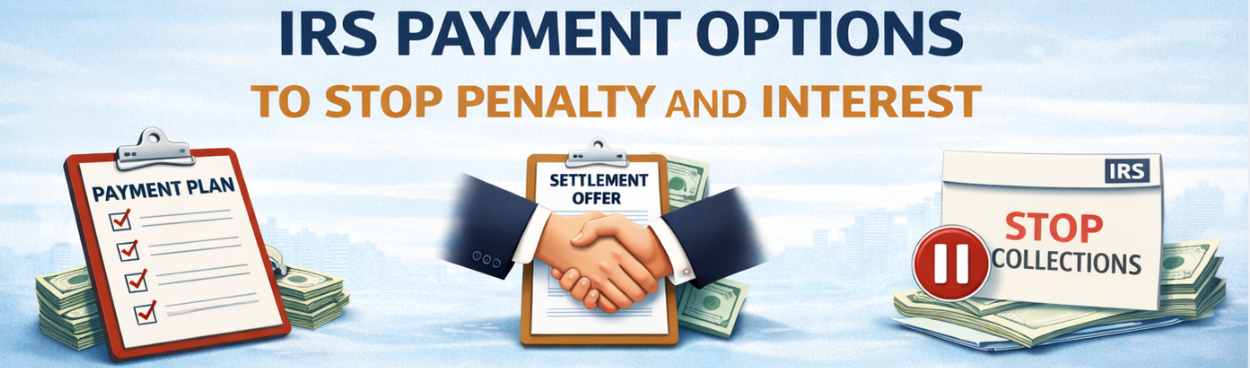
If you can pay your balance in full within 180 days, you can request a short-term payment plan. There’s no setup fee, but penalties and interest continue to accrue until the balance is paid.
2. Long-Term Payment Plan (Installment Agreement)
If you need more time, you can apply for a monthly installment agreement. Most individuals qualify if they owe $50,000 or less in combined tax, penalties, and interest. You can apply online, by phone, or by submitting Form 9465. Setup fees apply, but are reduced or waived for low-income taxpayers.
- Direct debit (automatic bank withdrawal) is recommended to avoid missed payments and may qualify you for a lower fee.
- While you’re on an approved installment agreement, the late payment penalty rate drops to 0.25% per month.
3. Offer in Compromise
If you can’t pay your full tax debt and doing so would create a financial hardship, you may qualify to settle your tax bill for less than the full amount owed. The IRS will review your income, expenses, and assets before accepting an offer. Use the IRS Offer in Compromise Pre-Qualifier tool to check eligibility.
4. Currently Not Collectible Status
If you can’t pay anything without sacrificing basic living expenses, you can request that the IRS temporarily delay collection. Interest and penalties continue to accrue, but enforced collection actions are paused.
Step 3: Make Payments Electronically
The IRS offers several secure, convenient ways to pay:
- Direct Pay: Pay directly from your bank account with no fees.
- Debit/Credit Card or Digital Wallet: Fees apply, but payments are processed quickly.
- IRS Online Account: View your balance, set up payment plans, and make payments.
- Electronic Federal Tax Payment System (EFTPS): For individuals and businesses; enrollment required.
- IRS2Go App: Make payments and check your refund status from your mobile device.
Step 4: Don’t Ignore IRS Notices
If you receive a bill or notice from the IRS, respond promptly. Ignoring IRS notices can lead to more severe collection actions, such as liens or levies.
Can Penalties or Interest Be Removed?
- Penalties: The IRS may remove or reduce penalties if you can show reasonable cause or if you qualify for first-time penalty abatement.
- Interest: Interest is charged by law and is only reduced if the underlying tax or penalty is reduced, or if there was an IRS error or delay.
Key Takeaways
- File on time and pay as much as you can.
- Set up a payment plan if you can’t pay in full.
- Consider an Offer in Compromise or Currently Not Collectible status if you’re in financial hardship.
- Use electronic payment options for speed and security.
- Respond to IRS notices and keep communication open.