Best Business Structure for Taxes in 2026
Choosing the best business structure can significantly impact your taxes, liability protection, and long-term financial strategy. However, there is no one-size-fits-all answer.
The most tax-efficient business structure in 2026 depends on several factors, including how many owners the business has, whether profits will be distributed or reinvested, and whether the business qualifies for special tax elections such as S corporation status.
Understanding how each structure is taxed can help you make a smarter decision as your business grows.
Common Business Structures
The most common federal tax structures include:
- Sole proprietorship or single-member LLC taxed as a disregarded entity.
- Multi-member LLC taxed as a partnership.
- C corporation.
- S corporation (including eligible LLCs that elect S corporation tax treatment).
Each structure offers different tax benefits and planning opportunities.
Single-Owner Businesses
For many entrepreneurs, a single-member LLC provides one of the simplest tax structures.
By default:
- The LLC is generally treated as a disregarded entity for federal tax purposes.
- Business income and expenses are reported directly on the owner’s individual tax return.
- The owner generally pays tax on the business income personally.
This approach minimizes administrative complexity while providing liability protection under state law.
Businesses with Multiple Owners
When an LLC has two or more members, it is generally taxed as a partnership unless another election is made.
This structure typically offers:
- Pass-through taxation.
- Flexible profit allocations.
- No federal income tax at the entity level.
- Greater flexibility in ownership arrangements.
Although partnership taxation offers significant flexibility, it also involves more complex tax reporting and basis rules.
When an S Corporation May Be a Better Choice
An S corporation may be attractive for businesses that qualify under IRS rules and prefer pass-through taxation within a corporate framework.
However, S corporations must satisfy several eligibility requirements, including:
- No more than 100 shareholders.
- Only eligible shareholders.
- No nonresident alien shareholders.
- Only one class of stock.
These restrictions make S corporations less flexible than partnership-taxed LLCs but suitable for many closely held businesses.
When a C Corporation Makes Sense
A C corporation pays tax at the corporate level, and shareholders may also pay tax when profits are distributed as dividends.
Despite this potential double taxation, a C corporation may be beneficial when:
- Profits will remain in the business for expansion.
- The company expects significant reinvestment.
- The ownership structure exceeds S corporation limitations.
- The business plans to raise outside investment.
For some rapidly growing companies, corporate taxation can support long-term growth strategies.
Changing Your Tax Classification
Business owners are not always locked into their original tax classification.
An eligible LLC may elect corporate tax treatment by filing Form 8832. If the business qualifies, it may also elect S corporation status.
However, these elections should be made carefully.
After changing an entity’s tax classification, IRS rules generally limit additional elective changes for 60 months unless an exception applies.
Changing classifications may also trigger deemed transactions that can create federal tax consequences.
Questions to Consider Before Choosing a Structure
Before selecting a business structure, ask yourself:
- Will there be one owner or multiple owners?
- Will profits be distributed or retained?
- Do you expect losses during the startup years?
- Will you need outside investors?
- Will there be foreign owners or business entities as owners?
- Do you need flexibility in allocating profits?
Your answers will often determine which structure provides the greatest tax advantages.
Final Thoughts
The best business structure for taxes in 2026 depends on your unique circumstances—not simply the type of entity you form.
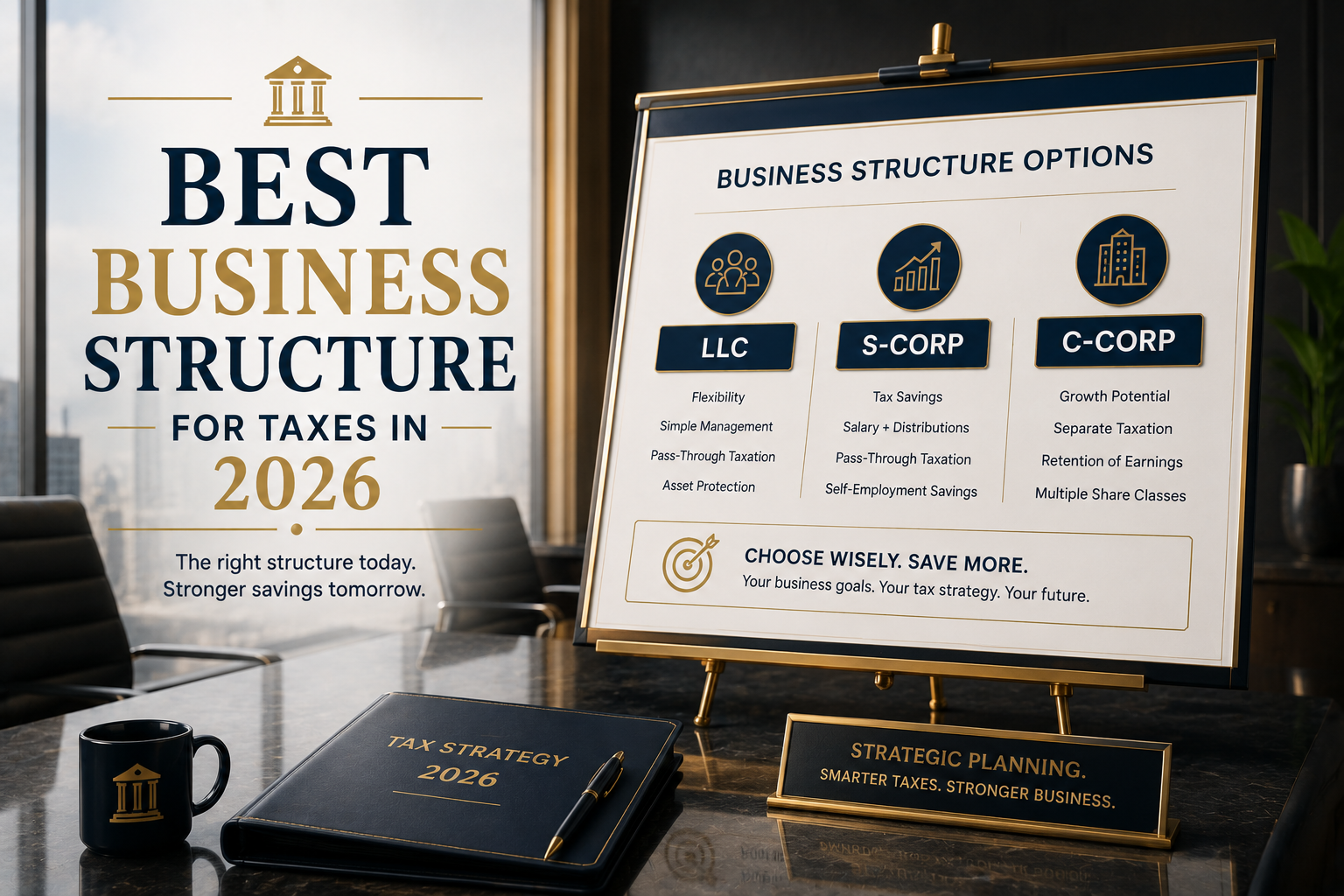
A single-member LLC often provides simplicity for solo entrepreneurs. Multi-member LLCs offer flexibility for multiple owners. S corporations can provide pass-through taxation for qualifying businesses, while C corporations may be better suited for companies focused on long-term growth and reinvestment.
Choosing the right structure early can help minimize taxes, simplify compliance, and support your business as it grows.
Need Help Choosing the Right Business Structure?
As a CPA firm, we help entrepreneurs and business owners evaluate the tax advantages of LLCs, partnerships, S corporations, and C corporations based on their specific financial goals.
Whether you’re launching a new business, restructuring an existing company, or planning for future growth, our experienced CPA team can help you select the structure that maximizes tax efficiency while keeping you compliant with IRS rules.
Contact our CPA team today to schedule a consultation and build the right tax strategy for your business in 2026 and beyond.
Choosing the right business structure today can lead to significant tax savings and greater financial flexibility for years to come.