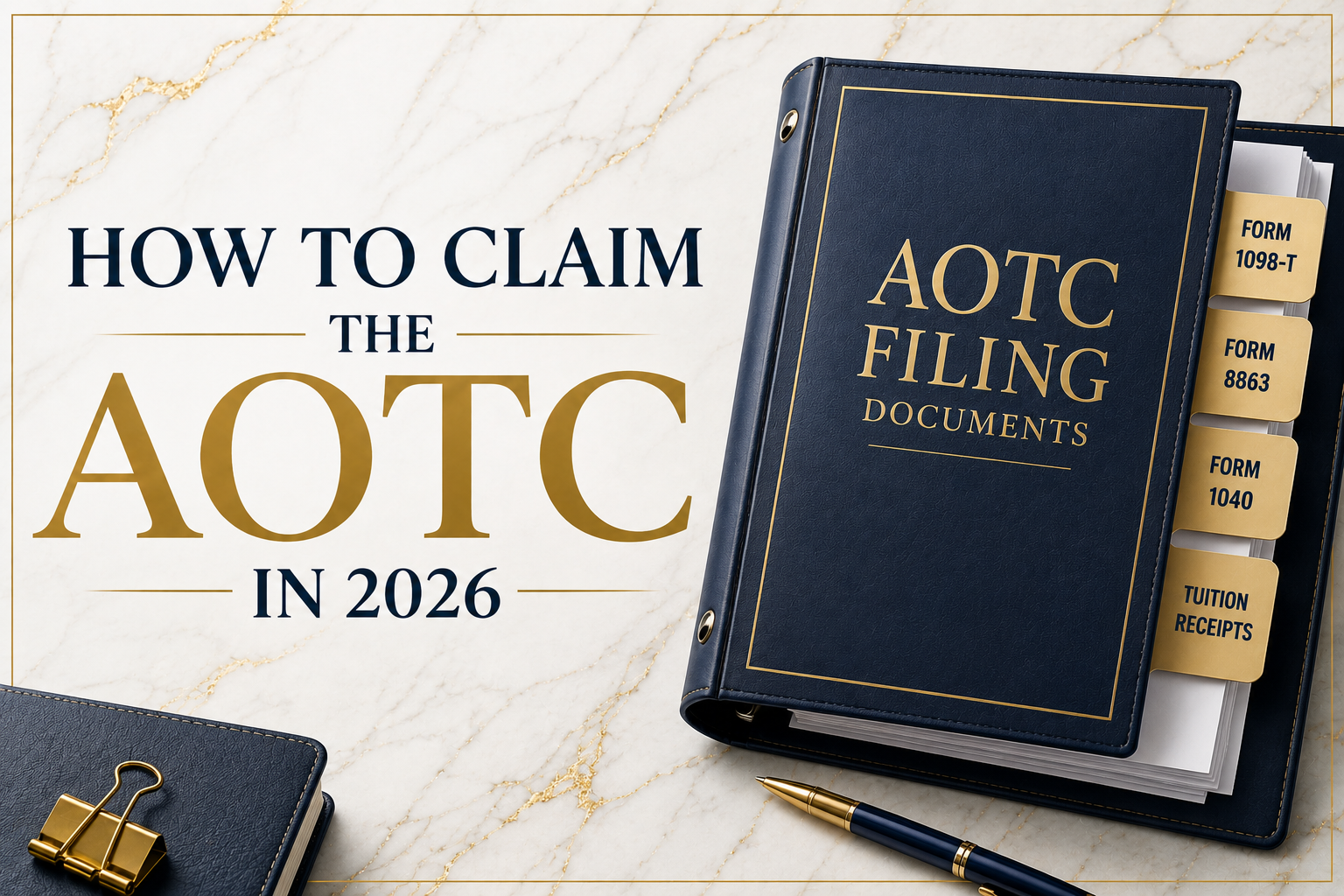
How to Claim the American Opportunity Tax Credit (AOTC) in 2026
The American Opportunity Tax Credit (AOTC) remains one of the most valuable education tax benefits available in 2026. Eligible taxpayers may receive a tax credit of up to $2,500 per qualifying student, with up to $1,000 potentially refundable, even if little or no income tax is owed.
However, claiming the AOTC requires more than simply paying college tuition. Taxpayers must meet specific eligibility requirements, calculate qualified education expenses correctly, and complete Form 8863 with their federal income tax return.
Here’s how to claim the American Opportunity Tax Credit for the 2026 tax year.
Step 1: Determine Whether the Student Qualifies
Before claiming the credit, confirm that the student meets all IRS eligibility requirements.
Generally, the student must:
- Be pursuing a degree, certificate, or other recognized educational credential.
- Be enrolled at least half-time for at least one academic period during 2026.
- Not have completed the first four years of postsecondary education before the beginning of the tax year.
- Not have already claimed the American Opportunity Tax Credit for four prior tax years.
- Not have a federal or state felony drug conviction at the end of the year.
If any of these requirements are not met, the student generally will not qualify for the AOTC.
Step 2: Confirm You Are Eligible to Claim the Credit
The taxpayer claiming the credit must also satisfy IRS eligibility rules.
You generally cannot claim the AOTC if:
- You file as Married Filing Separately.
- You are a nonresident alien who does not elect to be treated as a U.S. resident for tax purposes.
- Your modified adjusted gross income (MAGI) exceeds the allowable limits.
- You are claimed as a dependent on another taxpayer’s return.
For 2026, the credit begins to phase out when MAGI exceeds:
- $80,000 for Single or Head of Household filers.
- $160,000 for Married Filing Jointly.
The credit is completely phased out at:
- $90,000 for Single or Head of Household.
- $180,000 for Married Filing Jointly.
Step 3: Identify Qualified Education Expenses
The AOTC applies only to qualified education expenses.
Generally, eligible expenses include:
- Tuition.
- Required enrollment fees.
- Books.
- Required course materials.
- Required supplies.
Unlike some other education tax benefits, required books and course materials generally qualify even if they are purchased from a retailer rather than directly from the educational institution.
Expenses that generally do not qualify include:
- Room and board.
- Transportation.
- Insurance.
- Medical expenses.
- Personal living expenses.
Step 4: Reduce Expenses for Tax-Free Educational Assistance
You cannot claim a credit for expenses that were already paid with tax-free educational assistance.
Qualified expenses generally must be reduced by:
- Tax-free scholarships.
- Pell Grants.
- Veterans’ educational benefits.
- Employer-provided educational assistance.
- Other tax-free education assistance.
The IRS also prohibits using the same education expense to claim multiple tax benefits.
Step 5: Complete Form 8863
To claim the American Opportunity Tax Credit, you must file Form 8863, Education Credits, together with your Form 1040.
Generally, Form 8863 requires you to:
- Complete a separate section for each qualifying student.
- Enter the student’s identifying information.
- Provide the educational institution’s information.
- Calculate adjusted qualified education expenses.
- Compute both the refundable and nonrefundable portions of the credit.
Step 6: Meet the New 2026 Identification Requirements
Beginning with tax years after December 31, 2025, additional identification requirements apply.
Your return generally must include:
- Your valid Social Security Number (SSN).
- Your spouse’s SSN if filing jointly.
- The qualifying student’s SSN if claiming the credit for someone other than yourself or your spouse.
- The Employer Identification Number (EIN) of the eligible educational institution.
The Social Security Numbers generally must be valid for work and issued before the due date of the tax return, including extensions.
Step 7: Keep Form 1098-T and Supporting Records
Most taxpayers will receive Form 1098-T from the educational institution.
Keep copies of:
- Form 1098-T.
- Tuition payment records.
- Receipts for required books and course materials.
- Scholarship and grant documentation.
- Enrollment records.
These records can help support your credit if the IRS requests additional information.
Important Rules to Remember
- You cannot claim both the American Opportunity Tax Credit and the Lifetime Learning Credit for the same student during the same tax year.
- If the student is your dependent, only the taxpayer claiming that dependent may claim the credit.
- If your previous AOTC was denied for reasons other than a math or clerical error, you may be required to file Form 8862 before claiming the credit again.
- If you later receive a tuition refund or additional tax-free educational assistance, you may need to adjust or recapture part of the credit.
Final Thoughts
The American Opportunity Tax Credit can significantly reduce the cost of higher education by providing up to $2,500 per eligible student. However, successfully claiming the credit requires careful attention to eligibility rules, qualified expenses, income limits, and the expanded identification requirements that apply beginning with 2026 returns.
Taking the time to properly complete Form 8863 and maintain accurate documentation can help maximize your education tax savings while reducing the risk of IRS processing delays.
Need Help Claiming the American Opportunity Tax Credit?
As a CPA firm, we help students, parents, and families maximize available education tax benefits while ensuring full compliance with current IRS rules.
Whether you’re claiming the American Opportunity Tax Credit for the first time, determining qualified education expenses, or coordinating multiple education tax benefits, our experienced CPA team can help you maximize your tax savings.
Contact our CPA team today to schedule a consultation and ensure you’re receiving every education tax benefit available in 2026.
Professional tax planning today can help make higher education more affordable tomorrow.