
How the IRS Classifies Workers in 2026: The Common-Law Control Test Explained
Properly classifying workers is one of the most important payroll tax responsibilities for any business. Whether a worker is treated as an employee or an independent contractor affects payroll taxes, information reporting, employee benefits, and potential IRS penalties.
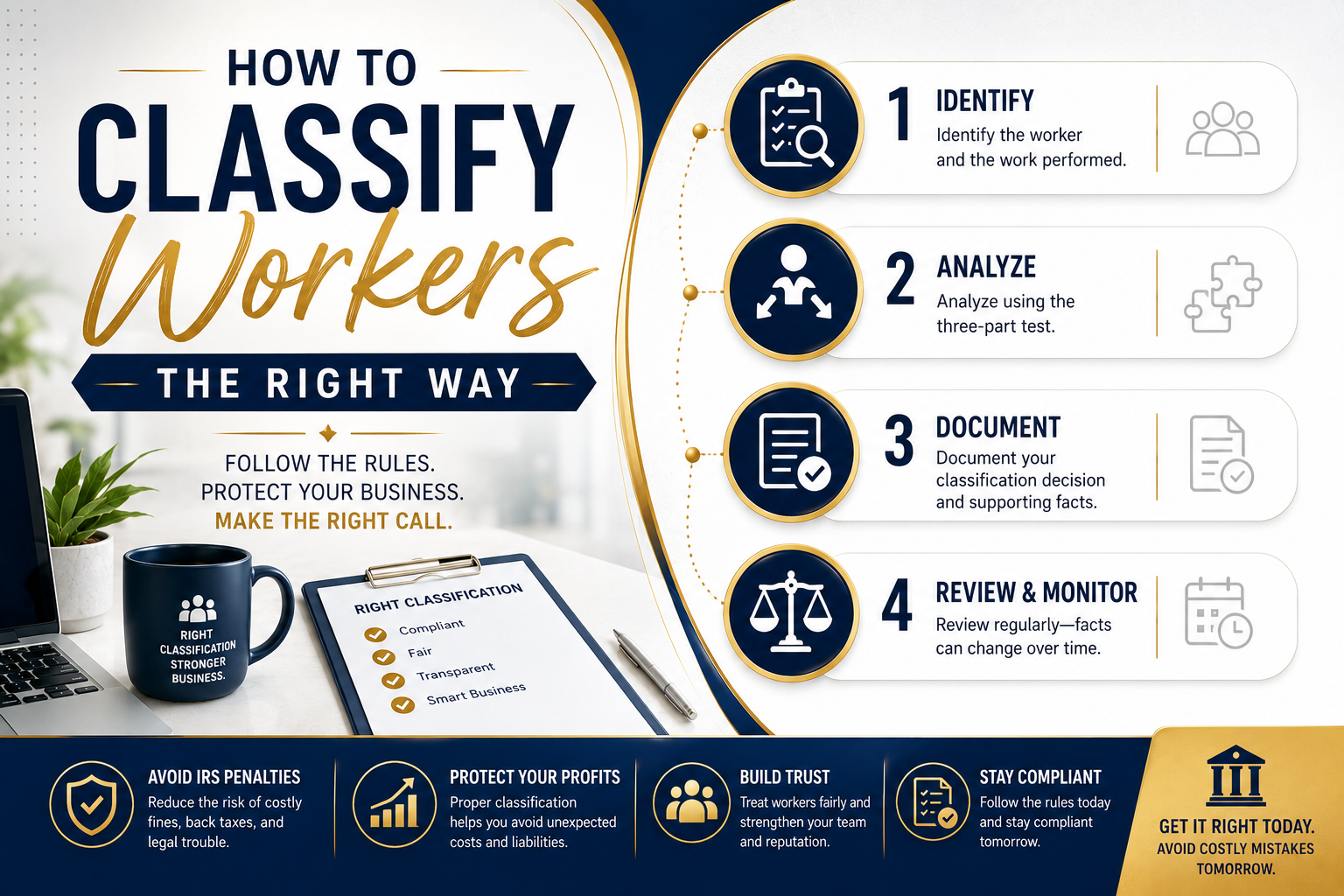
For 2026, the IRS continues to rely on the common-law control test to determine worker classification. The key question is not what a contract says—it’s whether the business has the right to control how the work is performed.
The IRS Common-Law Rule
In general:
- Employee: The business has the right to control both what work is performed and how it is performed.
- Independent Contractor: The business controls only the final result, while the worker determines the methods used to complete the work.
Even if the business does not actively supervise the worker every day, having the right to direct and control the work is often enough to establish an employer-employee relationship.
The Three Factors the IRS Reviews
The IRS evaluates the entire working relationship using three primary categories.
1. Behavioral Control
A worker is more likely to be an employee if the business controls how the work is performed.
Examples include:
- Setting work schedules
- Providing detailed instructions
- Specifying procedures or workflows
- Providing tools or equipment
- Selecting assistants or support staff
- Training workers to follow company methods
Generally, the more instruction and supervision involved, the more likely the worker will be classified as an employee.
2. Financial Control
The IRS also examines who controls the financial aspects of the work.
Independent contractors often:
- Pay their own business expenses
- Purchase and maintain their own equipment
- Provide services to multiple clients
- Invoice by project or contract
- Have the opportunity to realize a profit—or incur a loss
Although investing in equipment supports independent contractor status, it is only one factor in the overall analysis.
3. Relationship Between the Parties
The IRS also considers the overall relationship between the business and the worker, including:
- Written contracts
- Employee benefits
- Whether the relationship is ongoing or temporary
- Whether the worker performs services that are a key part of the business
While written agreements are helpful documentation, they do not determine worker status by themselves. The IRS focuses on the actual facts and circumstances of the working relationship.
Special Worker Categories
Statutory Employees
Some workers are treated as employees for Social Security and Medicare tax purposes even if they would not otherwise qualify under the common-law rules.
Examples include certain:
- Agent or commission drivers
- Life insurance salespersons
- Homeworkers
- Traveling or city salespersons
Statutory Nonemployees
Certain workers are treated as self-employed if they meet IRS requirements, including:
- Licensed real estate agents
- Direct sellers
- Certain companion sitters
Why Proper Classification Matters
If the Worker Is an Employee
The employer generally must:
- Withhold federal income tax
- Withhold Social Security and Medicare taxes
- Pay the employer share of payroll taxes
- Pay federal unemployment (FUTA) tax
- Issue Form W-2
If the Worker Is an Independent Contractor
Generally, the business:
- Does not withhold payroll taxes
- Does not pay the employer share of Social Security and Medicare taxes
- Reports qualifying payments on Form 1099-NEC when required
Independent contractors are generally responsible for paying their own income tax and self-employment tax.
Need an Official IRS Decision?
If worker classification is unclear, either the business or the worker may request an official IRS determination by filing Form SS-8.
The IRS reviews information provided by both parties and generally issues either a determination letter or an advisory information letter. Form SS-8 applies only to federal tax classification and generally is not used for hypothetical situations or business-to-business relationships.
Key Takeaways
✔ Worker classification is based on the IRS common-law right-to-control test.
✔ The IRS evaluates behavioral control, financial control, and the overall relationship.
✔ Written contracts alone do not determine worker status.
✔ Special rules apply to statutory employees and statutory nonemployees.
✔ Employees generally require payroll tax withholding and Form W-2 reporting.
✔ Independent contractors generally receive Form 1099-NEC and pay their own self-employment taxes.
✔ Form SS-8 can help resolve worker classification questions before they become IRS issues.
Need Help Classifying Workers?
Our CPA team helps businesses evaluate worker relationships, comply with IRS payroll tax rules, and reduce the risk of costly worker misclassification penalties.
Contact our CPA team today to ensure your business is classifying workers correctly and staying compliant with the latest IRS requirements.
Getting worker classification right today can help prevent expensive payroll tax problems tomorrow.