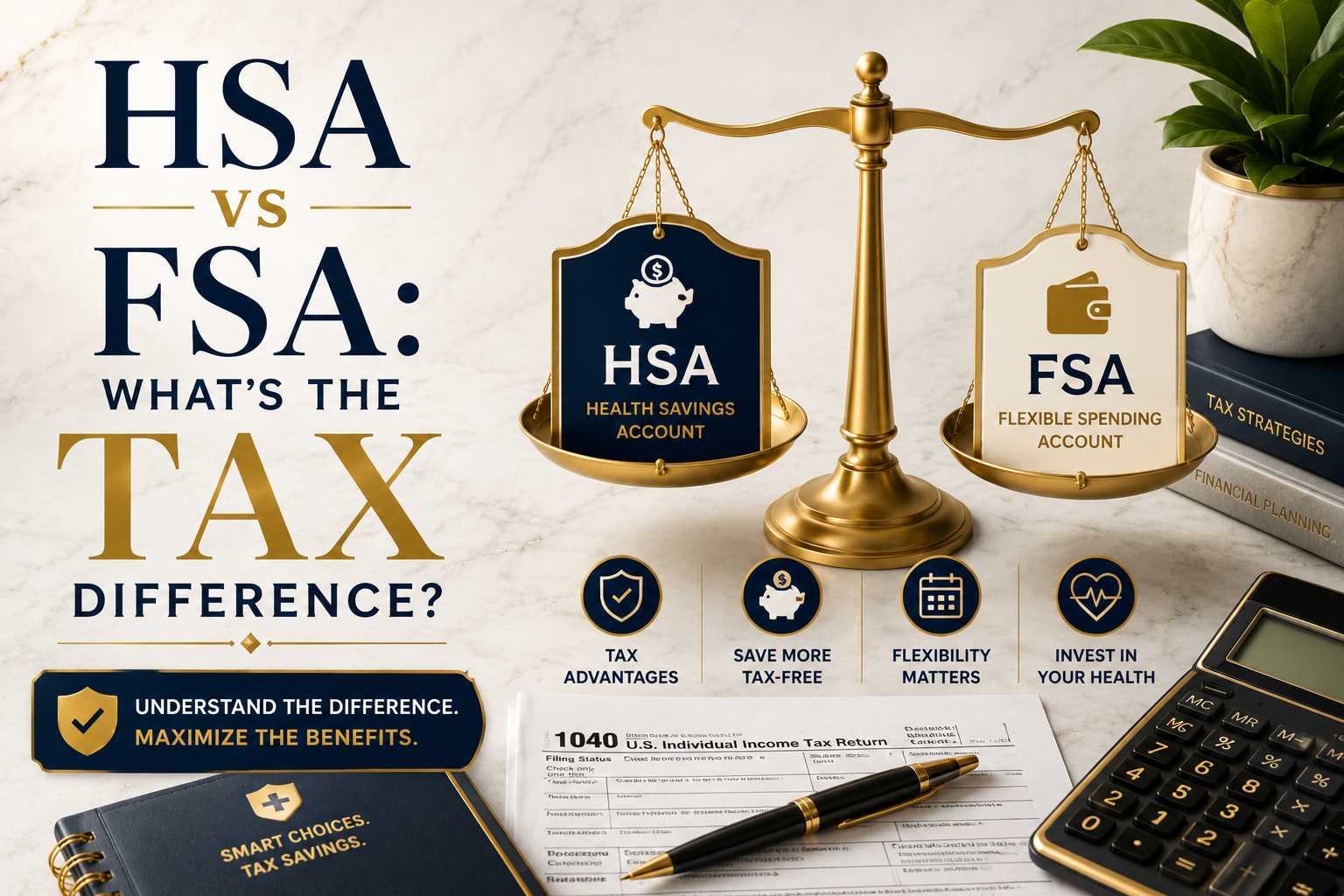
HSA vs. FSA: What’s the Tax Difference in 2026?
Health Savings Accounts (HSAs) and Health Flexible Spending Accounts (FSAs) both offer valuable tax advantages for medical expenses, but they work very differently.
Choosing the right account can help lower your taxable income and reduce healthcare costs. However, eligibility, ownership, contribution limits, and how unused funds are handled vary significantly between the two.
Here’s what you need to know for the 2026 tax year.
How an HSA Works
A Health Savings Account (HSA) is a tax-advantaged savings account available to individuals enrolled in a qualifying High Deductible Health Plan (HDHP).
HSAs offer what many tax professionals call a “triple tax advantage”:
- Contributions are generally tax-deductible or excluded from income.
- Investment earnings grow tax-free.
- Qualified withdrawals for medical expenses are tax-free.
If HSA funds are used for non-qualified expenses before age 65, the distribution is generally subject to income tax plus a 20% additional tax. After age 65, disability, or death, the additional tax generally no longer applies, although non-qualified withdrawals may still be taxable.
How a Health FSA Works
A Health Flexible Spending Account (Health FSA) is an employer-sponsored benefit offered through a cafeteria plan.
Instead of receiving a deduction on your tax return, employee contributions are made through pre-tax payroll deductions before federal income and employment taxes are calculated.
Qualified medical expense reimbursements are generally tax-free.
Unlike an HSA, the account is established through your employer and is subject to different ownership and forfeiture rules.
Key Tax Differences
Health Savings Accounts (HSAs)
- Contributions are generally deductible even if you do not itemize deductions.
- Employer contributions are generally excluded from taxable income.
- Investment earnings grow tax-free.
- Qualified medical withdrawals are tax-free.
Health Flexible Spending Accounts (FSAs)
- Employee salary reduction contributions are excluded from taxable wages.
- Qualified medical reimbursements are generally tax-free.
- There is no separate income tax deduction because the tax benefit occurs through payroll exclusions.
- Unused balances may be forfeited unless the employer offers an approved carryover or grace period.
Eligibility Requirements
To contribute to an HSA, you generally must:
- Be covered by a qualifying High Deductible Health Plan (HDHP).
- Have no disqualifying health coverage.
- Not be enrolled in Medicare.
- Not be claimed as someone else’s dependent.
A general-purpose Health FSA generally makes you ineligible to contribute to an HSA.
However, certain employer plans—such as limited-purpose or post-deductible FSAs—may still allow HSA eligibility.
Ownership and Portability
One of the biggest differences between these accounts is ownership.
- HSA: You own the account. It stays with you if you change jobs or retire.
- Health FSA: The account belongs to the employer’s benefit plan and generally does not transfer if you leave your employer.
What Happens to Unused Money?
- HSA: Unused funds remain in your account indefinitely and continue growing tax-free.
- Health FSA: Generally follows a “use-it-or-lose-it” rule. Depending on your employer’s plan, you may receive a limited carryover or a grace period to use remaining funds. Employers generally cannot offer both options under the same Health FSA.
2026 Contribution Limits
Health Savings Account (HSA)
- Self-only HDHP coverage: $4,400
- Family HDHP coverage: $8,750
- Age 55 or older catch-up contribution: $1,000
Health Flexible Spending Account (Health FSA)
- Maximum employee salary reduction: $3,400
- Maximum carryover (if permitted by the employer’s plan): $680
Which Account Is Better?
An HSA may be the better choice for individuals who qualify because it offers long-term tax-free growth, portability, and no expiration on unused funds.
A Health FSA can still provide valuable tax savings for employees with predictable medical expenses, even though unused balances may be subject to forfeiture rules.
The right choice depends on your health insurance coverage, expected medical expenses, employer benefits, and long-term financial goals.
Final Thoughts
Both HSAs and Health FSAs help reduce healthcare costs by providing valuable tax benefits, but they operate under different rules. Understanding eligibility requirements, contribution limits, portability, and how unused funds are treated can help you maximize tax savings while avoiding unexpected surprises.
Need Help Choosing the Right Tax Strategy?
Our CPA team helps individuals, families, and business owners evaluate HSAs, Health FSAs, retirement planning, and other tax-saving opportunities to build strategies tailored to their financial goals.
Contact our CPA team today to schedule a consultation and develop a personalized tax plan for 2026 and beyond.
Effective tax planning today can help you keep more of your money tomorrow.