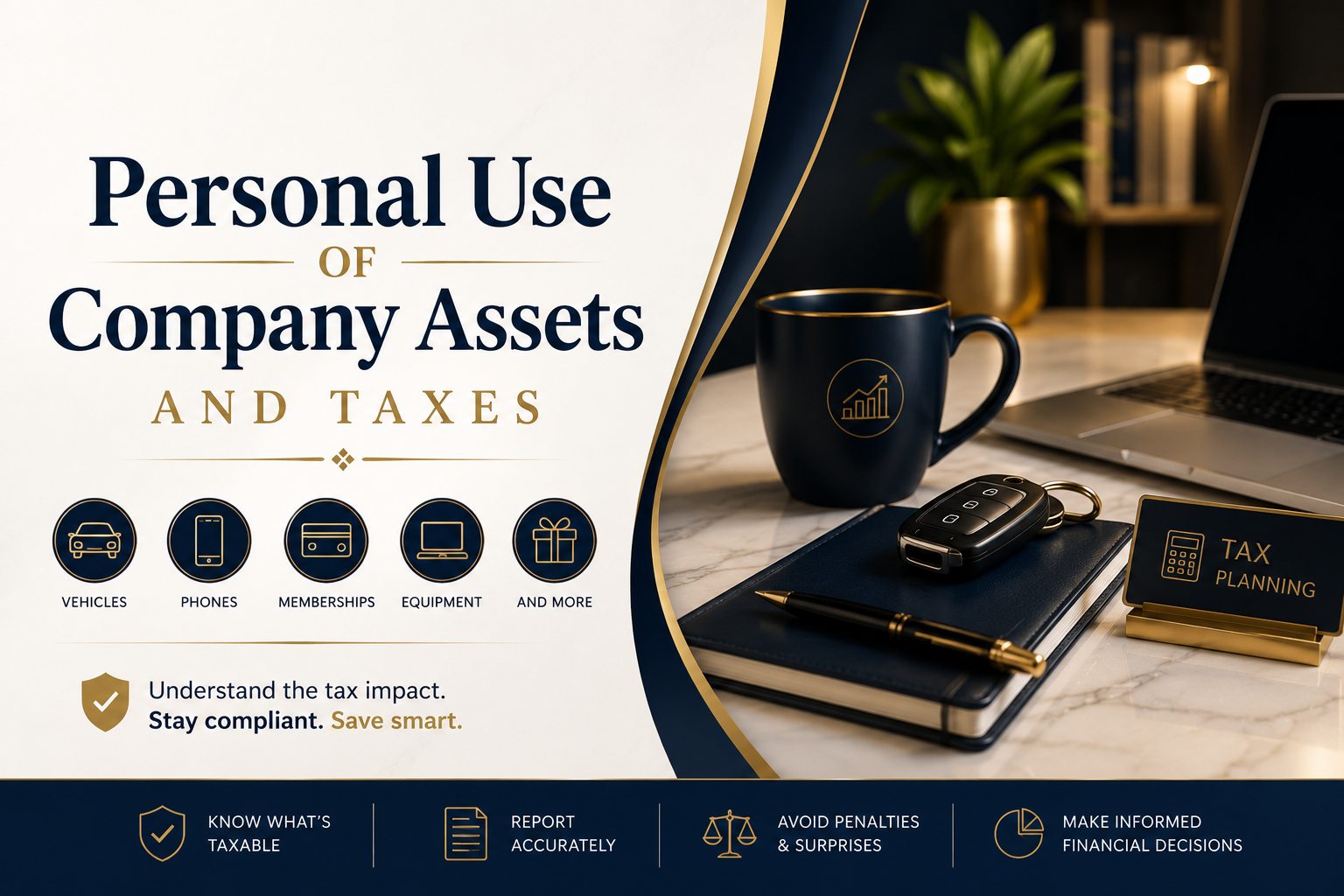
Personal Use of Company Assets: What’s Taxable in 2026?
Allowing employees to use company assets can be a valuable workplace benefit—but it can also create unexpected tax consequences.
In general, personal use of employer-owned property is considered taxable compensation unless a specific IRS exclusion applies.
The General Rule
When an employee uses a business asset for personal purposes, the fair market value of that personal use is generally treated as taxable income.
If the employee reimburses part of the cost, only the remaining value is generally taxable.
Common Company Assets That May Create Taxable Benefits
Company Vehicles
Personal use of a company vehicle—including most commuting—is generally taxable.
Business use may qualify for tax-free treatment, but personal mileage typically must be valued and reported.
The IRS permits several valuation methods, including:
- Annual lease value method.
- Cents-per-mile method (when eligible).
- Commuting valuation method.
Company Aircraft
Personal flights on company-owned aircraft are generally taxable, including flights taken by family members when the benefit is provided because of the employee’s services.
Vacation Homes, Apartments & Boats
Personal use of employer-owned vacation homes, apartments, boats, hunting lodges, or similar facilities is generally taxable unless a specific IRS exclusion applies.
Company Products
Personal use of company products may also be taxable unless the benefit qualifies under an approved business or product-testing program.
When Can Personal Use Be Tax-Free?
Certain fringe benefit exclusions may apply, including:
- Working condition benefits.
- Qualified employee discounts.
- No-additional-cost services.
- Limited de minimis benefits.
These exceptions are narrowly defined, and many forms of personal use do not qualify.
Payroll Reporting Requirements
If personal use is taxable, employers generally must:
- Determine the fair market value of the benefit.
- Include the value in employee wages.
- Report the benefit on Form W-2.
- Apply applicable payroll tax and withholding rules.
Certain company vehicle benefits have special valuation and reporting rules, but Social Security and Medicare taxes often still apply.
Key Takeaways
- Personal use of company assets is generally taxable.
- Business use may qualify for tax-free treatment.
- Company vehicles, aircraft, vacation property, boats, and similar assets frequently create taxable fringe benefits.
- Fair market value is generally used to determine the taxable amount.
- Proper payroll reporting helps avoid IRS penalties and compliance issues.
Need Help With Fringe Benefit Compliance?
Properly tracking and valuing personal use of company assets can reduce payroll tax risks and help keep your business compliant with IRS requirements.
Contact our CPA team today to schedule a consultation and ensure your fringe benefits and payroll reporting are handled correctly.
Accurate fringe benefit reporting today can help prevent costly tax issues tomorrow.