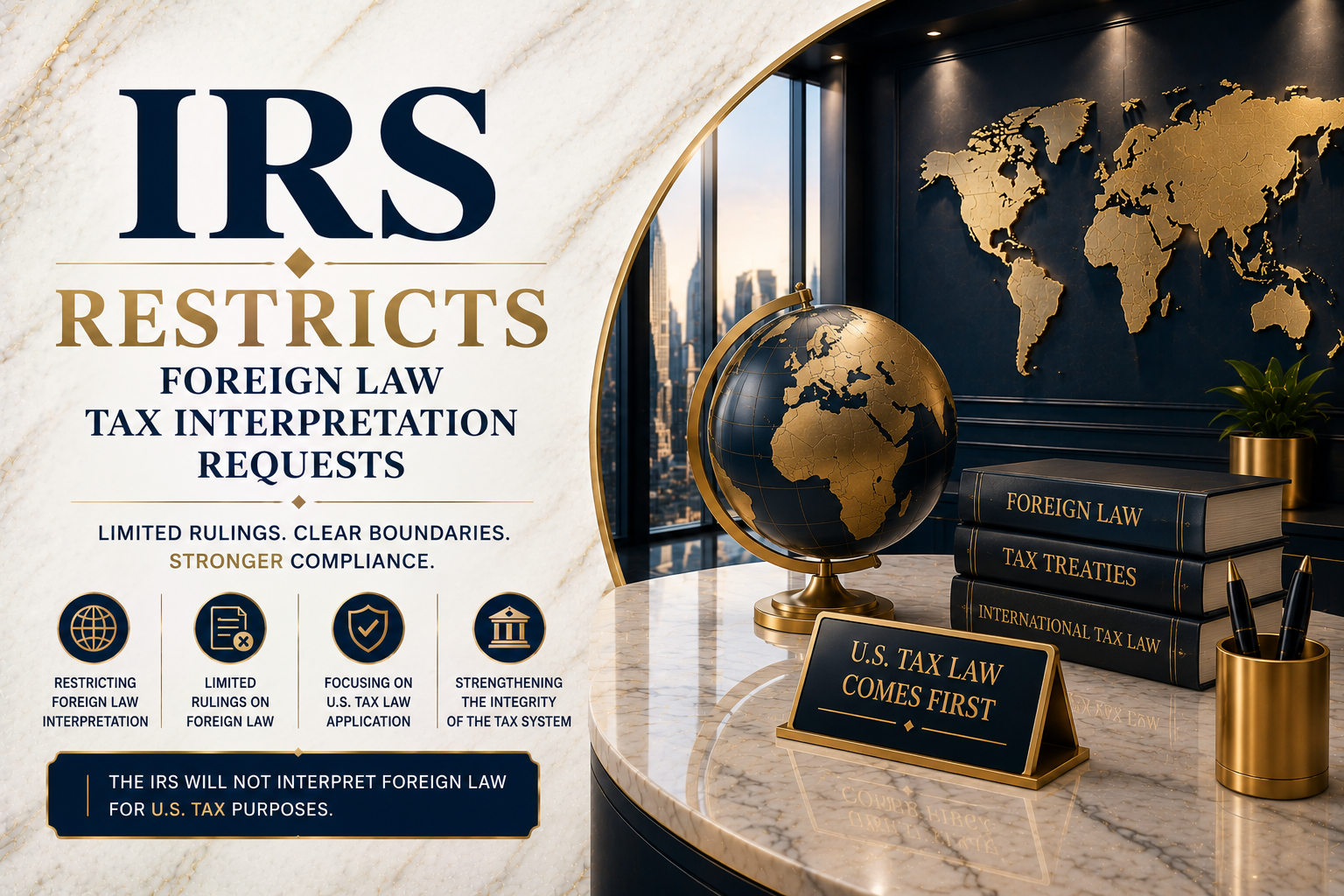
IRS Limits Advance Tax Rulings That Depend on Foreign Law Interpretation
As more countries adopt new international tax rules, many businesses have asked whether foreign taxes qualify for U.S. Foreign Tax Credits. The IRS has made it clear that these questions generally cannot be answered with a blanket ruling.
Instead, the tax treatment often depends on the specific foreign law enacted by each country and how that law interacts with U.S. tax rules.
Why Foreign Law Matters
Many international tax provisions require the IRS to determine whether a foreign tax qualifies for favorable treatment under the Internal Revenue Code.
Because each country may draft and implement its tax laws differently, two taxes with similar names may produce different U.S. tax results.
For this reason, the IRS generally does not issue advance rulings based on broad descriptions of foreign tax systems.
Foreign Tax Credits Require Careful Analysis
Businesses claiming a Foreign Tax Credit must determine whether a foreign tax satisfies the requirements of the U.S. tax rules.
This analysis may include reviewing:
- The actual foreign tax statute
- How the foreign tax is imposed
- Whether the tax is based on net income
- Whether the tax qualifies under U.S. Foreign Tax Credit rules
- Current IRS guidance and Treasury regulations
A general description of an international tax regime is usually not enough to determine whether the tax is creditable.
Global Minimum Tax Rules Add Complexity
The growing adoption of OECD Pillar Two and other global minimum tax regimes has increased the complexity of international tax planning.
Since countries may implement these rules differently, the IRS expects taxpayers to evaluate the enacted law in each jurisdiction rather than assume all similar taxes receive the same U.S. tax treatment.
Advance Rulings Are Generally Limited
The IRS has generally limited advance ruling requests involving certain foreign tax credit issues while additional guidance continues to develop.
This does not mean the IRS refuses to consider all matters involving foreign law. Instead, it reflects the fact that many international tax questions depend on detailed legal analysis of the specific foreign statute involved.
Final Thoughts
Foreign tax laws continue to evolve, especially as countries adopt new international tax regimes. Because U.S. Foreign Tax Credit eligibility often depends on the precise language of the enacted foreign law, businesses should carefully analyze each jurisdiction’s rules before claiming tax credits or relying on advance assumptions.
Doing business internationally or paying taxes in multiple countries? Our CPA team can evaluate foreign tax credit eligibility, review international tax reporting requirements, and help your business navigate today’s increasingly complex cross-border tax environment.